

Africa leads the entire world in stablecoin adoption — 79% ownership among crypto-active users. Nigeria, Kenya, South Africa, and Ghana are at the center. Stablecoins account for 43% of all crypto transactions in Sub-Saharan Africa. This isn't speculation — it's people protecting their money from currency collapse and bypassing broken banking systems.
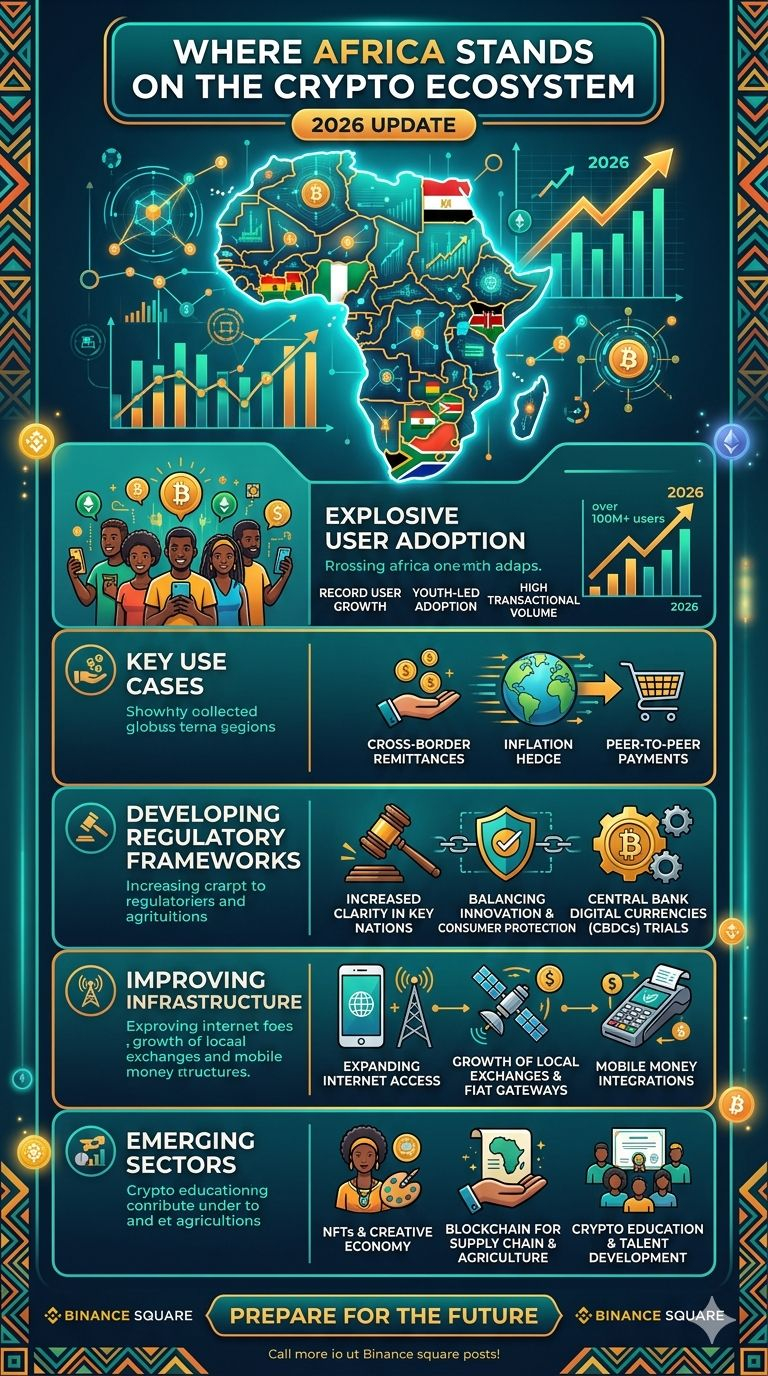
*2026–2028 · Foundation*
Regulation arrives. Ghana, Kenya, Nigeria, Uganda and South Africa all formalize virtual asset laws. Mobile money giants like M-Pesa integrate stablecoin rails directly. The AfCFTA launches its digital trade initiative (ADAPT) starting with Kenya and Ghana, targeting all 55 African nations by 2035.
*2028–2032 · Scaling*
Use expands from personal remittances into business trade settlement, supply chain finance, and government payment systems. African professionals earning in digital dollars becomes normal. Sending money home drops from ~8.78% fees to under 1% via stablecoins — billions saved annually.
*2032–2037 · Maturity*
Africa-native stablecoins emerge — pegged to commodity baskets (gold, cocoa, oil) or regional currencies. Central bank digital currencies (CBDCs) launch across major economies. The continent's on-chain economy surpasses $200 billion annually.
*2037–2045 · Sovereignty*
Africa stops being a passive consumer of Western dollar-pegged assets and begins building its own Pan-African monetary layer — aligned with African Union financial integration goals. Intra-African trade, currently more expensive than trade *into* Africa, finally becomes seamless and cheap.
*The big risk to watch*
Widespread USD stablecoin adoption could quietly dollarise African economies — weakening central banks and funneling value into US Treasuries rather than local development. Regulation and African-native stablecoin development are the counterweights.
*Bottom line:*
Stablecoins are infrastructure for Africa, not a trend. The next 20 years will determine whether Africa uses this moment to build financial sovereignty — or simply trades one dependency for another. Ghana is well-positioned to be a regional hub, especially in commodity tokenisation and land/real estate settlement.