

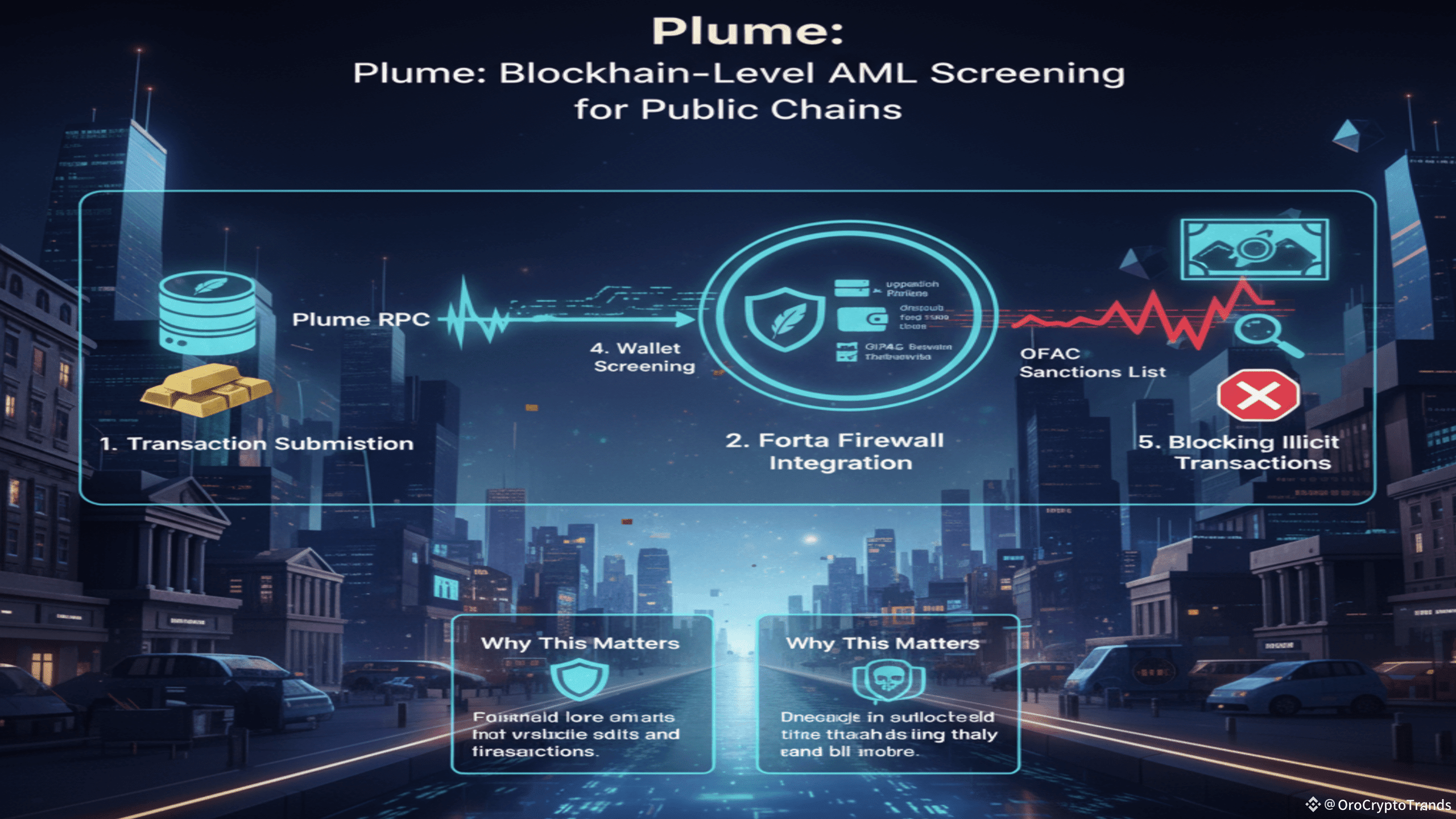
 Ensuring compliance without sacrificing decentralization has been a major challenge in crypto. Plume addresses this by running AML screening at the sequencer level, making it the only public and permissionless blockchain with this capability.
What is Plume’s AML Screening?
Plume’s approach ensures that transactions involving illicit funds are blocked before they enter the ecosystem. Here’s how it works:
1. Transaction submission: Every transaction on Plume Mainnet passes through the Plume RPC before execution.
2. Forta Firewall integration: The RPC forwards transaction details to the Forta Firewall API, which performs compliance and security screening.
3. Transaction unpacking: Firewall simulates and “unpacks” transactions to reveal internal components and logs.
4. Wallet screening: Extracted wallet addresses are checked against the OFAC sanctions list (and other high-risk lists).
5. Blocking illicit transactions: If a wallet is sanctioned, the transaction is immediately blocked. USDC or other tokens from illicit sources will not appear on Plume.
This happens in milliseconds, ensuring a seamless experience for compliant users while maintaining security and transparency.
Handling False Positives
While highly accurate, false positives (FPs) can occur:
Compliance FP: Rare, since the system checks addresses against official sanction lists.
Security FP: Slightly more likely, as it is based on risk analysis rather than binary checks.
If a false positive is identified, Plume investigates promptly. Once resolved, the transaction can be resubmitted and executed normally. Users can contact compliance@plume.org for assistance.
Why This Matters
Plume’s AML screening allows public blockchains to:
Protect users from interacting with illicit funds
Maintain regulatory compliance without sacrificing decentralization
Offer a secure foundation for DeFi and Real World Asset Finance (RWAfi) applications
By integrating AML at the sequencer level, Plume creates a safer, more compliant ecosystem while preserving the transparency and accessibility of a public blockchain.
FAQs
Q1: Is this screening applied to all tokens?
Yes, all transactions—including USDC and other bridged tokens—are screened during transfer.
Q2: Will my normal transactions be affected?
Compliant transactions pass seamlessly. Only those involving sanctioned or high-risk wallets are blocked.
Q3: How fast is the screening?
The process happens in milliseconds, so users experience minimal delay.
Action Tip: If you plan to interact with DeFi or RWAfi protocols on Plume, ensure your wallets are clean and compliant to avoid disruptions.
#plume $PLUME @Plume - RWA Chain

Learn how Plume integrates AML screening at the sequencer level to block illicit transactions and secure its public blockchain ecosystem.
Disclaimer: Not financial advice.