
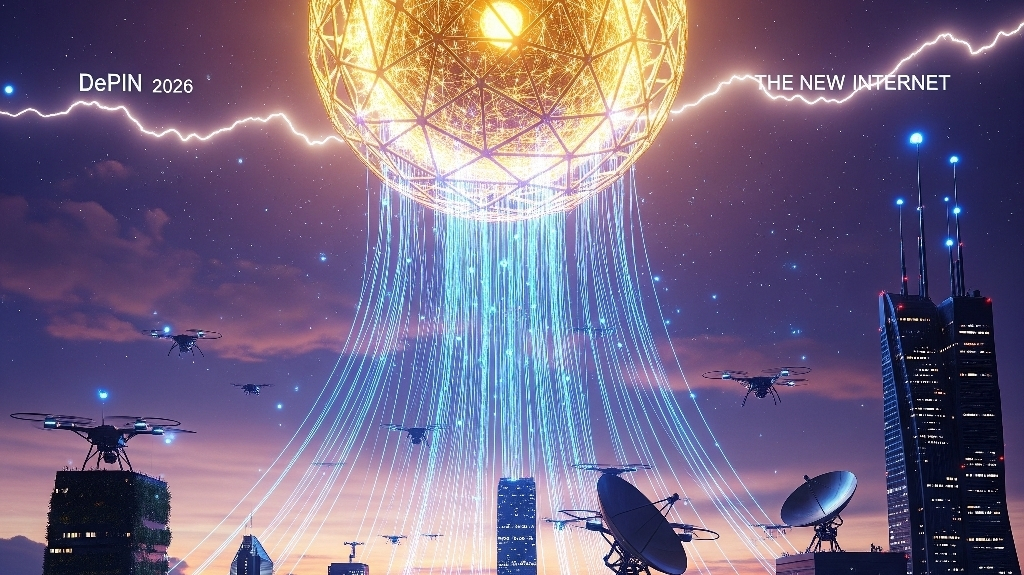
The Great Hardware Migration
We’ve spent a decade moving money to the blockchain. In 2026, we are moving the physical world to it. DePIN has officially become the fastest-growing sector on Binance, and it’s not hard to see why. While traditional telecom and energy companies struggle with high costs, decentralized networks are scaling at 10x the speed for a fraction of the price.
1. What is DePIN and Why Does it Matter Today?
DePIN stands for Decentralized Physical Infrastructure Networks. Think of it as "Uber for the Internet" or "Airbnb for Cloud Computing." Instead of one big company owning all the servers or cell towers, thousands of individuals (like you) own the hardware and get paid in crypto to provide service.
In April 2026, we are seeing a massive surge in projects like Helium (HNT), Render (RNDR), and Filecoin (FIL) because they are now being used by actual corporations to save on infrastructure costs.
2. The "AI + DePIN" Synergy
You can't have AI without massive computing power. As AI models become more complex this year, centralized cloud providers (like Amazon or Google) have hiked their prices. This has forced AI developers to turn to decentralized GPU networks.
When you see tokens like Render or Akash trending on your Binance dashboard, you’re looking at the "fuel" for the global AI revolution. If you missed the AI boom of 2024, DePIN is your second chance in 2026.
3. Why Retail is Flooding In
The beauty of DePIN is that it’s tangible. In a market full of "meme coins" with no value, DePIN projects represent real hardware, real users, and real revenue. Institutional investors are rotating their capital into these "Hard Assets" because they provide a safety net during market volatility.
The Final Verdict
2026 is the year of the "Real-World Yield." The days of "printing money out of thin air" are over. The projects that survive and thrive are those building the pipes and wires of the new internet.
Pro-Tip: Watch for the "Binance DePIN Index." When the volume there spikes, the entire market usually follows. Don't just trade the trend; trade the infrastructure.