
$BTC & $PAXG Analysis — When the "Digital Gold" Narrative Failed Its First Real Stress Test
The GrandBoard | X@BridgeholeMacro | Apr 3, 2026
The Setup: Everything's on Fire — Except Gold
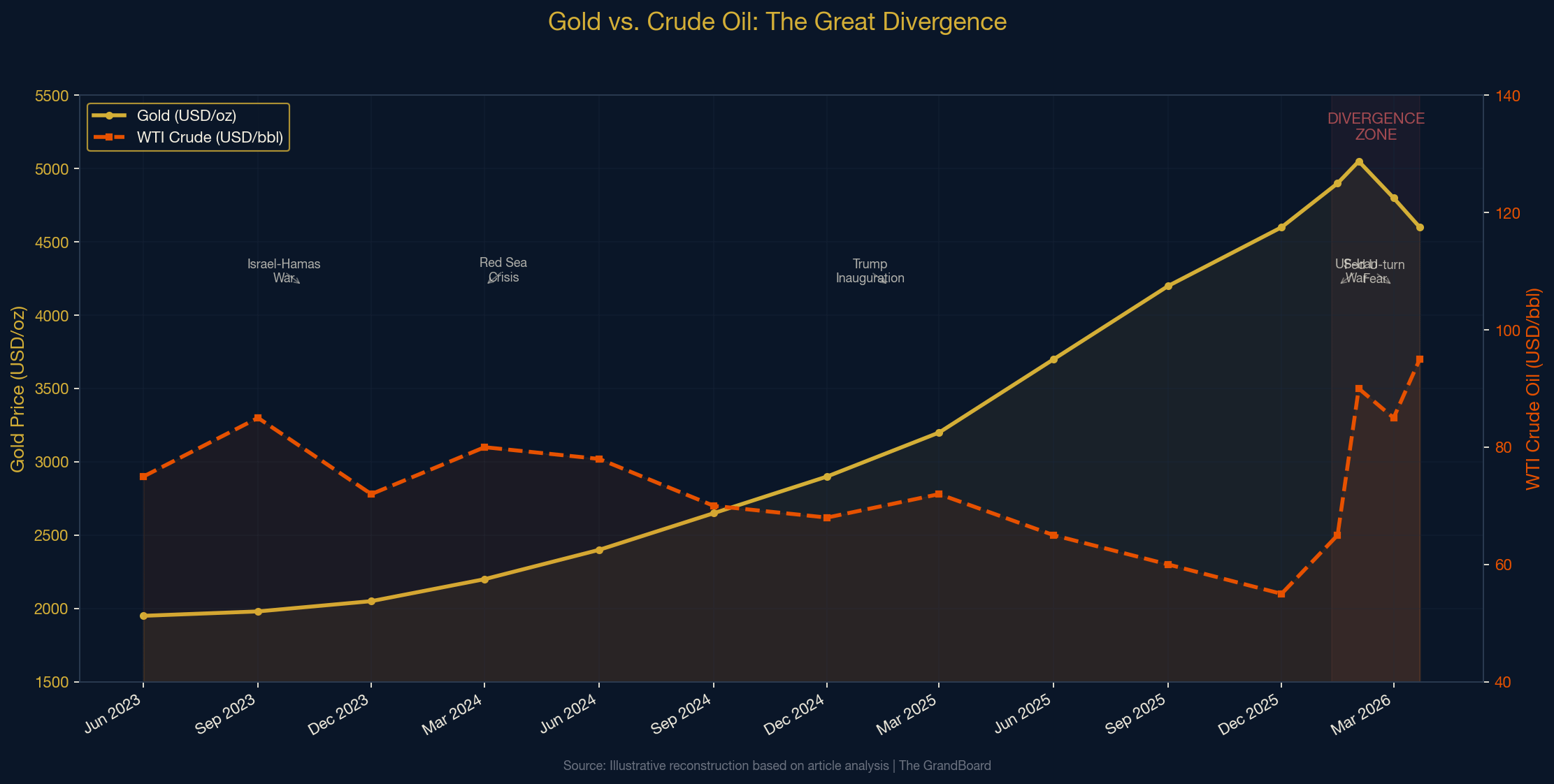
Since the outbreak of the US-Iran war, two of the most geopolitically sensitive asset classes have been moving in completely opposite directions. Crude oil has surged. Gold has dipped. Wait — isn't gold supposed to go up when the world goes to hell?
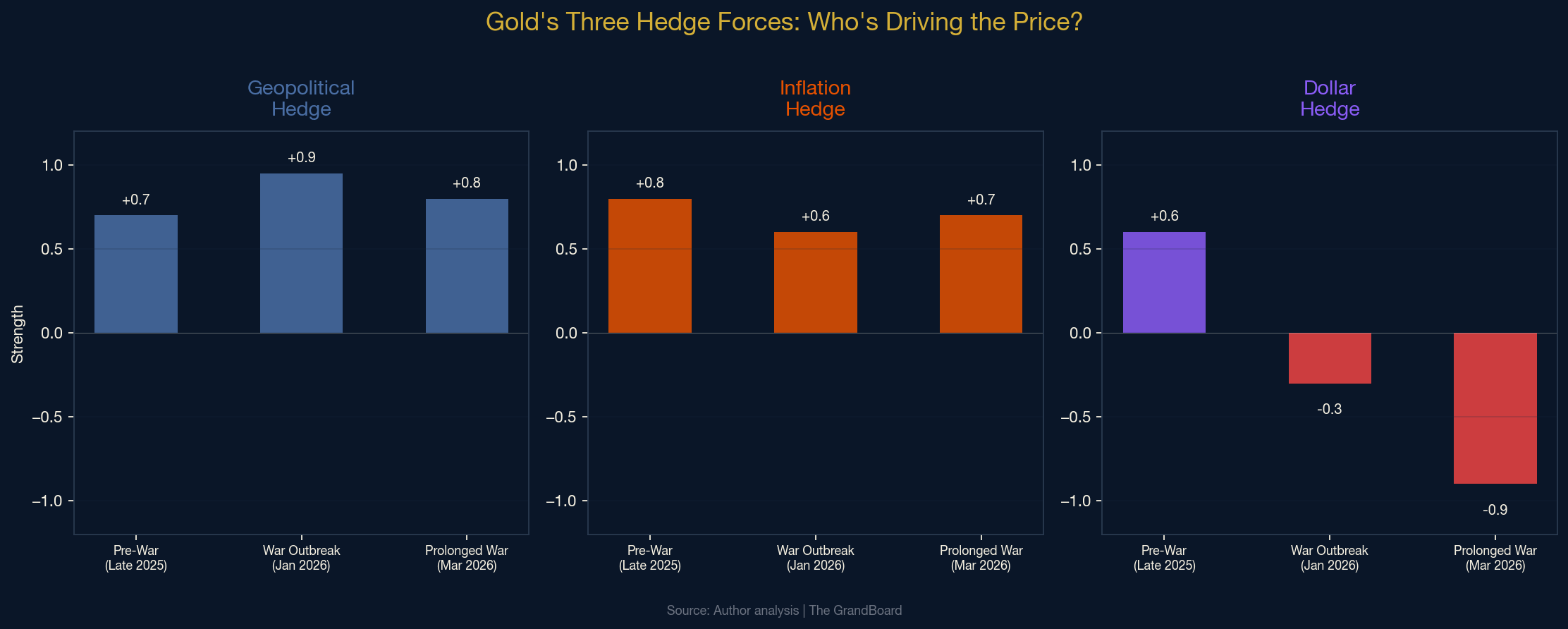
As the original "safe haven" currency, gold has three distinct hedge functions: geopolitical hedge, inflation hedge, and dollar hedge. The price of gold sits at the intersection of all three forces, and which one dominates shifts depending on the macro environment.
The Super Bull Run: When All Three Forces Align
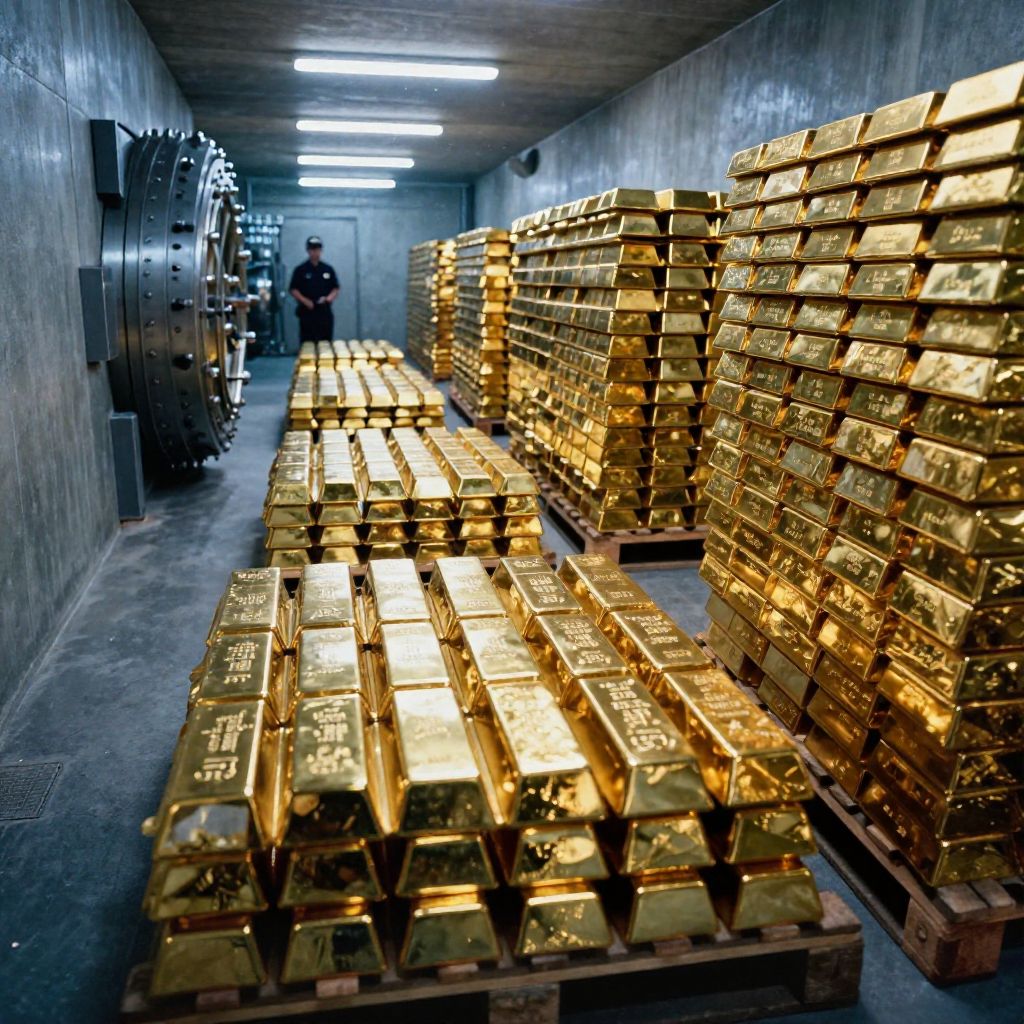
Since late 2023, precious metals have been on an absolute tear. Gold rocketed from $1,800 to over $5,000 per ounce. The reason for this explosive trajectory? Gold was simultaneously serving all three of its hedge roles — a rare alignment that doesn't happen often.
The geopolitical fuel was obvious. October 2023 brought the Israel-Hamas war on top of the still-smoldering Ukraine conflict. 2024 saw the Red Sea crisis and the blockade of the Mandeb Strait. By 2025, Trump's return to the White House sent the international order into full wobble mode. Chaos on every front — and gold feeds on chaos like a campfire feeds on kindling.
Meanwhile, the US economy shifted from overheating to stagflation in 2023. Then in 2024, for purely political reasons, the Fed launched a rate-cut cycle despite inflation being nowhere near solved. Dollar liquidity flooded back into the system like someone turned the fire hose on full blast. Add a second-inflation scare to the mix, and suddenly gold was pulling double duty — dollar hedge and inflation hedge. Rocket fuel for the price.
Oil's Story: A Different Playbook
Oil, however, was writing a different story. Last year's oil price level was clearly below the year before. Why? Trump wooed OPEC into massively ramping up production, trying to squeeze Russia into making concessions at the negotiating table. The strategy actually worked — for a while. Putin signaled willingness to negotiate multiple times. Had the US-Iran war not erupted, a Russia-Ukraine ceasefire would likely have been signed by the first half of this year.
The Divergence: Where Gold and Oil Parted Ways
Since the outbreak of the Middle East war, gold and oil have gone through several dramatic reversals. But the reasons behind each reversal tell very different stories.
Gold: The Three Phases of Pain
Phase 1 — Geopolitical Bump (Mid-January, Pre-War): As the probability of a US-Iran clash climbed, gold rose. Pure geopolitical hedging at work. The market expected something similar to last year's "Midnight Hammer" operation — quick, decisive, and temporary. A blip, not an era.
Phase 2 — The Great Rotation: After the US "decapitation strike" on Iran's leadership, gold briefly rallied — then collapsed. The reason? Big money rotated out of gold and into oil. Gold positions had become too crowded; fund managers needed liquidity to go long on crude, so they dumped gold to raise cash. A classic "sector rotation" move — gold to oil — and gold paid the bill.
It got worse. As overseas markets began pricing in a prolonged US-Iran war, risk assets like US stocks came under heavy selling pressure. A redemption wave swept through American financial markets. And gold — the most liquid asset after cash itself — became the ATM everyone ran to. The early March gold smash wasn't because investors turned bearish on gold. It was a liquidity-driven panic sell. Pure self-preservation.
Phase 3 — The Paradigm Shift: A liquidity crisis is survivable. Gold typically bounces back in a sharp V-shape, creating buying opportunities. But what came next was far more toxic.
By mid-March, the market narrative shifted to something genuinely frightening: not just a blocked Strait of Hormuz, but the possibility that both sides might start systematically destroying each other's energy infrastructure. That would keep oil prices elevated indefinitely — potentially destroying global growth, triggering a global supply chain meltdown, even causing the international order to collapse under its own weight.
In that scenario, the Fed wouldn't just pause rate cuts — it might restart hiking, à la 2022. And THAT expectation is what sent gold into its biggest correction in years. The dollar's anti-hedge function — the fear of a stronger dollar from tighter Fed policy — overpowered both the geopolitical and inflation hedge narratives. The fundamentals had changed. This wasn't profit-taking or a liquidity squeeze. It was the market pricing in a Fed U-turn.
KEY INSIGHT
Given the paradigm shift, BTC remains exposed to the same dollar-strength dynamic that crushed gold. When the Fed pivots hawkish, every non-yielding asset gets hit — crypto included.
Oil: The TACO Whiplash
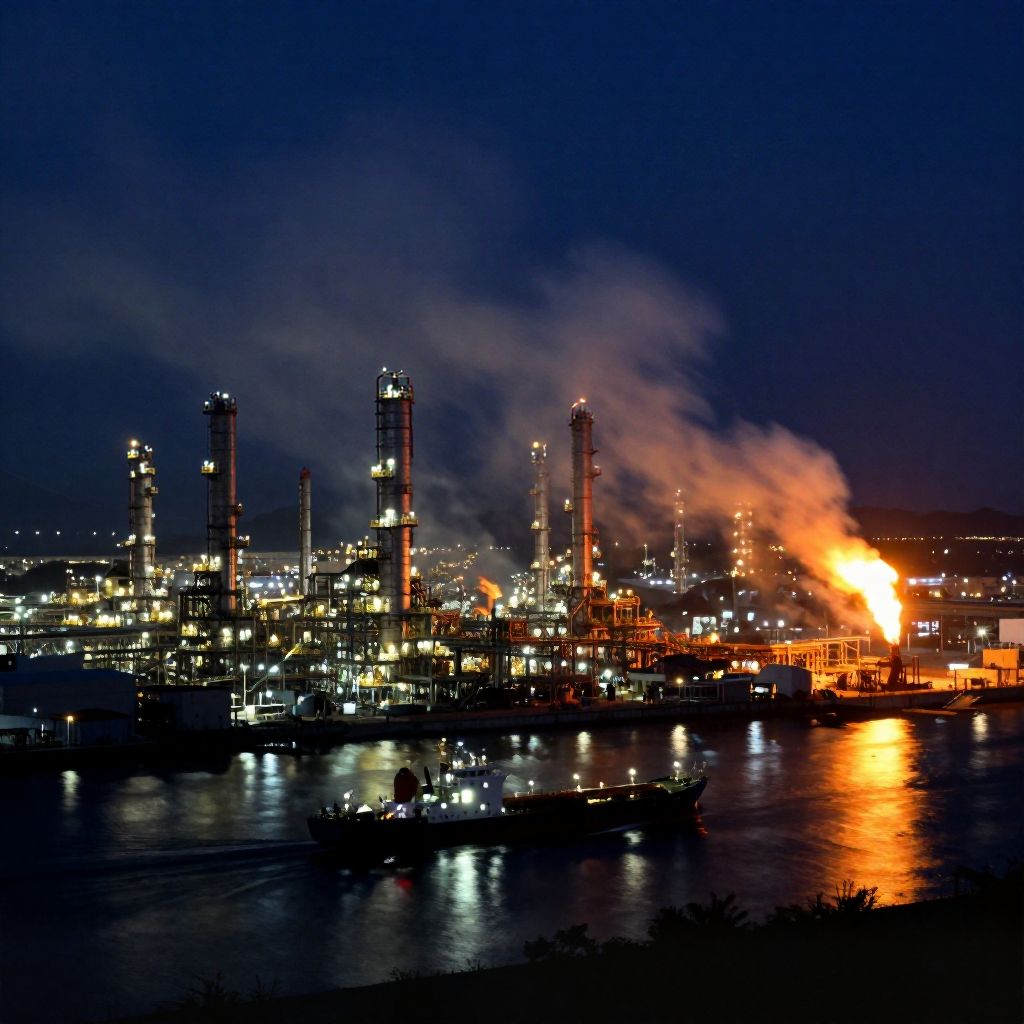
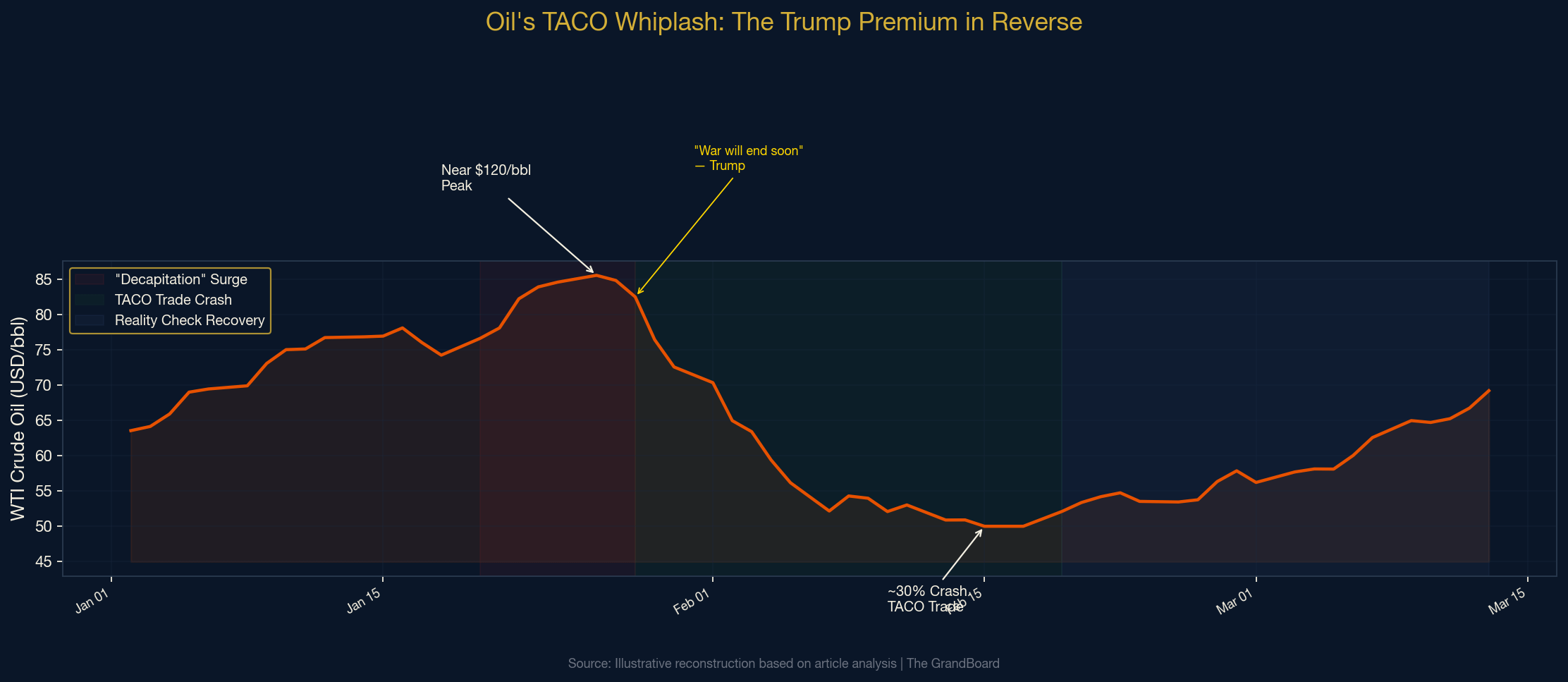
Oil's been a rollercoaster too. After the "decapitation" strike, crude surged to nearly $120/bbl. Then in early March, Trump hinted the war would "end soon," and the market piled into the "TACO" trade (Trump Always Calls for Oil — investors betting on lower oil prices). Crude crashed 30% in a heartbeat.
But here's the thing: unlike tariff policy, Trump doesn't control geopolitics. He can't wave his hand and unblock a strait that's already been shut. The market eventually realized this, revised its expectations, and oil climbed back into its uptrend. Lesson learned: in geopolitical markets, bullishness on peace can be just as wrong as bullishness on war.
The Stress Test Nobody Asked For: Bitcoin, DeFi, and the Dollar Trap
The "Hormuz Paradox" — the same mechanism crushing gold — hit cryptocurrency even harder. Bitcoin dropped from $97,000 to $78,000 during the same week gold was crashing from its peak. Not because of any crypto-specific event. Because the macro machine that powered the 2024-2025 crypto bull run — cheap dollars, falling rates, risk-on sentiment — just threw itself into reverse.
Bitcoin is an even purer non-yielding asset than gold: no cash flow, no dividend, no industrial floor price. When Treasury yields spike and the DXY surges past 100, leverage gets unwound across every risk asset — and crypto, with its higher average leverage on centralized exchanges, gets the worst of it.
KEY INSIGHT
The "digital gold" narrative just failed its first real geopolitical stress test. $BTC is NOT a geopolitical safe haven — the data proves it.
The DeFi ecosystem offered a darker subplot. Stablecoin depegs tell the real story of a dollar liquidity crunch: $USDT briefly traded at $0.98 as the Strait closed. Not a crisis — but a stress fracture. DeFi protocols backed by Treasury-heavy collateral saw TVL drops of 15-20% as yield farmers bolted for cash. In a real geopolitical shock, "decentralized finance" is only as stable as the centralized dollars it's built on.
KEY INSIGHT
For traders seeking digital gold exposure in this regime, $PAXG offers a closer proxy to gold's price action than $BTC.
The lesson isn't that crypto is worthless. It's that the "digital gold" and "dollar hedge" narratives need to survive a test like this before they earn the right to be taken seriously. They didn't. If your entire investment thesis is "the dollar will die," you're not hedging — you're making a one-way bet on American decline. And the Hormuz Paradox just reminded us: in a real crisis, everyone still runs to dollars. Including, ironically, the people who spent years telling you dollars were finished.
The Road Ahead: What to Watch
Going forward, both gold and oil dance to the rhythm of the US-Iran conflict. If this drags into a Ukraine-style war of attrition, gold likely stays under pressure through the first half of the year — the energy complex becomes the better trade in the short term.
Energy remains the better trade. $OIL continues to benefit from the supply gap that no alternative route can fill.
But the situation remains fluid. The US-Iran war could hit a critical inflection point — one that determines whether the Strait of Hormuz gets unblocked anytime soon. And that outcome rests entirely on Trump's next move. The man who can't keep a secret may be about to make the most consequential decision of his presidency.
When the safe haven stops being safe, the real question isn't "what happened to gold?" — it's "what just happened to the world?"
For the full interactive charts and deep-dive newsletter,
check the link in my Bio.
thegrandboard.substack.com
The GrandBoard — "The world is a chessboard. We explain every move."
X@BridgeholeMacro | thegrandboard.substack.com