
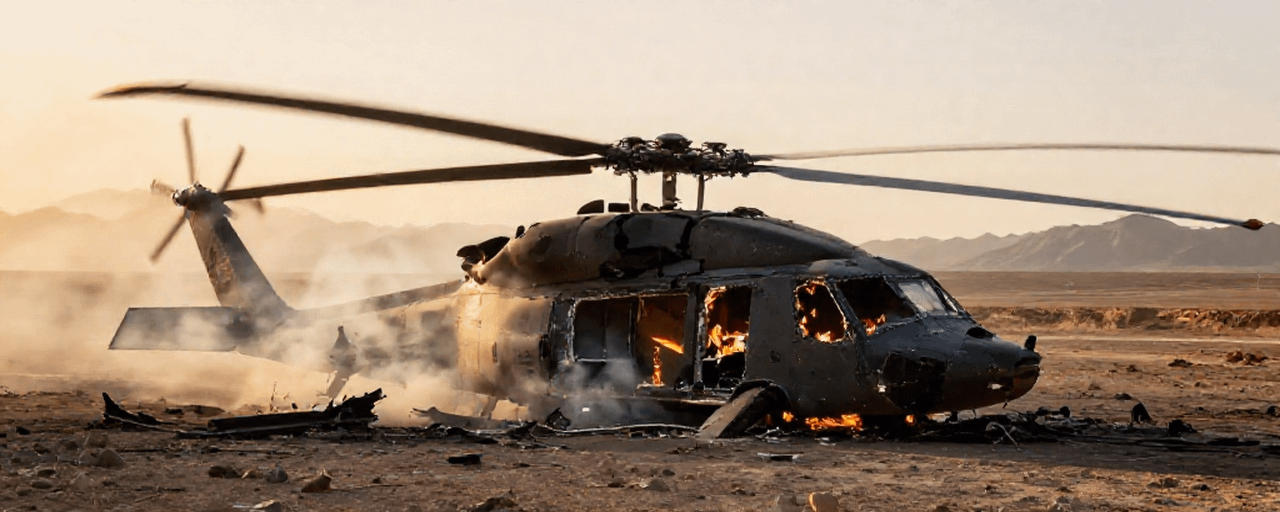
Day 38. Three carriers, 50,000 troops, one plan: improvise.

THE RESCUE THAT BROKE THE INTERNET (AND REVEALED EVERYTHING)
On April 3rd, an F-15E Strike Eagle from the U.S. Air Force's 494th Fighter Squadron went down over Khuzestan province in southwestern Iran.
The pilot and weapons systems officer both ejected. Standard bad day in wartime.
Except the weapons systems officer in the back seat was a colonel — a senior officer with access to classified targeting intelligence, mission plans, and force disposition data that no one, under any circumstances, wanted sitting in Iranian hands.
What followed was not a standard CSAR operation. It was a Black Hawk Down sequel that nobody in Hollywood had the audacity to greenlight.
Three hours after the shootdown, two rescue teams penetrated deep into Iranian territory. The first attempt: two helicopters damaged, one A-10 Warthog shot down. The front-seat pilot was recovered. The colonel — the one who actually mattered in Washington's calculus — was not.
So the U.S. military did something remarkable: it lied. Publicly. It announced both crew members had been recovered — a deliberate disinformation campaign to make Iranian forces stand down — and then sent special operations forces back in under cover of darkness.
They found the colonel. Iranian forces closed in. U.S. special operators established a blocking position and extracted him — but not before two transport aircraft, unable to take off from the soft mountain soil, had to be abandoned and destroyed on the ground.
Final tally: ~5 U.S. killed, 8 wounded. ~15 Iranian soldiers dead, 20 wounded. Six American aircraft lost. The global media was electrified. And yet: this was a rounding error.
THE MOST EXPENSIVE FLEET IN HISTORY GOES TO WAR (SORT OF)
The U.S. nominally operates 11 aircraft carriers — the most of any nation on Earth, and roughly equal to the rest of the world combined. In practice, right now, in this war, three are operational.
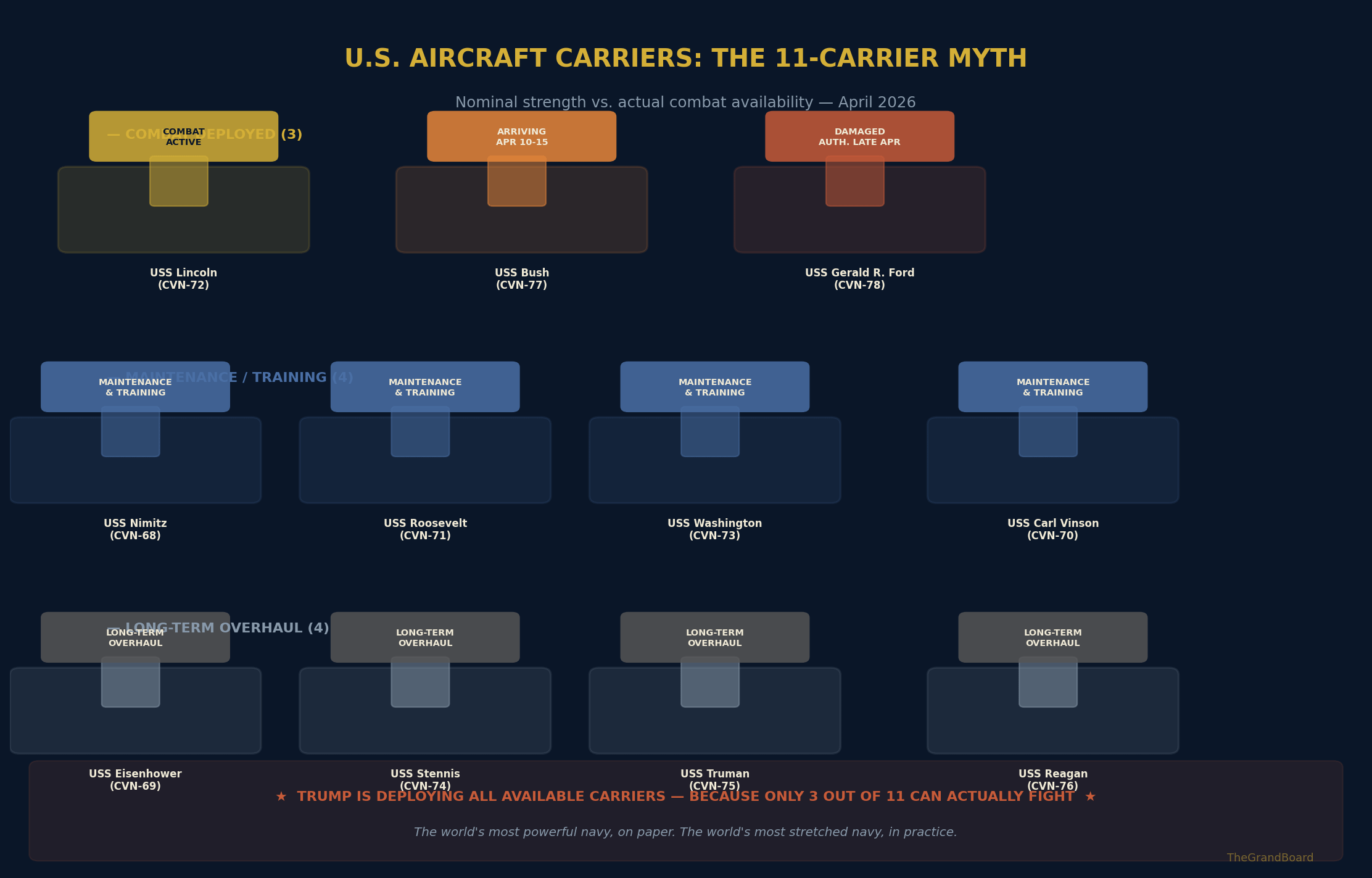
The USS Gerald R. Ford — the crown jewel. A $13.3 billion carrier. Electromagnetic launch systems. Advanced weapons elevators. The Navy had already scheduled it for a 14-month deep maintenance cycle. Informed crews' families. Received a formal Navy objection at 282 consecutive deployment days. Then the White House called.
The laundry room fire was not about laundry. The clogged toilets were not about plumbing. They were dispatches from the enlisted ranks: "We are done. We want to go home." Trump sent them back anyway.
THE MATH THAT NOBODY IN WASHINGTON WANTS TO DO
By late April, the United States will have assembled three aircraft carriers (Ford, Lincoln, Bush), two amphibious assault ships, 17-20 escort warships, and 50,000 personnel. Impressive. Sufficient? History has a polite but firm answer: no.
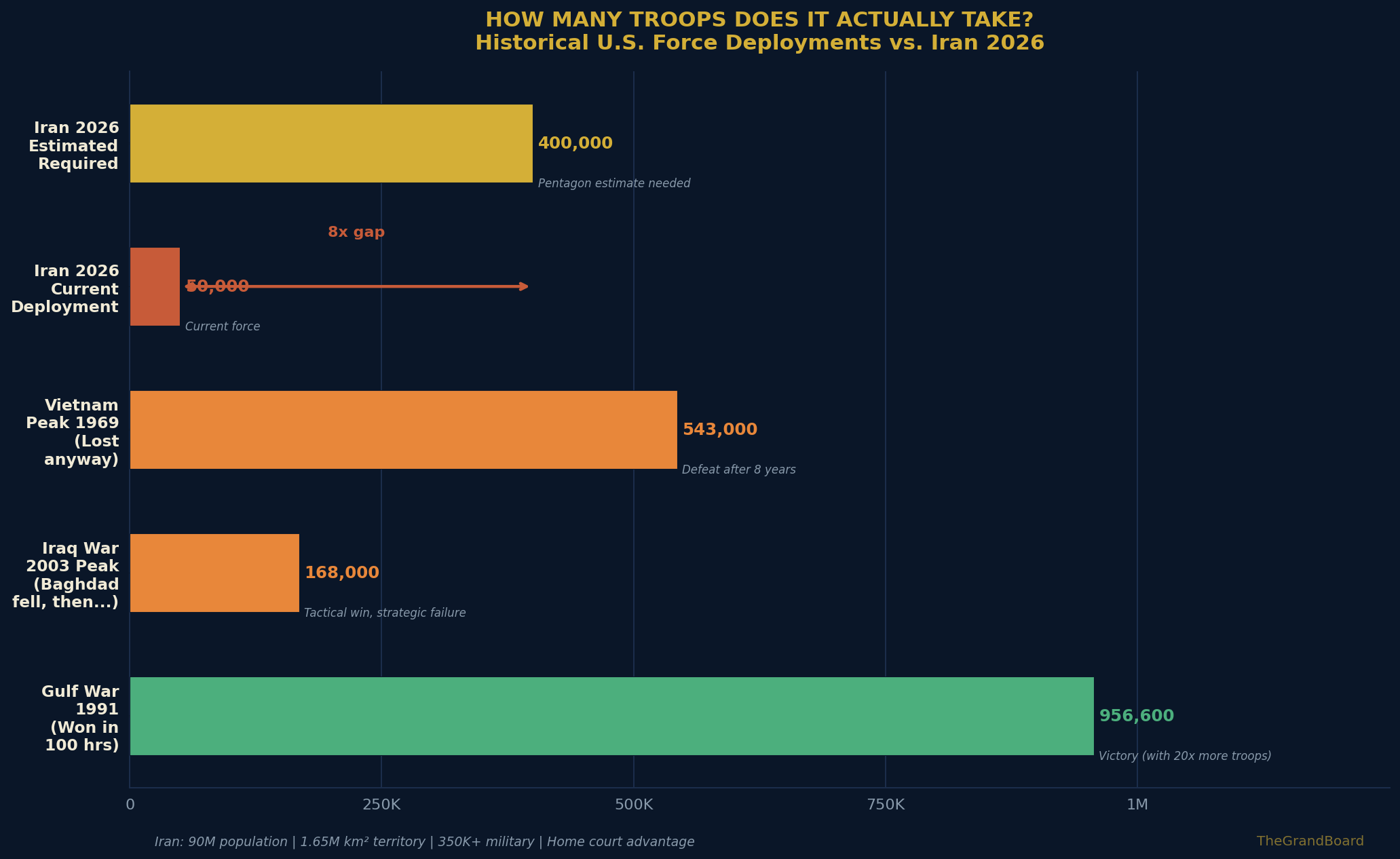
Iran is not Iraq 2003. Iran has a population of 90 million (Iraq 2003: 25 million), 350,000 standing army plus 190,000 Revolutionary Guards, strategic depth of 1.648 million square kilometers, thousands of ballistic missiles, hundreds of thousands of drones — and critically, a home court.
50,000 troops at the gates of Iran is not an invasion force. It's a demonstration of commitment — and a very expensive way to discover that air power alone doesn't win wars. Ask the architects of the bombing campaigns over North Vietnam how that worked out.
IRAN'S ASYMMETRIC PLAYBOOK — BLEED, DON'T BREAK
American and Israeli strikes have inflicted serious damage: 60% of Natanz centrifuges destroyed, Tehran's power grid crippled, the Beyk Highway Bridge — a $400M, 5-year project two months from completion — snapped in two.
And yet, on April 1st alone, Iran launched 220 medium-range ballistic missiles, 300 drones, and 80 cruise missiles in a single salvo — its largest single strike since the war began. And it still has more.
The Telegraph: Iran purchased enough sodium perchlorate in early April — delivered in four cargo vessels — to produce hundreds of additional ballistic missiles. The supplier? China. Consistently. Reliably. With full knowledge of the end use.
Iran's counter-strikes have targeted Israel's Dimona nuclear complex (perimeter), Haifa oil refinery, Tel Aviv military command infrastructure, U.S. staging areas in the UAE, Saudi Arabia and Kuwait, and Kuwait power and desalination facilities.
This is not a new playbook. It's the playbook that worked against the French in Algeria, against the Americans in Vietnam, against the Soviets in Afghanistan, against the Americans again in Iraq. The strategic logic is clean and cold: you don't need to win the war. You need only to make it hurt enough, for long enough, that the political cost in Washington becomes untenable.
THE STRAIT IS THE STORY
21% of global oil transits the Strait of Hormuz daily. Since Iran moved to selectively restrict passage, global commodity markets have registered the following moves over 37 days of war:
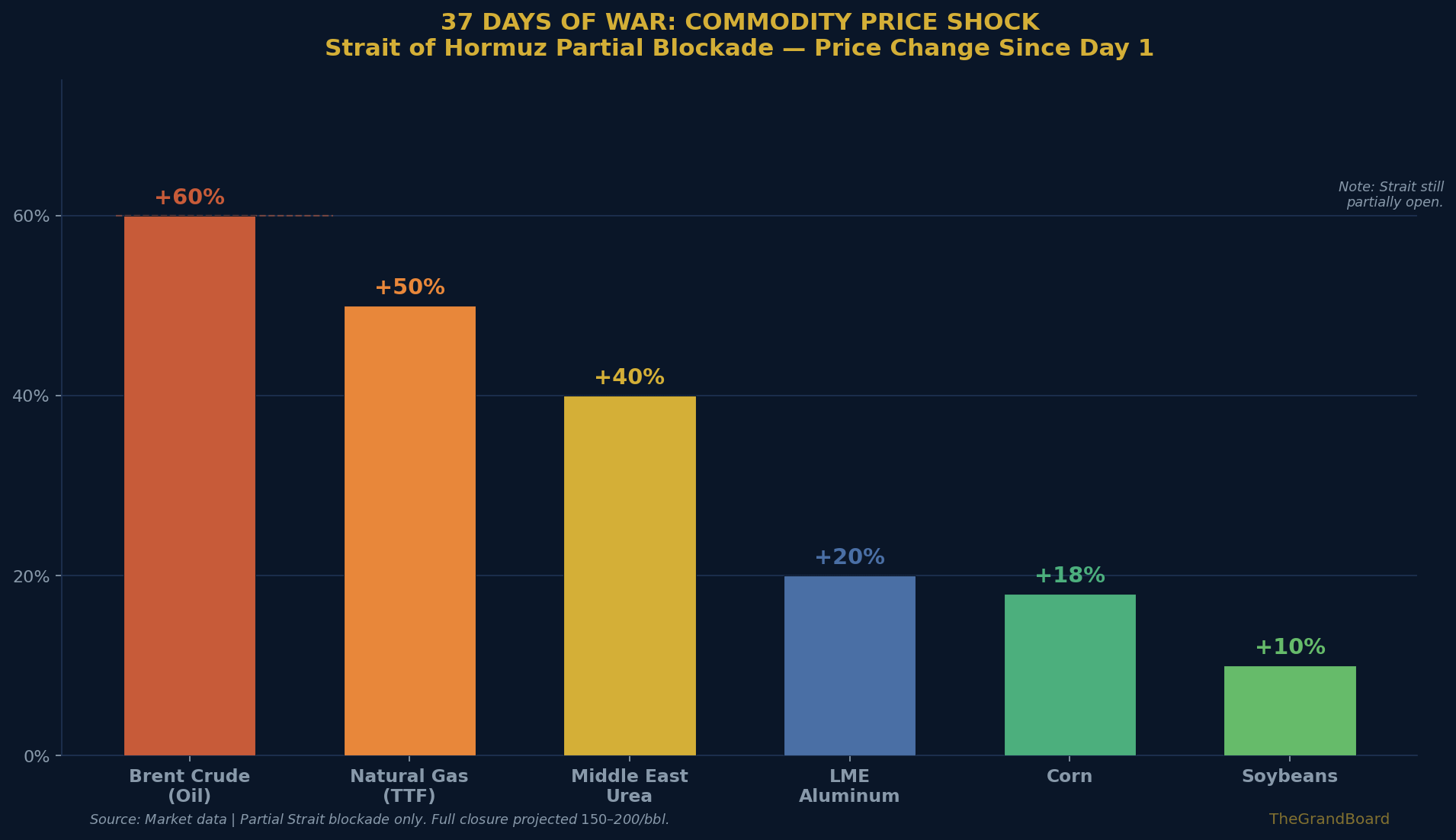
And the Strait is still partially open. Iran is being strategic about who gets through — France ships pass because France opposed military action. The rest play roulette. Bank of America has already raised its 2026 Brent forecast. Analysts are pricing $200/barrel scenarios if the Strait closes fully past mid-April.
TRUMP'S STRATEGIC MESS — A MANAGEMENT PARABLE
The operation unfolding in the Persian Gulf is not the product of a coherent military strategy. It is a series of reactive escalations. Trump did not plan this war. Netanyahu pulled him in. There was no Phase 1, Phase 2, Phase 3. There was: "Let's hit Iran, see what happens, maybe add some troops, actually add a lot of troops, wait where did we put the Ford, can we get it back from Croatia?"
Trump is managing the world's most expensive military apparatus with the planning methodology of someone who forgot a birthday dinner and is now furiously booking a restaurant at 7pm. The institution is bailing out the improviser — but institutions have limits.
THE COUNTDOWN — WHAT HAPPENS NEXT
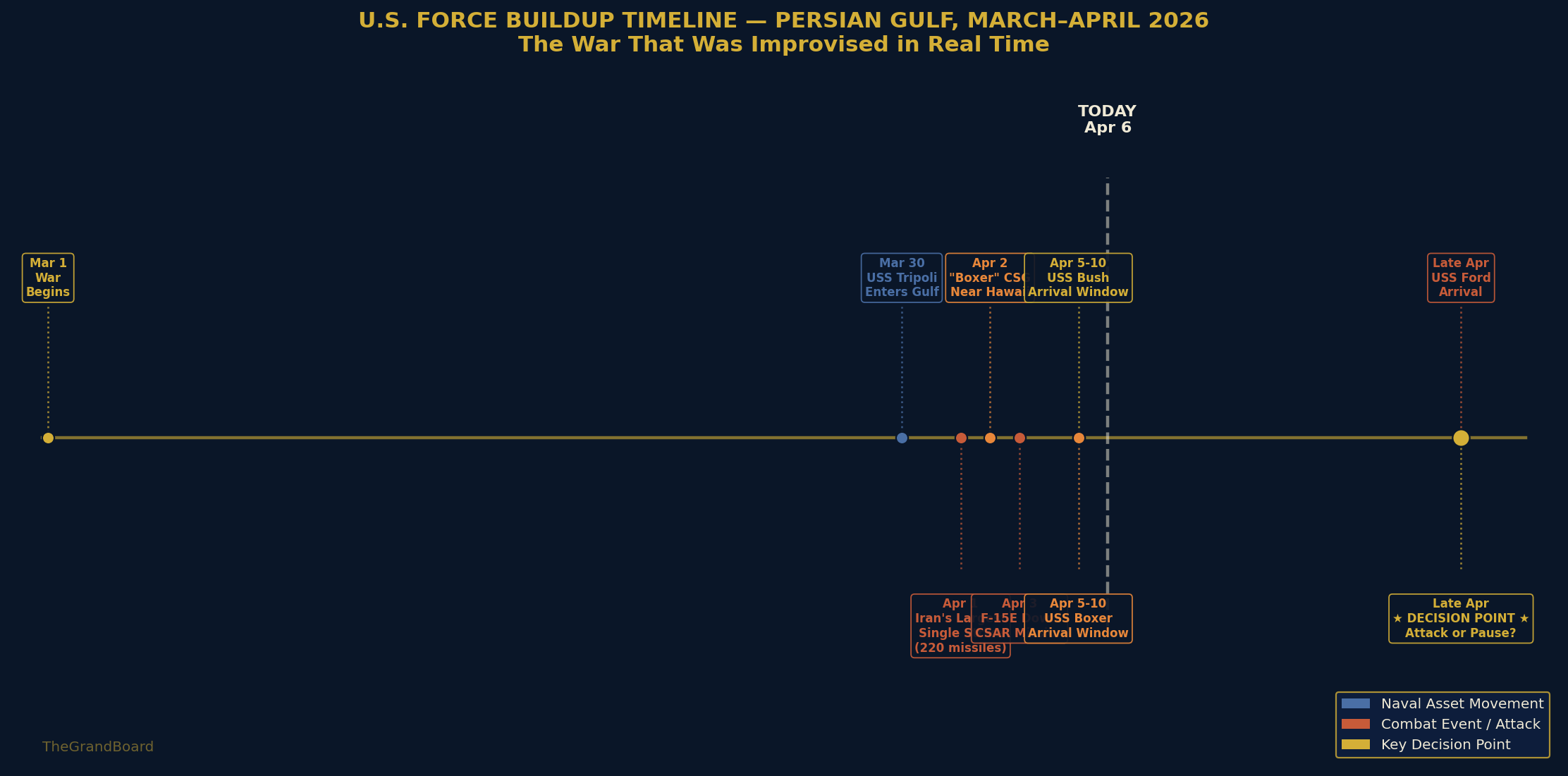
Scenario A — The Big Attack (60% probability): Late April. All three carriers on station. Trump orders a full assault on the Strait. Militarily feasible. Outcome: Iran cannot be subdued from the air. Houthi forces seal Bab-el-Mandeb. War enters Phase 2: two chokepoints closed, full global commodity shock.
Scenario B — The Humiliating Pause (30% probability): Economic pressure reaches a breaking point. Trump accepts a Qatar or Turkey-brokered ceasefire. Iran celebrates this as victory. Because it is. A country with half the GDP of California held the United States Navy at bay for two months.
Scenario C — The Long Bleed (10% probability): Neither decisive strike nor ceasefire. American air power bombs Iran indefinitely, Iranian missiles bleed American logistics and regional allies, oil permanently reprices the global economy.
EMPIRE ARITHMETIC
America is winning every tactical engagement. The F-15E rescue was audacious and ultimately successful. The air strikes are accurate and destructive. The logistics machine is functioning.
And yet. You cannot bomb your way to regime change in a country of 90 million people. You cannot impose your will through air power alone on a nation with 1.6 million square kilometers. You cannot sustain a three-carrier war with carriers that are catching fire and running 282-day deployments.
The empire has the stronger punch. Iran has the stronger chin. Trump started a war without a plan. Iran is executing a plan without a defined end. History tends to favor the latter.
Day 38. The bleed has begun. The bill is coming.
THE GRAND BOARD
"The world is a chessboard. We explain every move."
© 2026 TheGrandBoard | X@BridgeholeMacro | thegrandboard.substack.com