
Washington didn't order a ceasefire. The Pentagon's calendar did.
When news broke that the U.S. and Iran had agreed to a 14-day ceasefire brokered by Pakistan, the hopeful crowd did what the hopeful crowd always does: they called it a breakthrough. Diplomacy working. Rational actors choosing peace. The beginning of the end.
Here's a different read: it's a shopping trip. And Washington needed exactly two weeks to complete its order.
"The ceasefire window and the reinforcement window are the same window."
Why Pakistan, and Why Now
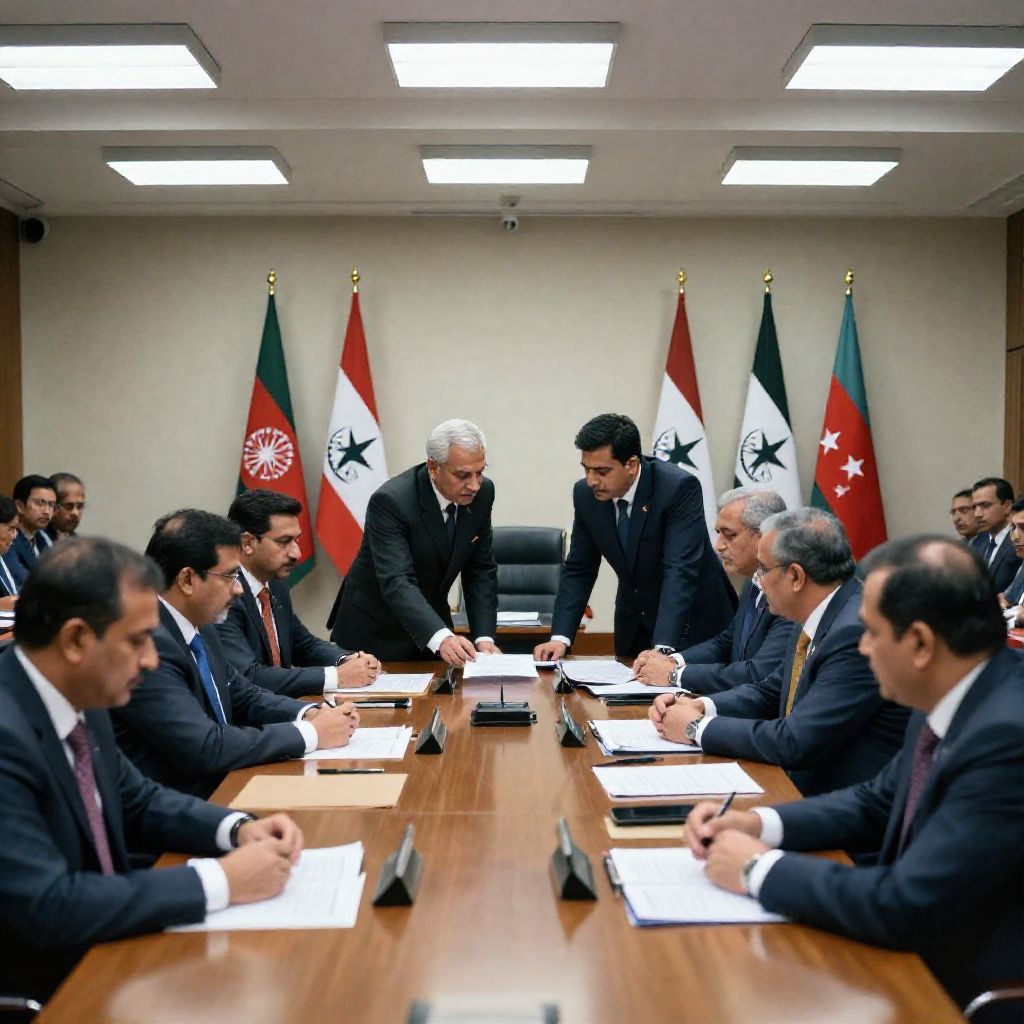
Before we get to the military math, let's address the obvious: Pakistan as a peace broker is a strange choice — unless you understand whose interests Pakistan actually serves here.
Pakistan's relationship with the United States is considerably warmer than its relationship with Iran. The idea that Islamabad sat down at the negotiating table and said, "You know what, let's make sure this is fair to Tehran" strains credulity. Pakistan didn't broker this deal; Pakistan delivered a deal that Washington needed delivered, with diplomatic packaging that Iran could at least swallow without immediately spitting out.
That's not cynicism. That's just reading the room.
And if that still seems too harsh, consider: the moment Pakistan pressed Iran to accept the ceasefire, the UAE — one of Pakistan's largest creditors — immediately demanded repayment on $3 billion in loans. Islamabad's "neutral broker" role apparently had a price, and someone didn't appreciate the bill being run up on their behalf.
The Spreadsheet Behind the Peace Gesture
Here's the part where the calendar becomes the most important document in this story.
When Iran agreed to a 14-day temporary ceasefire — suspending its Hormuz blockade in exchange for a halt to U.S. and Israeli airstrikes — it inadvertently handed Washington exactly the window it needed.
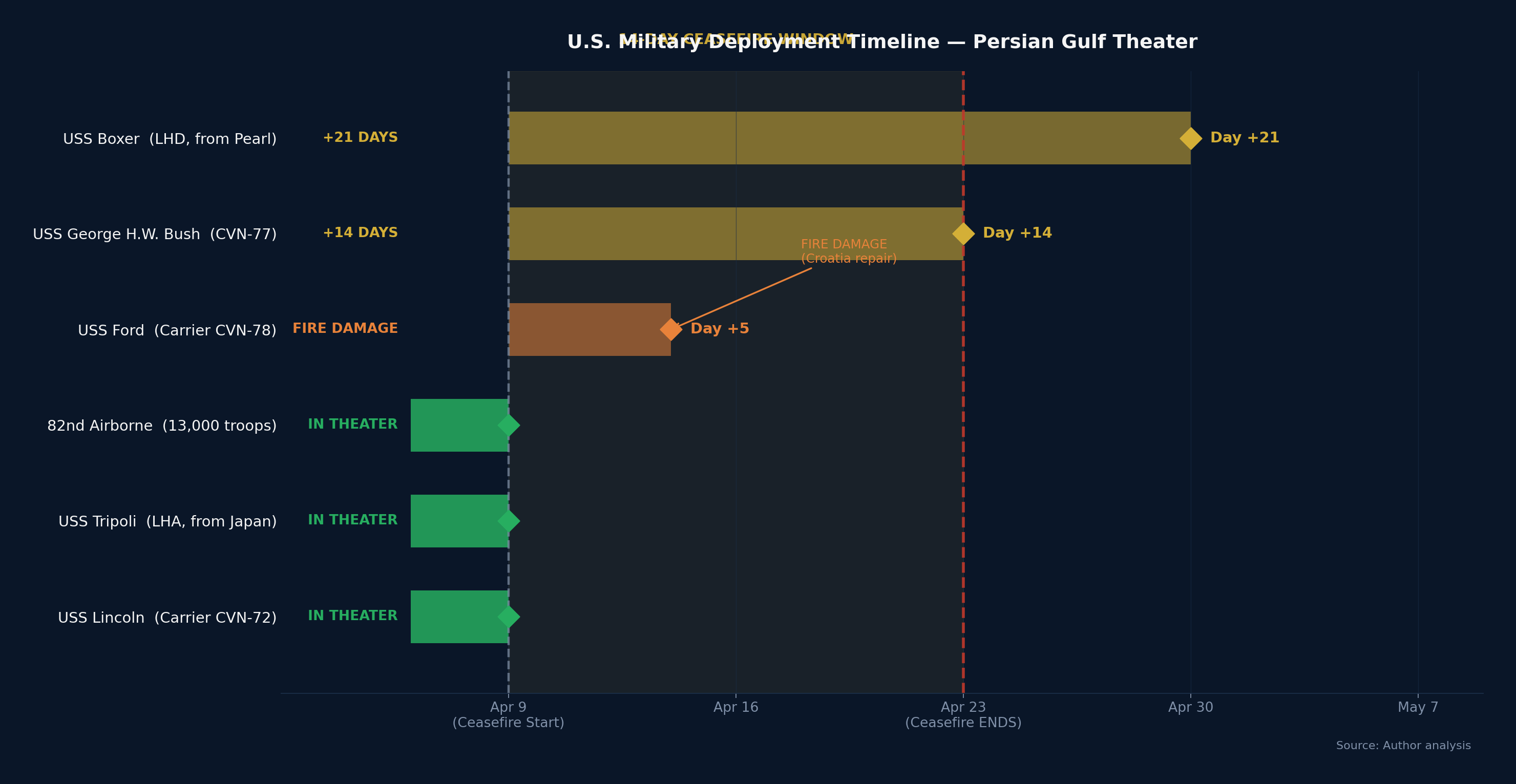
The second wave of American power projection is en route, and it's running on schedule:
USS George H.W. Bush (carrier): Currently in the Atlantic. Estimated arrival in the Eastern Mediterranean: two weeks.
USS Boxer (amphibious assault ship): Just departed Pearl Harbor. Being thirty-plus years old, she's not sprinting. Projected route: Manila (next week) → Diego Garcia (the week after) → Gulf of Oman (three weeks out). Carrying 2,500 Marines and hovercraft capable of delivering tanks directly onto beaches — regardless of terrain.
The 82nd Airborne: Already in theater, having flown in from the continental U.S. Combat-ready.
Right now, the U.S. posture in the Middle East is functional but thin: the USS Lincoln (carrier) and USS Tripoli (amphibious assault ship, fresh from Japan) are holding the line, while the USS Gerald R. Ford is in Croatia — recovering from an onboard fire that knocked it out at the worst possible moment.
In short: if Washington ordered a full escalation today, the toolkit has gaps. You can strike Iran's energy infrastructure at Kharg Island. Iran retaliates by hitting Gulf states' desalination plants. Everyone loses water. The oil market goes vertical. It's a mutual destruction scenario, just without the nuclear element.
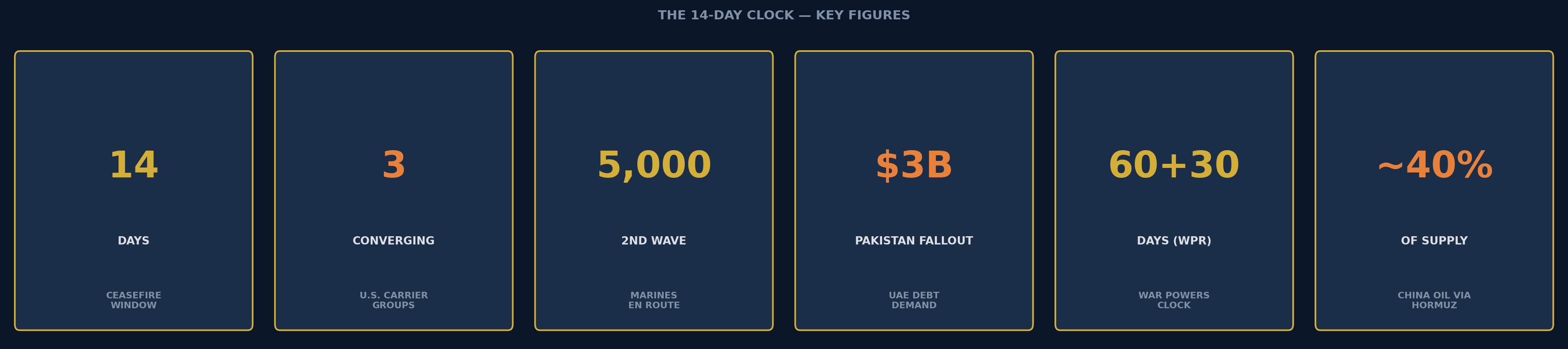
But give it two or three weeks — when the Bush, the Boxer, and a full Marine landing force have all checked in — and the math shifts. Three carrier groups. 5,000 Marines ashore. The entire 82nd Airborne as a backstop. That's not a threat. That's an option.
Why Did Iran Say Yes?
This is the genuinely puzzling part.
Iran is not run by people who just fell off the turnip truck. The government in Tehran is controlled by hardliners who took over precisely because the reformists couldn't deliver results. These are people who watched America's previous negotiating track record — the JCPOA signed, then torn up, then used as a ghost haunting every subsequent round of talks — and concluded that Washington's word has a shelf life measured in presidential terms.
So why accept a ceasefire that is, by most analyses, more favorable to the side doing the reinforcing?
The most credible explanation is that a third party made it worth Iran's while. Pakistan hinted as much: in the final hours before the deal, unnamed "major powers" were reportedly involved. If that framing is accurate, someone offered Tehran something to offset the strategic cost of giving Washington its two-week window. Insurance against the buildup. Or at minimum, a guarantee that the pause wouldn't be used to engineer a knockout blow.
That someone, if you're keeping score, likely speaks Mandarin.
The Legal Fine Print Nobody Wants to Read
Washington insiders keep citing the War Powers Resolution as a hard limit on Trump's campaign: the President can initiate military action without Congress, but only for 60 days (plus 30 to withdraw). If Trump launched operations in late February, the clock runs out at the end of April.
This is technically true and practically irrelevant.
The Resolution doesn't specify the form of withdrawal. The President can define "orderly withdrawal" to mean almost anything. In 1999, Clinton stretched a similar constraint to conduct 78 days of airstrikes over Yugoslavia — by characterizing the operation as protecting American personnel on the ground. Trump, who has never met a legal interpretation he couldn't stretch, will find his lawyers drafting something creative if April turns into May.
The working assumption: the authorization ceiling is May, not April. The reinforcement timeline fits neatly inside that envelope.
The Negotiating Theater
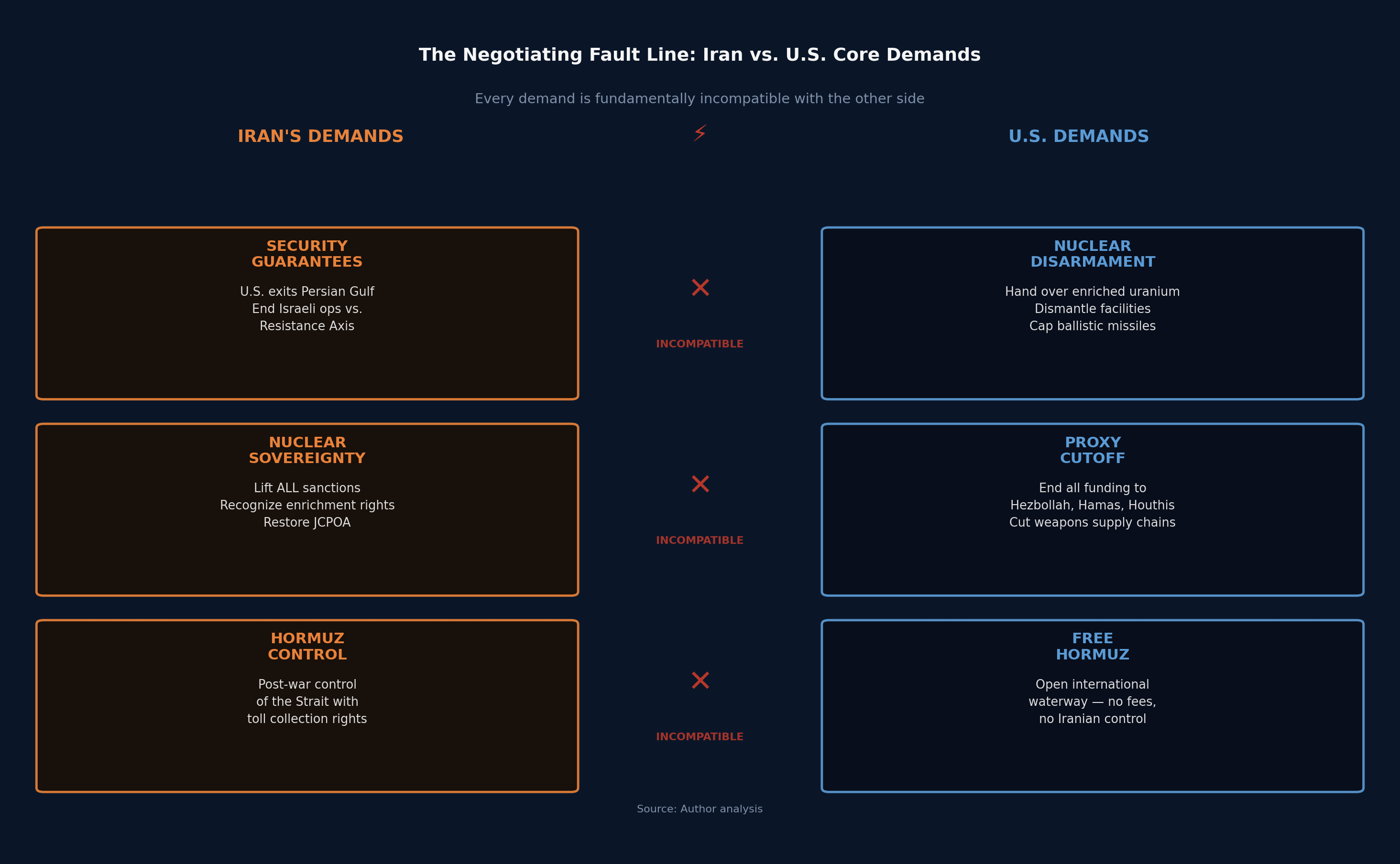
Let's look at what's actually on the table, because the gap between the two positions is less a negotiating spread and more a geological fault line.
Iran's 10-Point Demands (condensed to three):
Full U.S. military withdrawal from the Persian Gulf, plus an end to Israeli operations against the Resistance Axis — in exchange for security guarantees that a second invasion won't happen.
All sanctions lifted. Iran's right to enrich uranium recognized. In return: no nukes (essentially the Obama-era JCPOA, restored).
Post-conflict control of the Strait of Hormuz, operated under a fee structure modeled on Turkey's management of the Bosphorus — to compensate Iran for war damages.
The U.S. 15-Point Demands (condensed to two):
Iran hands over all high-enriched uranium stockpiles, dismantles key nuclear facilities, caps ballistic missiles, and cuts funding to Hezbollah, Hamas, and the Houthis. In exchange: sanctions relief and civilian nuclear energy rights.
Hormuz becomes a free international waterway. Full stop.
The American position is essentially the pre-war "zero enrichment" demand, with a Hormuz clause stapled on. Iran's Supreme Leader refused this before the war started, when Iran had full diplomatic standing and a functioning economy. The current Iranian government, which is more hawkish than the one that refused, is being asked to accept something worse.
The probability of a comprehensive peace deal in 14 days is approximately the same as the probability that I'm wrong about the Bush carrier timeline: technically nonzero, functionally zero.
The Strait, the Scorecard, and Who Really Wants What
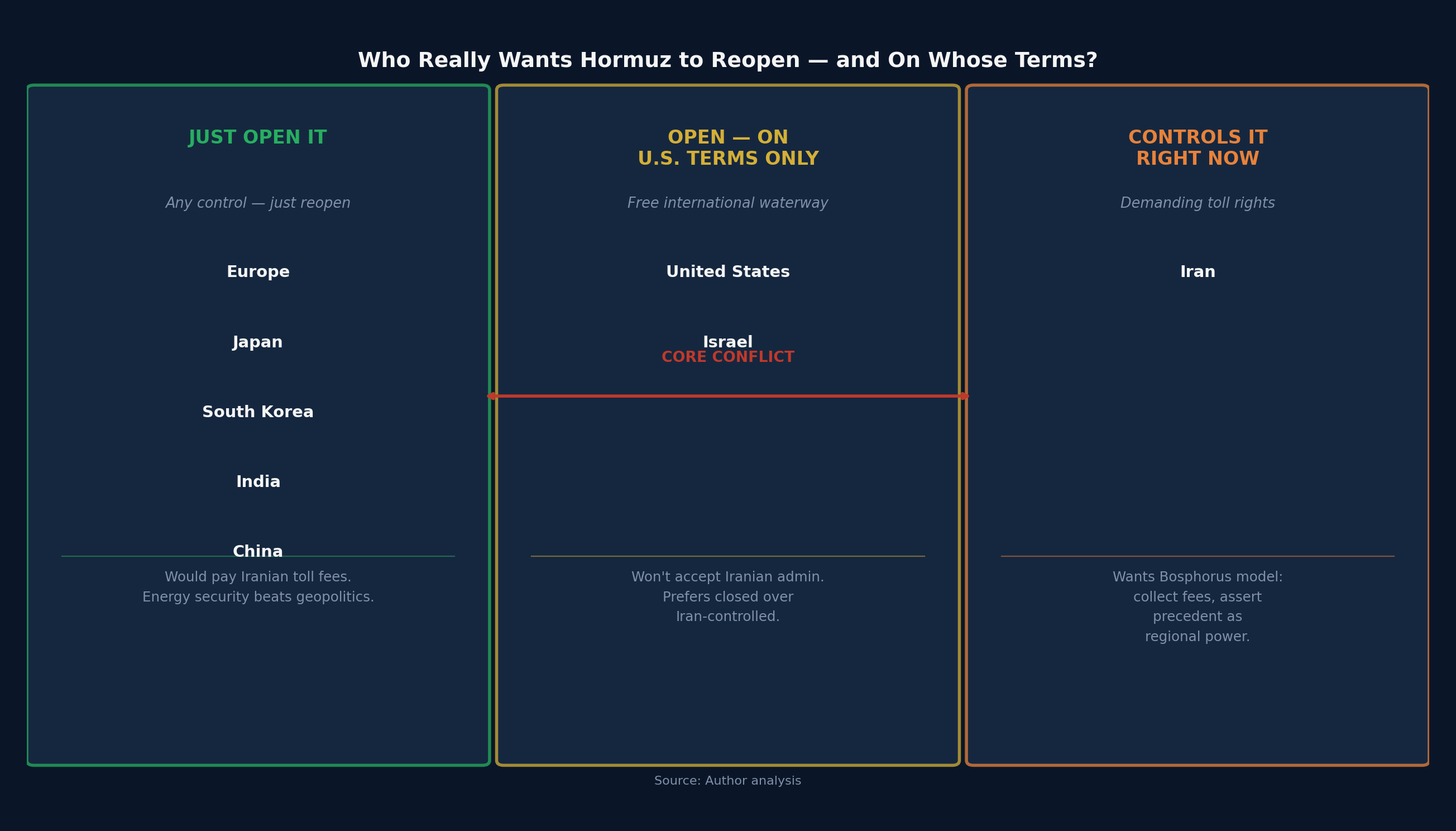
Step back and ask a simple question: who actually needs Hormuz to reopen?
Not America. The U.S. doesn't route its oil supply through the Persian Gulf. Washington wants the strait open for the same reason a landlord wants the tenant's plumbing to work — not because they use it, but because its dysfunction creates headaches for everyone they depend on.
Europe, Japan, South Korea — the industrial nations that actually depend on Gulf oil — desperately want the blockade lifted. They don't care who controls the strait. They'd pay the toll. This is why European and East Asian capitals have been quietly courting Tehran even as Washington bombs it: for them, the math is simple. A fee is manageable. An energy shock is not.
America's calculus is different. Washington would rather see the strait closed indefinitely than see it open under Iranian administration. Control of the world's most critical oil chokepoint, permanently in the hands of an adversarial state, is not a tolerable outcome — regardless of what it costs the global economy in the interim.
This is the core tension nobody in the mainstream coverage will say plainly: the United States and its closest trade partners have opposing interests on the Hormuz question. The Europeans and Asians want it open. Washington wants it open on its terms — or would rather keep it closed until those terms are met.
That's why the Gulf states are being asked to foot part of the military bill. In the 1991 Gulf War, Saudi Arabia and Kuwait covered much of the U.S. operational costs, allowing Washington to run a high-tech war on a discounted ticket. Trump is reportedly pressing regional powers to fund more than half of this operation's cost. The UAE is willing. Saudi Arabia is hedging.
If the Gulf states write the check, the incentive to wrap this up quickly weakens considerably.
The Bigger Pieces on the Board
China hasn't been sitting this out. Beijing has no interest in a prolonged Hormuz blockade — roughly 40% of its oil supply transits that strait. But it has an even stronger interest in preventing the United States from establishing permanent military control over the world's most important shipping chokepoint.
China's red line is regime change. If Washington moves to replace the Iranian government entirely, Beijing will find ways to respond — starting with the Caspian trade corridor, which offers Iran an economic lifeline that bypasses the Gulf entirely. The implicit message: push hard enough, and the chessboard gets more complicated.
The next 14 days, in other words, are not a peace interlude. They're a loading screen — while all the major pieces move into position for whatever comes next.
A ceasefire is a calendar. Read it right: the date it ends is the date the real negotiations begin — at gunpoint.
The GrandBoard
The world is a chessboard. We explain every move.
Substack · X @BridgeholeMacro