
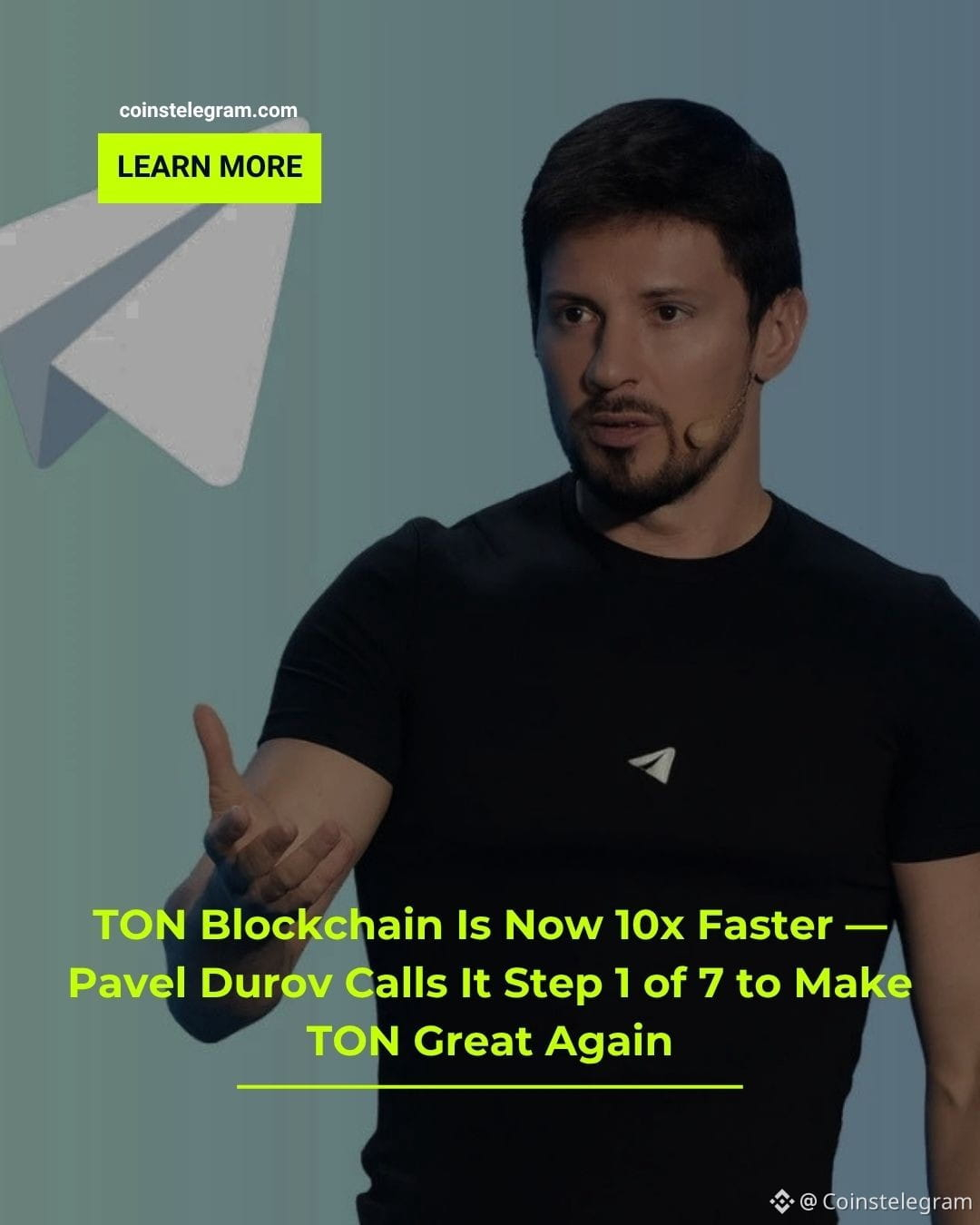

Pavel Durov announced yesterday that The Open Network has completed a major technical upgrade — one that makes TON ten times faster than it was before. B
lock production is now six times quicker, transactions confirm in under a second, and the network runs on an entirely new consensus mechanism. For a blockchain embedded inside Telegram’s ecosystem of over one billion users, that’s not a minor patch. It’s a foundational shift.
“This was step 1 of 7 to Make TON Great Again (MTONGA),” Durov wrote in his Telegram channel.
Six more upgrades are coming. The question the market is already asking: what do the other six look like?
What Actually Changed Under the Hood
The upgrade is built around Catchain 2.0 — a new consensus mechanism that fundamentally changes how the network agrees on transaction validity. Before the upgrade, TON confirmed transactions in approximately ten seconds. As of April 10, 2026, sub-second finality is live on mainnet. Blocks now arrive every 400 milliseconds. A new streaming layer pushes state updates to applications almost instantly rather than waiting for apps to request them through polling.
This is not a benchmark run in a controlled environment. It is a live change on the mainnet that any TON application is running on right now. The gap between a user taking an action and that action being confirmed on-chain has collapsed from multiple seconds to approximately one second — and in many cases, less.
For most blockchains, ten-second finality is acceptable. For a network that lives inside a messaging app where people expect responses in milliseconds, it was a fundamental mismatch. Catchain 2.0 closes that gap in a way that makes TON technically competitive with the fastest chains in the space.
The next step, according to Durov, is cutting transaction fees by six times — bringing the already low cost of using TON down further, which matters enormously for the micro-payment and Mini App use cases that define TON’s roadmap inside Telegram.
Why Speed at This Scale Actually Matters for TON
Sub-second finality is not just a performance improvement — it’s a prerequisite. The applications TON is positioned to support at scale inside Telegram’s billion-plus user ecosystem could not be fully realized at ten-second confirmation times. Payments that feel as instant as sending a message. Trades that execute without lag. Mini Apps that respond with the immediacy users expect from every other digital product they use daily.
None of that was fully achievable before this upgrade. It is achievable now.
TON’s strategic position is unique among blockchains. It is not competing for developer attention on a neutral playing field — it is the native blockchain of the world’s fifth-largest messaging platform, with distribution built in. Every Telegram user is a potential TON user. The bottleneck was never distribution. It was whether the underlying technology could deliver the experience those users would expect.
With sub-second finality on mainnet, that bottleneck is removed — at least at the protocol level. Whether users actually feel the difference depends on what developers do next.
The upgrade requires applications to move from polling-based updates to streaming APIs that push real-time state changes directly to the app. Developers who make that transition will deliver genuinely instant UX. Those who don’t will still appear slow to users, even though the network underneath them is no longer the limiting factor.
The Economic Side of Going Faster
The speed upgrade does not come without trade-offs on the economic side, and it’s worth understanding what changes. More blocks per second means more validator rewards — which strengthens staking incentives and draws more TON into the network as staked capital.
The direct consequence is a rise in annual inflation. TON’s inflation rate is expected to increase from approximately 0.6% to around 3.6% as a result of the higher block frequency.
That’s a meaningful change in tokenomics, and one that the community will be watching closely. The theory is that increased staking participation absorbs the additional supply and rewards settle at a new equilibrium — but equilibrium takes time to establish, and the transition period matters.
For long-term TON holders and validators, stronger staking incentives are positive. For those evaluating TON purely as a store of value, the inflation increase is a factor worth pricing in. The network is optimizing for performance and utility over monetary scarcity — a deliberate trade-off that aligns with TON’s role as infrastructure for Telegram’s ecosystem rather than a Bitcoin-style hard money asset.
TON Price Reacted — But Remains Far From Its All-Time High
The market responded to Durov’s announcement with a modest move. TON price climbed from $1.21 to a daily high of $1.32 following the news, before settling back into flat trading. It’s a reaction that reflects cautious optimism rather than euphoria — the upgrade is real and significant, but the broader market environment remains difficult.
Context matters here. TON hit an all-time high of $7.20 back in 2024, during the peak of the Telegram Mini App boom when developers were flooding into the ecosystem and retail interest was at its highest. The distance between $1.32 and $7.20 is significant, and no single technical upgrade closes it overnight.
What the upgrade does is remove a genuine technical ceiling that was limiting what TON could build. Whether that translates into price recovery depends on what gets built next, how the remaining six MTONGA steps land, and whether the market cycle turns in TON’s favour. The infrastructure is now faster than it’s ever been. The narrative needs to follow.