
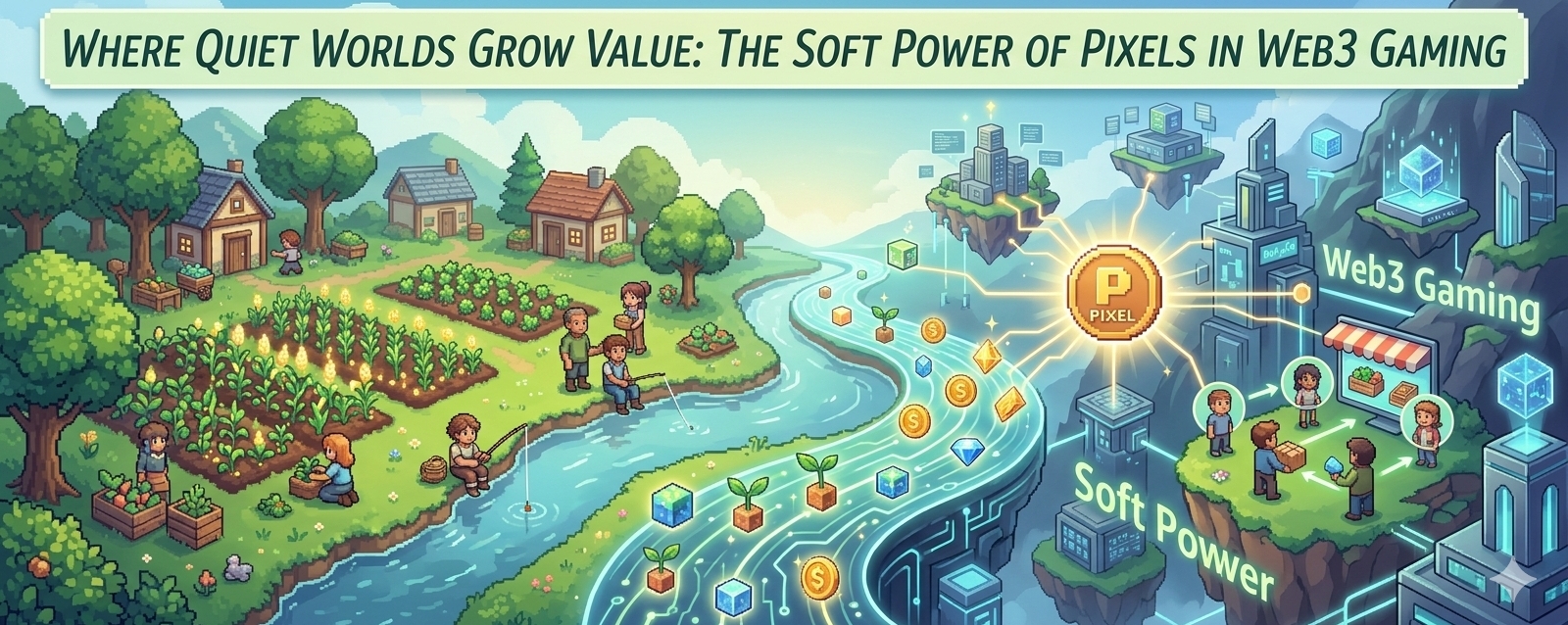
@Pixels There’s something disarming about Pixels when you first step into it. It doesn’t try to impress you with noise or complexity. Instead, it feels familiar—like a slow, peaceful farming world where time stretches gently and nothing feels rushed. But that calm surface hides something far more intentional. Pixels was never built to be just another game. It was shaped as a place where time spent actually means something, where effort isn’t lost, and where ownership quietly becomes part of the experience without overwhelming it. Built on the Ronin Network, it represents a different kind of Web3 vision—one that doesn’t force players to understand blockchain, but instead lets them discover it naturally, almost without noticing.
The early days of Pixels say a lot about why it feels different today. Around 2021, when most Web3 games were still trying to figure themselves out, many of them leaned too heavily into profit. They turned gameplay into routine tasks, where the focus shifted from enjoyment to earning as quickly as possible. Pixels didn’t follow that path. It leaned into something more human—familiar mechanics, simple interactions, and a world that people could actually enjoy being in. The blockchain layer was always there, but it stayed in the background. That choice made a bigger difference than it seemed at the time. Instead of overwhelming players, it gave them space to connect with the world first. When the project moved to Ronin in 2023, it unlocked a new phase of growth. The experience became smoother, faster, and more scalable, and suddenly Pixels wasn’t just a quiet experiment anymore—it became one of the most active spaces in Web3 gaming.
Today, Pixels feels less like a game and more like a small digital society. Players plant crops, gather materials, craft items, and move through the world at their own pace, but every action connects to something larger. There’s an economy running beneath everything, and it’s built in a way that feels natural rather than forced. Resources aren’t just items you collect—they’re part of a living system where supply and demand actually matter. Land ownership adds another layer, giving players a way to benefit from the activity happening around them. And at the center of it all is the PIXEL token, linking in-game effort to real-world value. What makes this system work is its balance. Everyday actions stay fast and simple, while ownership and trading exist on-chain, keeping the experience smooth without losing its deeper meaning.
The design behind Pixels is quietly thoughtful. It doesn’t try to show off its complexity, but it’s there if you look closely. The energy system, for example, creates a natural rhythm. You can’t do everything all at once, which protects the economy from being flooded and keeps progression meaningful. Then there’s the way resources are structured—some are easy to find, others require time, effort, or access to specific land. That difference creates scarcity, and scarcity is what gives things value. The NFT layer adds opportunity without becoming a barrier. You don’t need to own land to enjoy the game, but owning it gives you advantages and long-term benefits. It’s a design that rewards commitment without shutting newcomers out, and that balance is harder to achieve than it looks.
What really sets Pixels apart is the way it learned from what came before it. Many early Web3 games made the mistake of building economies first and experiences second. When rewards dropped, the worlds felt empty. Pixels flipped that idea. It focused on making something people would enjoy even without incentives. The economy came later, growing around the experience instead of replacing it. That shift changed how players interact with the game. They’re not just there to extract value—they’re there because they actually like being part of it. The free-to-play approach strengthens that even more. Anyone can enter, explore, and decide at their own pace how involved they want to be.
Its success shows up in more than just numbers, but the numbers still matter. The growth in daily active users reflects something real—people aren’t just trying it, they’re staying. The PIXEL token gaining traction on major platforms added another layer of credibility, connecting the game to a wider audience. But maybe the most important sign of life is the community itself. Players interact, collaborate, compete, and build relationships inside the world. That social energy creates its own demand, turning the game into something that feels alive rather than static.
At the same time, the path forward isn’t without challenges. Any system that connects gameplay with real-world value has to stay balanced. If rewards grow too quickly without enough demand, the economy can weaken. There’s also the risk of players focusing too much on earning and not enough on enjoying the experience. That shift can slowly change the feeling of the game, turning it into something more mechanical than meaningful. And beyond that, there’s still skepticism around Web3 gaming as a whole. Pixels continues to carry the responsibility of proving that it’s more than just a financial system wrapped in a soft aesthetic.
Looking ahead, Pixels feels like it’s only getting started. New systems, deeper mechanics, and expanded social features hint at something bigger taking shape. It’s moving toward becoming more than a single game—a space where players can create, interact, and build their own paths within the world. If that vision continues to grow, Pixels could evolve into a platform rather than just a product, where the community itself plays a major role in shaping what comes next.
In the end, Pixels doesn’t try to overwhelm you. It doesn’t rely on noise or hype. It grows quietly, almost patiently, building something meaningful beneath a simple surface. It shows that ownership doesn’t have to feel complicated, and that value doesn’t need to be forced. Sometimes, the strongest ideas don’t arrive all at once—they grow slowly, like seeds in the background, until one day you realize they’ve already changed the landscape. Pixels feels like one of those ideas, steady and understated, but carrying the kind of impact that lasts.
