
I’ll say it straight…
most Web3 reward systems don’t really fail fast they just slowly leak value.
At the start, everything looks healthy.
Users show up numbers climb dashboards look clean.
But if you stay long enough and stop looking at charts… you start noticing behavior instead.
People aren’t playing.
They’re calculating.
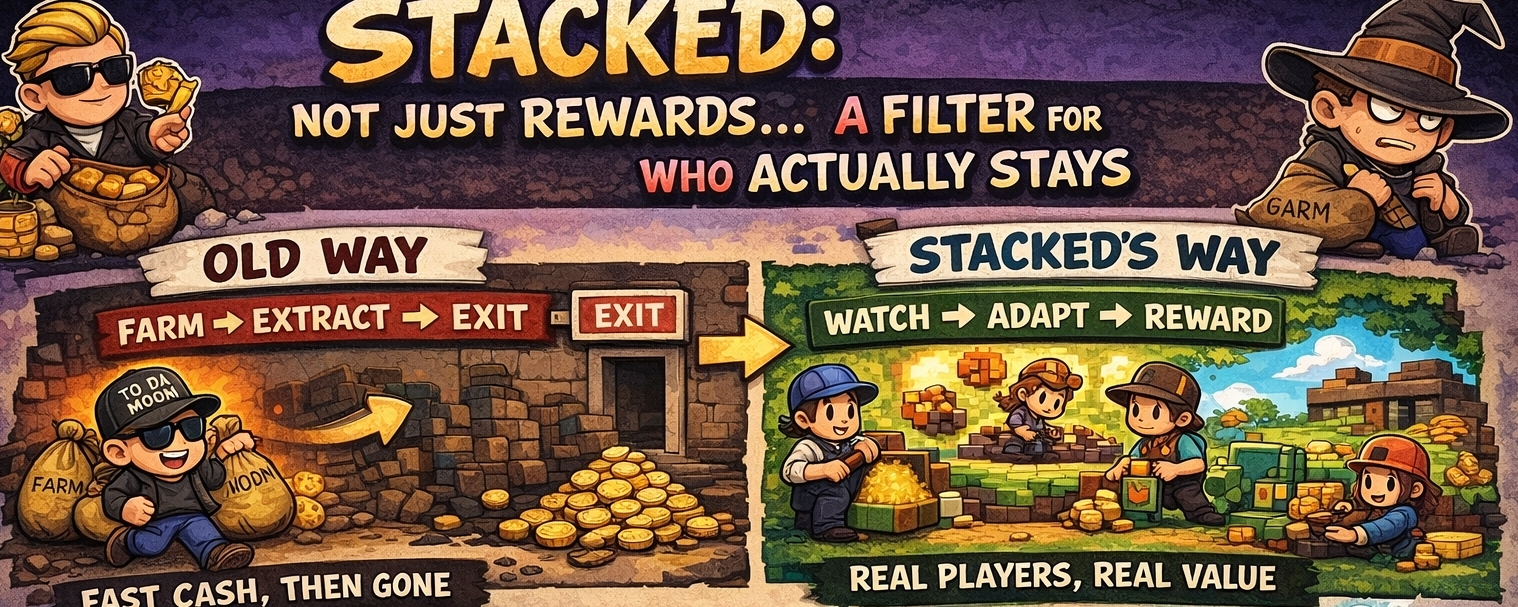
They enter → farm → extract → disappear.
No attachment. No real participation. Just timing.
And honestly I used to think that was just how the system works.
But looking at how Stacked operates inside @Pixels … it feels like someone finally questioned that assumption.
At first glance I thought Stacked was just another reward distribution layer.
You know… make incentives smoother maybe more efficient.
But that’s not really what it’s doing.
It’s doing something slightly uncomfortable for Web3 systems:
It’s watching what happens after rewards are given.
That shift is small… but it changes everything.
Because most systems are built like this:
Launch → distribute → measure → repeat
Stacked breaks that rhythm.
Instead of pushing rewards blindly, it reacts to behavior in real time.
If something brings players back it leans into it.
If something attracts low-effort farming it quietly pulls back.
No announcements. No drama. Just adjustment.
And this is where it gets interesting.
Because the real issue in GameFi was never we need more rewards.
It was always this:
Rewards were going to the wrong people… for the wrong reasons.
So instead of building an economy, systems were feeding short-term extraction loops.
You don’t notice it immediately.
But over time, it drains everything.
Stacked feels like it’s trying to fix that not by adding more rewards…
but by making rewards selective.
Not everyone who shows up should benefit equally.
Some players build.
Some just pass through.
And if a system can’t tell the difference… it eventually collapses.
What I like here is that rewards start acting like signals not just payouts.
Are players returning?
Are they actually engaging?
Are they contributing something that lasts?
Those questions start shaping incentives.
Which honestly feels closer to running an economy… than running a campaign.
And yeah… we’re at a point where this kind of shift is needed.
Players already understand how to farm systems.
Memecoin cycles trained people to move fast extract faster and not look back.
Even in games that mindset didn’t disappear it just got quieter.
So if your reward system is predictable… it’s already being gamed.
That’s probably why Stacked stands out to me.
It’s not trying to out-reward the problem.
It’s trying to out-adapt it.
And the fact that it’s already live inside the @Pixels ecosystem matters more than anything.
Because theory is easy.
Real players are not.
Once real behavior hits everything breaks, or everything sharpens.
Stacked didn’t stay in theory.
It stepped into actual pressure.
If I had to simplify it:
Most systems try to increase activity.
Stacked is trying to increase useful activity.
And yeah… that sounds subtle.
But that’s usually where the real difference is.
Not saying this fixes everything.
But it’s one of the first times I’ve seen a system that doesn’t just reward movement…
it tries to understand why the movement matters.
And in a space where even memecoin behavior shaped user psychology…
that might be the only way forward.
After closely reading and analyzing the Pixel project I'm confident that it presents a strong opportunity. The token taps into fundamental human drives particularly through its social aspects and digital ownership which could drive long-term adoption. Based on its current direction I believe it has the potential to become a significant player in the digital asset space moving forward. If you found this analysis helpful, please like, comment with your thoughts and share it with others.
@Pixels #pixel $PIXEL $PEPE $BONK
