
I was halfway through checking unlock schedules late at night, flipping between tabs, when something about Pixels (PIXEL) didn’t sit right. Not in a dramatic way—nothing was crashing, no red candles screaming for attention. It was quieter than that. The kind of quiet where volume holds steady, price doesn’t move much, but the underlying numbers start shifting in a way that feels… deliberate.
There was a small unlock coming up—nothing massive compared to some of the bigger cliff events you see in other gaming tokens. Roughly around 1.2% of circulating supply scheduled over a short window. Normally, that’s not enough to break structure on its own. I’ve seen far worse get absorbed without any visible damage. But what caught me was how PIXEL had been behaving before the unlock even hit.
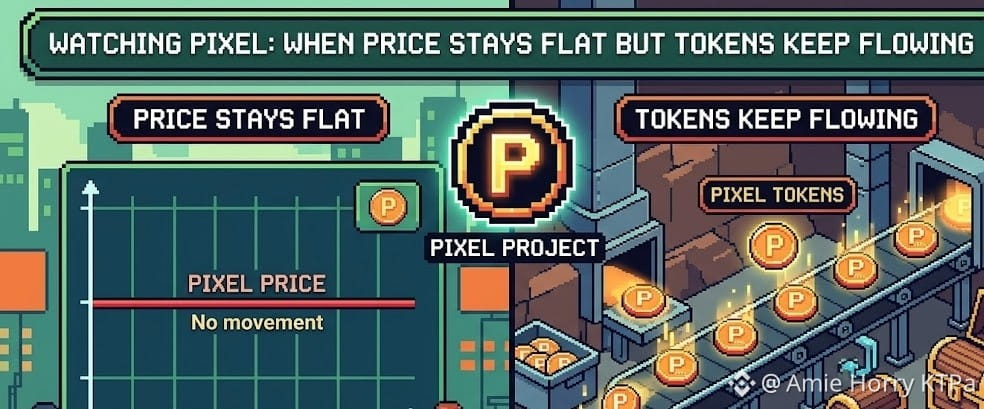
Price wasn’t trending up. It wasn’t trending down either. It was just… stuck. Hovering in a narrow band, with volume that looked artificially consistent. Not declining, not expanding. Just enough activity to keep things alive. That’s usually where I start paying closer attention, because sideways markets often hide positioning.
So I pulled up a few dashboards and started comparing wallet activity. Nothing too deep—just basic flows. And the pattern started to show itself: tokens moving, but not aggressively selling. More like repositioning. Small chunks shifting between wallets, occasional deposits toward exchanges, but not enough to spike sell pressure immediately.
That’s when the idea clicked.
PIXEL doesn’t behave like a hype-driven token right now. It behaves like a token being managed through supply.
There’s a difference.
In hype-driven tokens, price leads everything. Volume spikes, narratives follow, and supply reacts afterward. But here, it feels inverted. Supply events are shaping the behavior first, and price is just adjusting slowly in response. Almost like the market already knows what’s coming and is pacing itself.
The interesting part is how the token handles these micro-unlocks. Instead of sharp drops, you get this slow bleed or flat compression. It’s subtle, but it matters. Because it tells you that either:
sellers are distributing carefully, or
buyers are stepping in just enough to absorb without letting momentum build
Neither scenario is explosive. But both are intentional.
I noticed something similar a few weeks back. There was a period where daily volume hovered around a consistent range—nothing extreme, but also not fading. At the same time, circulating supply ticked up slightly. Again, not dramatic. But enough to suggest that tokens were entering the market without triggering panic.
That kind of behavior usually points to one thing: controlled dilution.
And controlled dilution isn’t necessarily bearish in the short term. In fact, it can keep a chart stable longer than expected. But it creates a ceiling. Because every time price tries to move up, there’s just enough extra supply waiting to meet it.
That’s the part I keep coming back to with PIXEL.
It’s not dumping. It’s not pumping. It’s being absorbed.
Now, if you connect that to how the token is actually used—mainly inside the game economy—it starts to make more sense. Emissions don’t hit the market all at once. They flow through players, incentives, rewards. Which means sell pressure is fragmented. It doesn’t show up as one big red candle. It shows up as hundreds of small decisions.
And small decisions are harder to track—but easier to underestimate.
The risk here is pretty straightforward, though.
If this steady absorption stops—if buyers step back even slightly—then all that controlled supply can quickly turn into visible pressure. What looks stable now could unwind faster than expected. Especially if one unlock overlaps with weaker demand or declining player activity.
I’ve seen this happen before with other GameFi tokens. Everything looks fine until it isn’t. The moment liquidity thins out, even small unlocks start to matter a lot more.
So I’m not looking at PIXEL as a breakout candidate right now. That’s not the setup.
What I’m watching instead is how it reacts around these supply events.
Does price continue to compress after each unlock?
Does volume stay artificially steady, or does it start fading?
Do we see stronger reactions—either up or down—when slightly larger batches hit the market?
Because if this pattern continues—slow unlocks, steady absorption, tight range—it eventually builds pressure. And pressure doesn’t stay quiet forever.
One detail I’m keeping an eye on is whether exchange inflows start clustering instead of spreading out. Right now, they feel staggered. If that changes—if multiple wallets start moving tokens at the same time—that’s usually when structure breaks.
On the flip side, if price starts pushing up despite these unlocks, that’s a different signal entirely. That would mean demand is finally outpacing supply, not just matching it. And that’s when the character of the token changes.
But we’re not there yet.
Right now, PIXEL feels like a market in balance—but not a natural one. A managed balance. The kind that holds until something shifts underneath.
And until I see that shift, I’m treating it exactly like that: a controlled environment where supply is quietly doing more work than price is showing.
