

I keep coming back to Pixels because, the more I look at it, the less it feels like a pitch and the more it feels like a habit-forming online place. My first impression is not really about crypto at all. It is more like a calm farming and exploration game where people build routines, tend land, raise animals, and spend time around other players in a shared world. That plainness is part of why it works. The official framing still leans on simple ideas like playing with friends, building communities, managing crops, and shaping your own corner of the map, and I think that tells you a lot about what kind of game it wants to be.
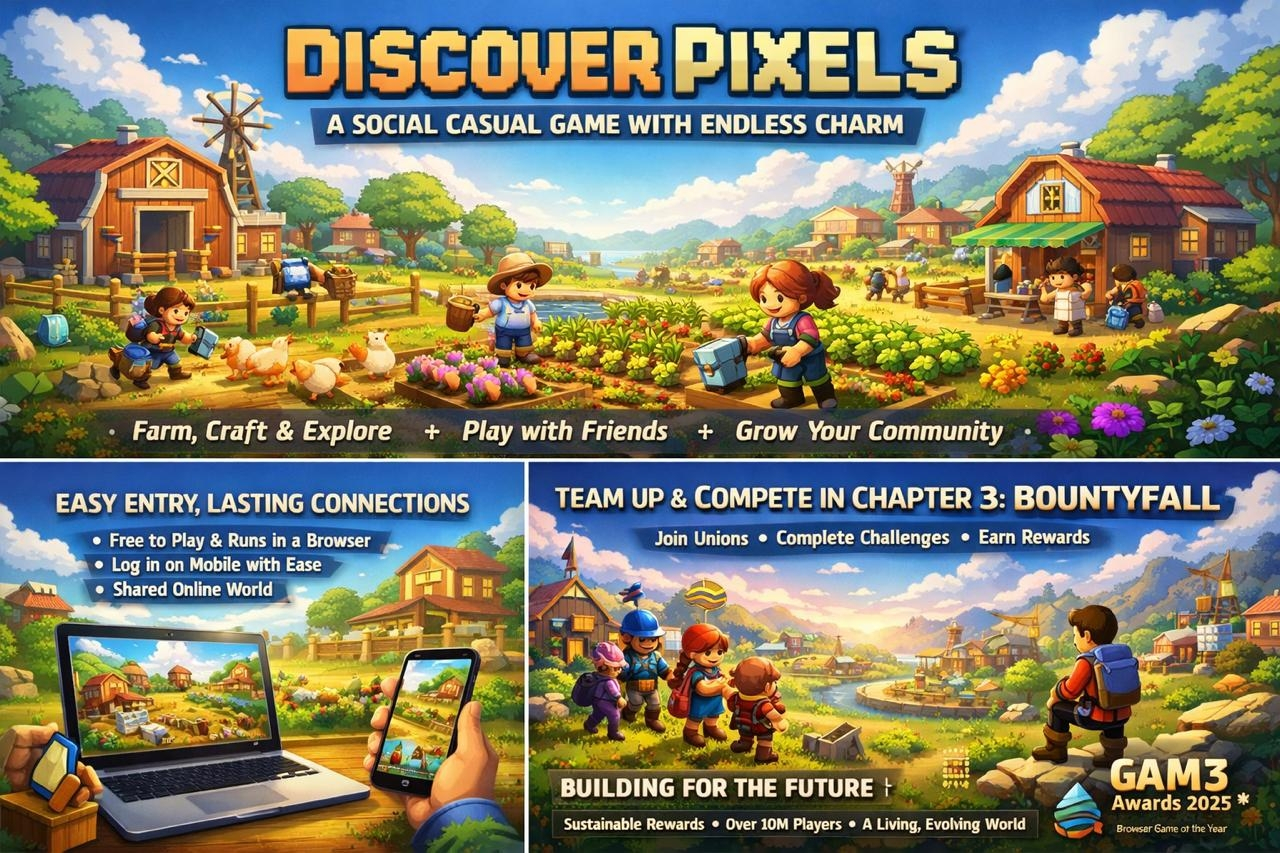
What I find helpful is to separate Pixels from the noise that usually surrounds this category. Yes, it has a blockchain layer, and yes, ownership and rewards are part of the picture. But if I try to explain why people pay attention to it, I would start somewhere more ordinary: it is free to play, it runs in a browser, and the team says you can log in on mobile through a regular browser or wallet browser. That lowers the barrier in a very practical way. You do not have to make a grand commitment before you understand the appeal. In a moment when a lot of games are fighting for time and attention, that kind of access matters more than people sometimes admit.
I used to think the “social casual” label was mostly marketing shorthand, but Pixels makes the phrase easier to understand. The core loop is quiet enough to feel familiar—plant, gather, craft, upgrade, repeat—yet the world keeps nudging you toward other people. Even the official description leans on relationships, shared communities, and cooperation, and the game’s recent chapter design has pushed that idea further rather than pulling back from it. In Chapter 3, Bountyfall, players pick one of three Unions and take part in a large team race where every contribution counts, sabotage can happen, and the rewards grow with participation. That is a notable shift. It keeps the relaxed farming surface, but it adds a layer of social strategy that makes the world feel less private and more alive.
What surprises me is that the game is getting attention now for reasons that feel a little more mature than they did a few years ago. The conversation is not only about whether a token exists or whether a game can attract a quick rush of users. It is increasingly about retention, structure, and whether a live game can reward people without letting the reward system swallow the game itself. You can see that in Pixels’ own language around sustainability and in the newer tools around it. The team has been pretty open about the fact that long-term success depends on building an economy that can actually last. That makes Ronin’s March 2026 announcement of Stacked feel important. Built by the Pixels team, it shifts rewards toward real behavior, consistency, and progress across games rather than just rewarding people for showing up and grinding. To me, that feels like part of a bigger correction: less spectacle, more thoughtful design.
There is also something honest, almost endearing, about the fact that Pixels still looks like a moving target. Its public pages do not always line up neatly with its newest chapter, which is messy but also normal for a live service game that keeps changing. I do not see that as a flaw you have to hide. I see it as part of the picture. A game like this is always negotiating between cozy routine and competitive economy, between welcoming newcomers and giving regulars enough depth to stay. Sometimes that balance will look elegant. Sometimes it will look patched together in real time. That uncertainty is not incidental; it is the actual condition of the game.
For someone thoughtful who’s never touched Pixels, I wouldn’t sell it as a game-changer. I’d explain it in a grounded way, without skipping over the tricky bits. I would say it is a browser-based social farming game that became important because it made entry easy, gave people a shared world to inhabit, and kept evolving after the first wave of attention. Ronin’s own year-end review said Pixels won Browser Game of the Year at the GAM3 Awards 2025, passed 4 million RON in trading volume, and was preparing the wider rollout of Stacked. Pixels talks about having over 10 million players, and of course that matters. Scale alone is not what makes it interesting to watch. What feels more important is the quieter experiment underneath it all: whether a game built on routine, shared spaces, and small actions can continue to feel welcoming and alive after the initial excitement settles. Pixels is still being tested in that way, and that is what keeps it interesting.
