
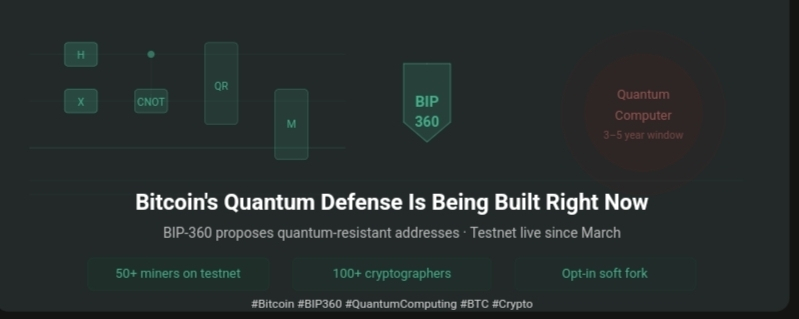
Everyone's watching the Iran headlines and the $75K level. Meanwhile, Bitcoin's developers shipped something that nobody's talking about but everyone should understand.
BIP-360 — also called Pay-to-Quantum-Resistant-Hash, or P2QRH — is a formal proposal to introduce quantum-resistant address formats to the Bitcoin network. A dedicated testnet launched in March 2026, attracting over 50 miners and 100 cryptographers for initial trials. The upgrade is opt-in, meaning existing wallets and transactions remain unaffected, but adoption would require broad community consensus via a soft fork.
Why does this matter now? The threat isn't imminent. But the window is closer than most people think.
Here's the actual problem. Bitcoin's current cryptography — specifically the elliptic curve digital signature algorithm (ECDSA) — is vulnerable to quantum computers. Not to today's machines. But Bernstein analysts noted this week that the crypto industry has a 3–5 year window to implement quantum-resistant upgrades before quantum computing reaches a level that poses a credible threat to exposed public keys on the blockchain.
The key phrase there is "exposed public keys." When you receive Bitcoin to an address but haven't spent from it yet, your public key is hidden. But the moment you spend from that address, your public key is revealed on-chain. A sufficiently powerful quantum computer could — in theory — use that exposed public key to derive your private key and steal your funds.
This affects wallets that reuse addresses or have pending transactions particularly badly. Satoshi's earliest coins — millions of BTC that have sat unmoved since 2009, with public keys permanently exposed on-chain — would be among the most vulnerable in a post-quantum world.
BIP-360 addresses this by introducing a new address format that uses lattice-based cryptography, which is believed to be quantum-resistant. The trade-off is slightly larger transaction sizes and marginally higher fees for users who opt into the new format.
Calling this urgent would be overstating it. But it's also not something that can be left until the last minute — protocol upgrades in Bitcoin require years of coordination, testing, and community consensus. The fact that developers are formalizing this now is exactly the right timeline.
Long-term holders should understand what's being built on their behalf. This is Bitcoin's immune system being upgraded in real time.