
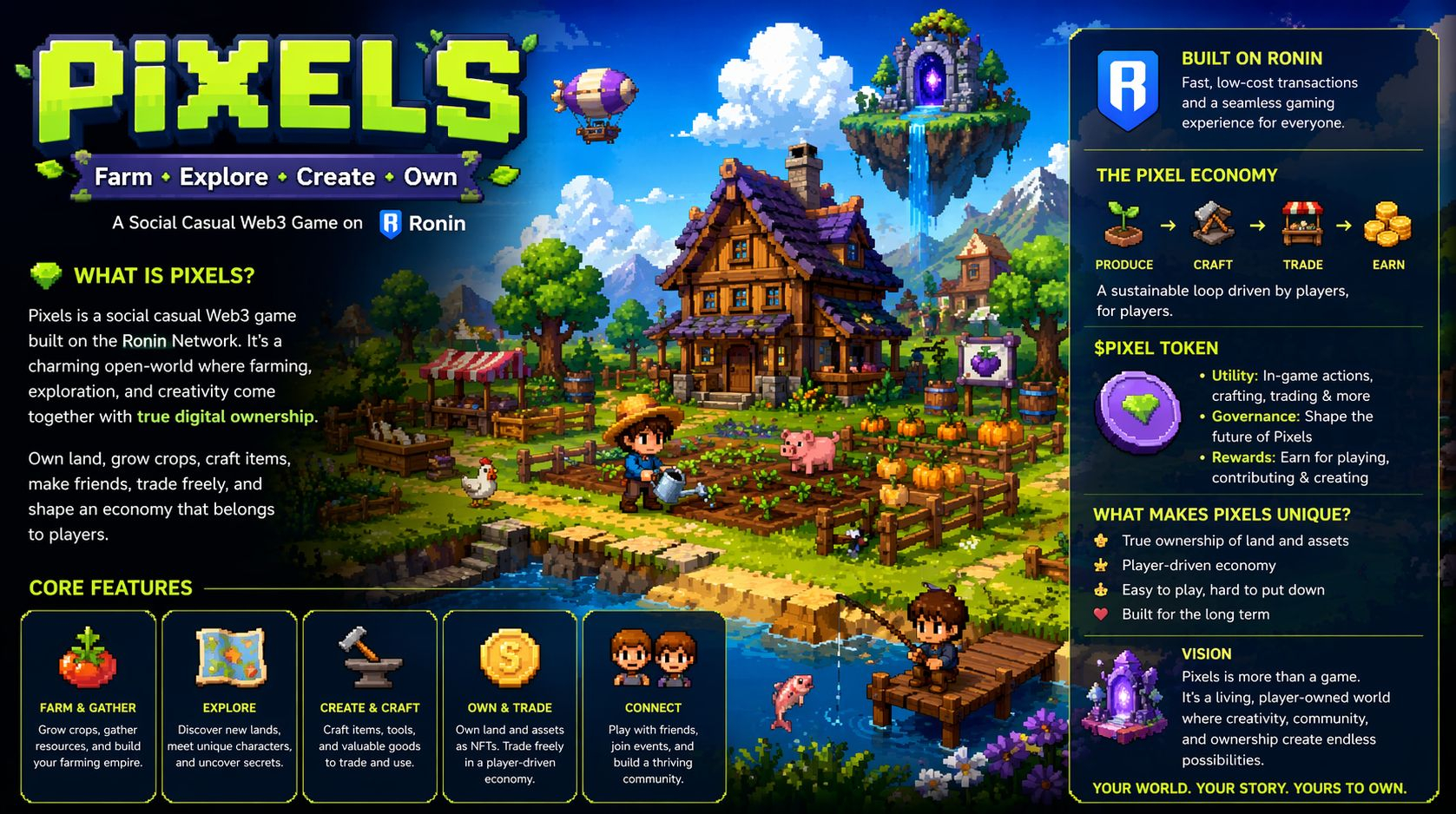
I’m not going to lie, when I first heard about Pixels, it sounded like just another farming game trying to ride the Web3 wave, and honestly, we’ve all seen so many of those that it becomes hard to feel anything new, but something about this one feels different the longer I sit with it, because it’s not trying to impress me loudly, it’s slowly pulling me in, and before I realize it, I’m not just playing, I’m caring, and that shift from playing to caring is where everything begins to change.
There’s a strange comfort inside Pixels, like stepping into a place that doesn’t rush you, doesn’t pressure you, and doesn’t treat you like a number in a system, and if it becomesomething deeper, it’s because it quietly asks a question most games never ask, what if your time actually mattered here, what if the things you build stayed yours, and what if this small digital world could feel a little bit like home.
Where It All Started — A Feeling We All Know
They didn’t create Pixels out of nowhere, because the idea comes from something we’ve all felt at some point, that quiet disappointment when you leave a game and everything you worked for just disappears, like it never existed, like your time had no weight, and maybe we got used to it, maybe we stopped questioning it, but that feeling never really went away.
Pixels feels like a response to that pain, not in an aggressive or revolutionary way, but in a soft and human way, like it’s saying, what if we try something different this time, what if we let players keep a piece of what they build, what if progress doesn’t vanish when you close the screen, and that idea alone carries more emotion than any flashy feature ever could.
The First Experience — Calm, Gentle, Real
When I enter the world of Pixels, nothing feels overwhelming, and that’s rare, because most games either try too hard or explain too much, but here, I’m just walking, planting, harvesting, talking, and slowly understanding things without being forced to, and it reminds me of simpler times when games were about feeling rather than optimizing.
But then something shifts inside me, because I start realizing that what I’m doing isn’t just temporary, that the land, the items, the effort, they’re not locked away in some invisible system controlled by someone else, they’re connected to me in a way that feels more permanent, and suddenly the smallest actions begin to feel meaningful.
The Invisible Magic — Ownership Without Noise
They’ve done something very subtle here, something most projects struggle with, and that is making blockchain feel invisible, because let’s be honest, technology can sometimes create distance instead of connection, but Pixels hides that complexity behind a soft and natural experience.
I’m farming, crafting, exploring, and interacting, and I don’t feel like I’m dealing with systems or tokens, I just feel like I’m living inside a small world that responds to me, and yet behind all of that, there’s a structure quietly ensuring that what I do has value, that it stays, that it belongs, and that quiet assurance changes how I feel about every moment I spend inside.
The Heart of It — Why It Feels Alive
If I try to explain why Pixels feels alive, it’s not just because of the mechanics, it’s because of the intention behind them, because they didn’t design this world to extract from players, they designed it to include them.
The PIXEL token, the land system, the economy, all of it exists, but it doesn’t scream for attention, it supports the experience instead of dominating it, and that balance is rare, because we’ve seen what happens when games focus too much on earning and forget about feeling.
Here, I’m not just thinking about rewards, I’m thinking about growth, about progress, about connection, and that emotional layer is what turns a system into something that actually matters.
The Struggle Behind the Scenes
But even something that feels this calm carries tension underneath, because building a living economy is not easy, and if it becomes unbalanced, everything can start to fall apart.
If rewards become too easy, they lose meaning, and if they become too hard, players lose hope, and somewhere between those two extremes is a fragile space where the system can breathe, and maintaining that balance is a constant challenge.
There’s also the fear that people might come only to take, to earn quickly and leave, because we’ve seen that story before, and it always leaves behind empty worlds that once felt full, and that’s something Pixels will have to protect itself from as it grows.
Why It Stays With You
What surprises me the most is not what Pixels does, but how it makes me feel after I leave, because I find myself thinking about it, not in a compulsive way, but in a quiet, reflective way, like remembering a place I’ve been rather than a task I completed.
It doesn’t exhaust me, it doesn’t pressure me, it gives me space, and in that space, I start to feel something we rarely feel in digital environments, which is a sense of belonging, even if it’s small, even if it’s just a tiny piece of land or a simple routine.
Looking Ahead — A Soft but Powerful Future
If Pixels continues on this path, it might not explode overnight or dominate headlines, but it could slowly become something more meaningful than that, something that people return to not just for rewards, but for comfort, for creativity, for connection.
We’re seeing the early shape of a world where games don’t just entertain us, they respect us, where time is not wasted but transformed into something that stays with us, and if that idea grows, it could quietly reshape how we think about digital life.
Final Thoughts
I don’t see Pixels as perfect, and maybe that’s why it feels real, because it’s still growing, still learning, still finding its balance, just like the players inside it, and maybe that’s what makes it special.
It doesn’t promise everything, it doesn’t try to be everything, but it offers something simple and honest, a place where your effort matters a little more, where your presence feels a little more real, and where, for a moment, you’re not just playing a game, you’re part of something that remembers you.
And maybe, in a world where so much feels temporary, that small feeling of being remembered is exactly what we’ve been missing all along.