
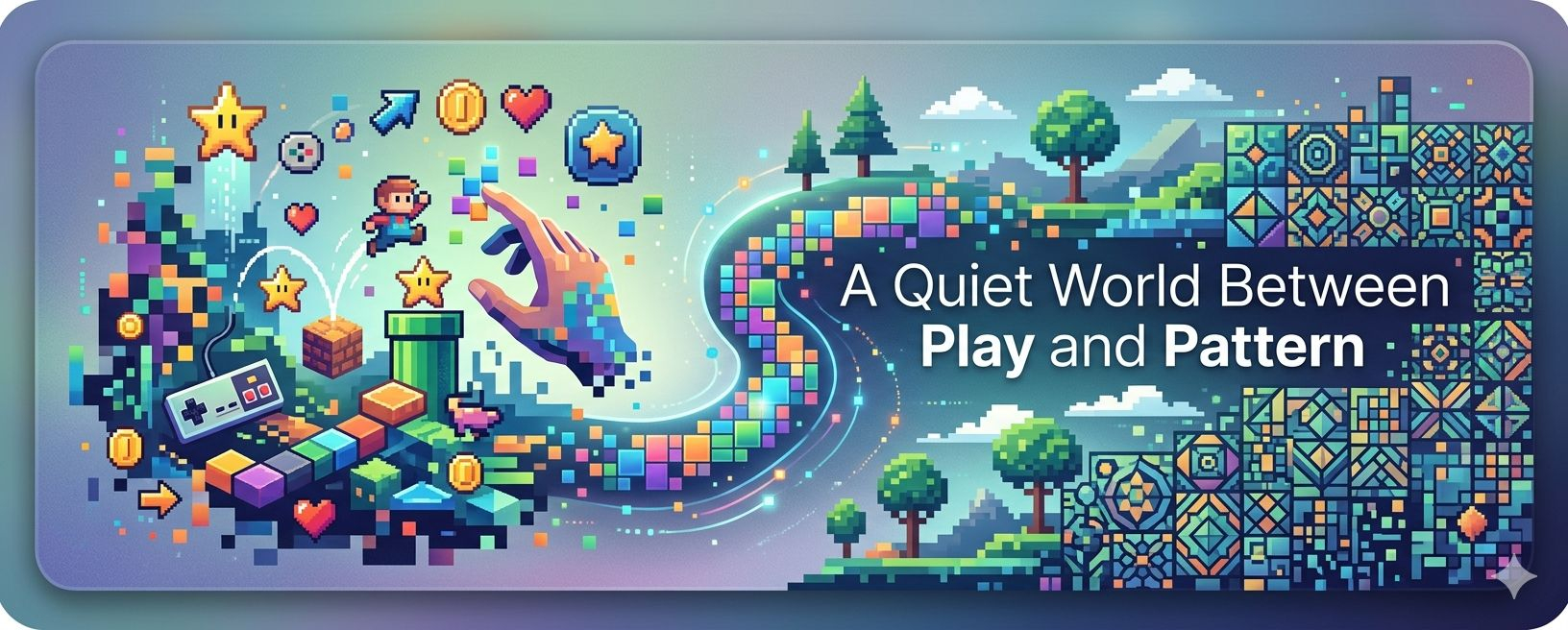
I’m watching how Pixels presents itself quietly, almost deliberately understated as if it doesn’t want to overwhelm at first contact, and I keep wondering whether that simplicity is an entry point into something deeper or just a surface that never fully opens.
The initial experience feels intentional. Farming, movement, light exploration—none of it demands much cognitive effort. You don’t need to understand blockchain mechanics or token structures to begin. You simply interact, progress, and exist within the environment. For a moment, it succeeds in feeling like a game before it feels like an ecosystem.
But over time, the experience begins to stretch rather than expand. The core loop remains consistent, almost too consistent. Actions repeat with minimal variation, and while the world maintains a visually active presence, its mechanical responses feel limited. There’s a subtle difference between a world that reacts to players and one that simply accommodates them, and Pixels often leans toward the latter.
The social layer is present, but it feels passive. Other players exist within your space, yet interaction is rarely required. There is little structural pressure to collaborate, trade meaningfully, or depend on others. As a result, the “social” aspect becomes more observational than participatory. It creates an environment where players coexist rather than truly engage.
Beneath this, the economic system sits quietly but persistently. It is not aggressively imposed, which initially works in the project’s favor. However, as time passes, the influence becomes more noticeable. Progression pacing, reward distribution, and minor friction points begin to feel aligned with an underlying economic logic. Not in a disruptive way, but in a manner that subtly shapes behavior.
What stands out is that Pixels does not force its token dynamics into the foreground. Instead, it allows players to encounter them gradually. This approach avoids immediate resistance but raises a different question—whether the system is designed around player experience first, or if the experience has been structured to support the economy in a less visible way.
The Ronin Network provides a layer of inherited credibility. It anchors the project within an ecosystem that has already proven its ability to scale and attract users. That trust matters. However, infrastructure alone does not sustain engagement. It can support a game, but it cannot define whether the game itself remains compelling over time.
What continues to draw attention is not excitement, but observation. There is an ongoing question of whether there is depth beneath the simplicity or if the design intentionally avoids complexity to maintain accessibility. Because accessibility, if not paired with evolving depth, risks becoming stagnation.
At its core, the uncertainty lies in retention. Pixels feels welcoming, even comfortable, but it does not yet demand commitment. And without that demand, it becomes unclear whether users stay because they are genuinely engaged or simply because nothing has yet disrupted their presence.
For now, it feels like a space that holds attention gently rather than firmly—a world that is easy to enter and easy to remain in, but still uncertain in its ability to grow alongside its players. I find myself continuing to observe, not because the answers are clear, but because they are not.
