There is a question I keep coming back to whenever I look at Web3 gaming incentives: why do so many reward systems look powerful in the early stage, only to become fragile once real user behavior starts pressing against them?
That is exactly why @Pixels has been on my mind.
At first glance, it would be easy to reduce this story to something simple. Another gaming ecosystem. Another rewards layer. Another attempt to keep users active through incentives. But the more I look at what the team is doing with Stacked, the more I feel that reading is too shallow. What they are building seems less like a short-term rewards app and more like infrastructure born out of years of pressure, mistakes, adaptation, and direct contact with the hardest problem in GameFi.
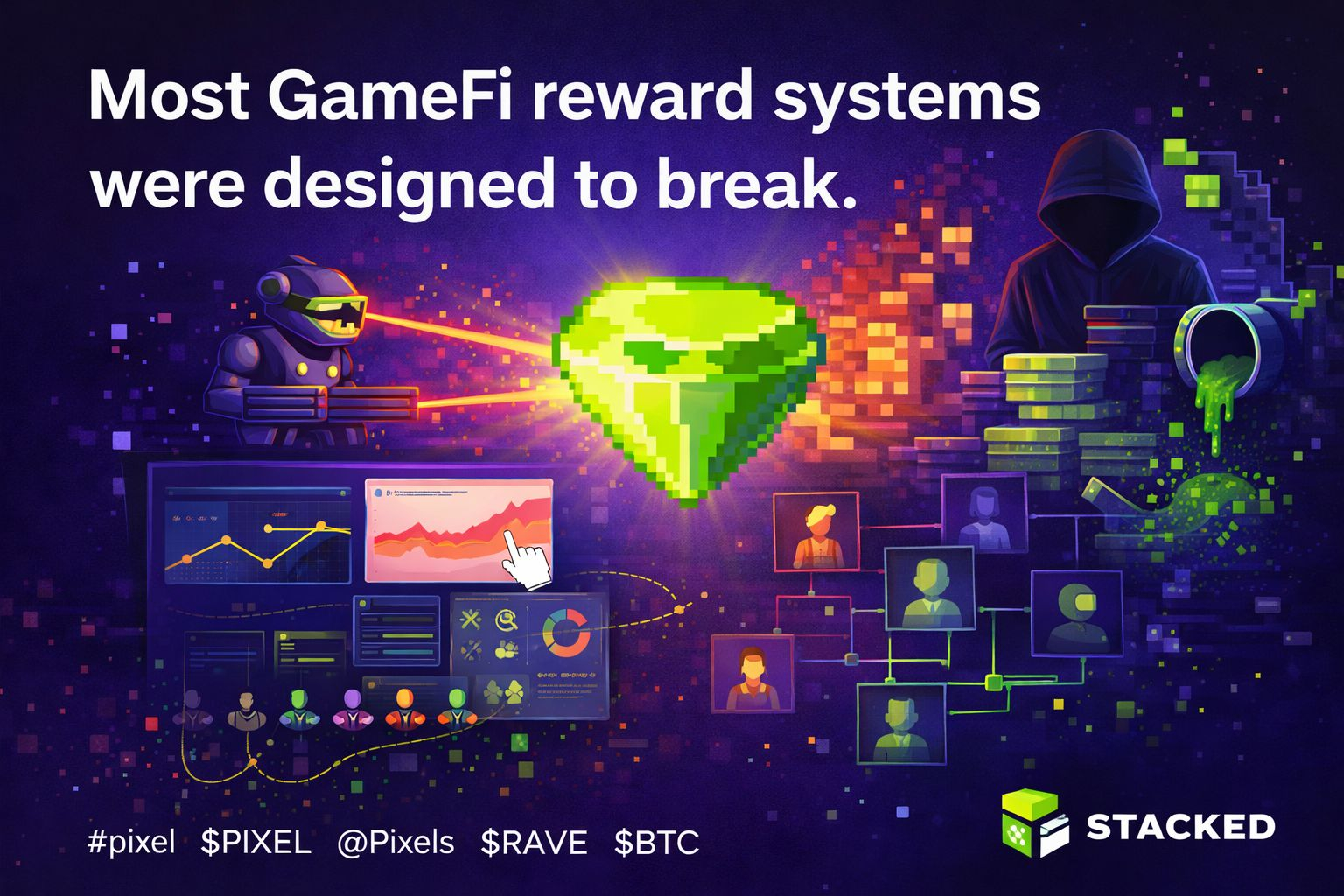
Most reward systems fail for reasons that are actually very predictable. They attract the wrong behavior faster than they create the right one. They bring in users who are highly efficient at extraction but weak at retention. They create temporary spikes in activity, but those spikes are often expensive, low quality, and economically misleading. Bots learn the game faster than communities do. Farmers arrive before loyal players can compound value. And slowly, what looked like growth starts revealing itself as leakage.
That is why I think the most important thing about Stacked is not that it gives out rewards. The interesting part is that it seems designed around the logic of controlled incentives.
That difference matters more than people think.
Anyone can build a quest board. Anyone can distribute points. Anyone can promise that participation will be rewarded. But the harder question is much more operational. Who should actually receive the reward? At what moment? For what behavior? And most importantly, did that reward improve anything meaningful such as retention, revenue, or long-term value?
This is where the Stacked thesis starts to look far more serious than the average Web3 growth play.
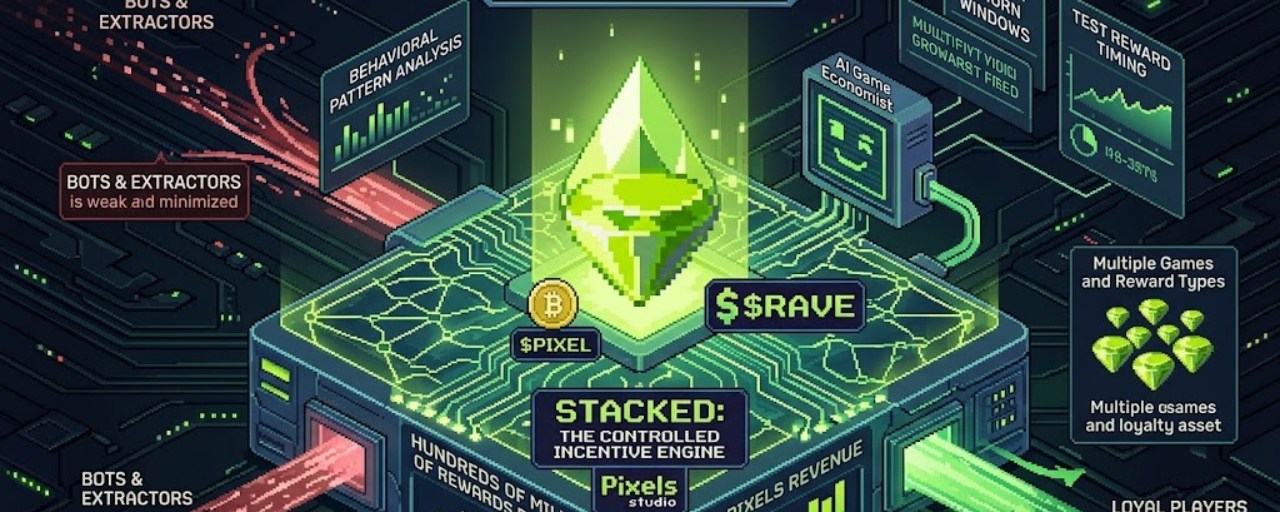
The idea of a rewarded LiveOps engine with an AI game economist on top is not interesting just because it sounds advanced. It is interesting because it changes how incentives are managed. Instead of treating rewards like a blunt marketing expense, the system starts treating them like a measurable lever. Studios can look at behavioral patterns, identify churn windows, analyze which cohorts are weakening, and test whether better reward timing actually improves user outcomes. That is a completely different level of maturity compared with the old model of simply throwing emissions into the market and hoping engagement survives.
And what gives this story more weight, in my view, is that it does not appear to be a whiteboard fantasy. It comes with operational proof. The material around Stacked points to hundreds of millions of rewards processed across millions of players and a contribution to more than 25 million dollars in Pixels revenue. That matters. In crypto, I trust systems that were shaped in production far more than systems that only sound elegant in presentations.
This is also where PIXEL becomes more interesting to me.
A lot of gaming tokens struggle because their utility stays trapped inside one narrow loop. Their value proposition depends too heavily on one title, one economy, or one temporary user pattern. But if Stacked expands as infrastructure for multiple games and multiple reward types, then PIXEL arts moving into a wider role. It stops looking like a token tied to one isolated ecosystem and starts looking more like a rewards and loyalty asset inside a broader network. More games means more surfaces for utility. More surfaces for utility means a more meaningful demand story.
That is why I do not see this as just another reward narrative.
I see a team trying to turn incentive design from a weakness in Web3 gaming into an operational advantage. If they succeed, the value is not only in the player experience. It is also in the infrastructure layer, the studio tooling, the anti-fraud moat, the data advantage, and the growing relevance of PIXEL inside a larger system.
To me, that is a much stronger story than simple GameFi hype.
#pixel $PIXEL @Pixels $RAVE $BTC