
I almost ignored Pixels.
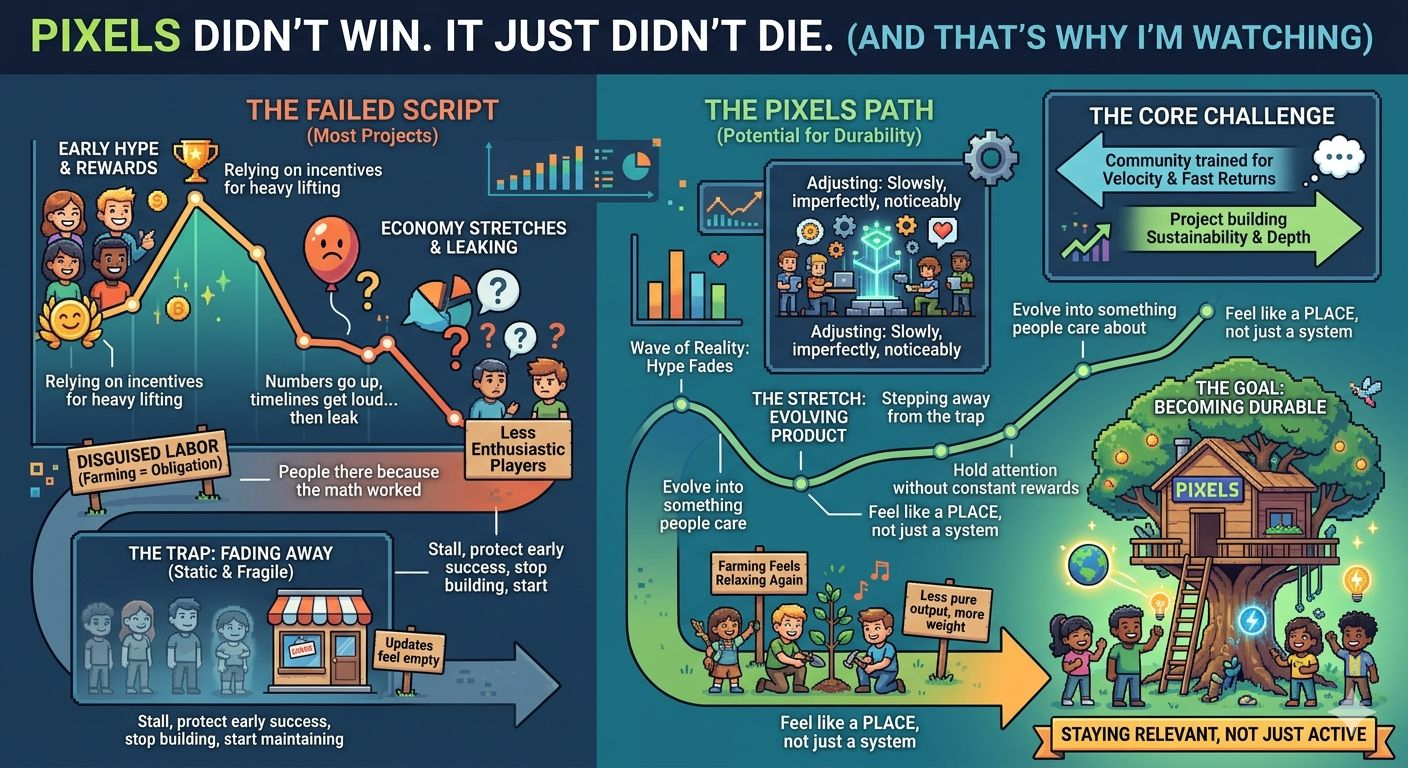
Not because it looked bad, but because it looked too familiar. The same soft visuals, the same calm farming loop, the same friendly surface layered over a system that usually runs on one thing — incentives doing all the heavy lifting. I’ve been around long enough to know how that script usually plays out. It starts warm and welcoming, people pile in, numbers go up, timelines get loud… and then slowly, quietly, the whole thing starts leaking.
At first, nobody notices.
Rewards still feel decent. Progress still feels fast. People convince themselves they’re early, or smart, or both. But underneath, the pressure starts building. The economy stretches. The loops get thinner. What felt like a world starts feeling like a routine. And then one day, it clicks — people weren’t really there for the game. They were there because the math worked.
When the math stops working, so does everything else.
That’s the part most projects don’t survive.
And that’s exactly why Pixels is more interesting now than it ever was during the hype phase...
because it’s already been through that first wave of reality.
The easy excitement is gone. The illusion that growth can carry itself forever is gone. What’s left is the part most teams try to avoid the stretch where you either evolve the product into something people actually care about, or you slowly become another system running on fumes while pretending everything is fine.
Pixels doesn’t feel like it’s pretending.
It feels like it’s adjusting. Slowly, imperfectly, but noticeably.
And I think that matters more than people realize.
A lot of Web3 games get trapped by their own early success. They build something that works “well enough” when rewards are flowing, and instead of questioning it, they protect it. They double down on the same loops, the same structure, the same promises. Because changing it risks upsetting the very users who showed up for those rewards in the first place.
So they stall.
They stop building a world and start maintaining a system.
That’s when everything becomes fragile.
Pixels, at least from what I’m seeing, looks like it’s trying to step away from that trap. Not completely, not perfectly, but enough to notice. There’s a shift away from pure output thinking. Less focus on just extracting value, more on giving the world some weight again.
And honestly, that’s the only direction that gives this space a chance.
Because when everything becomes about efficiency, the game dies in a very specific way. Farming stops feeling relaxing and starts feeling like obligation. Crafting becomes a checklist. Exploration becomes pointless unless it pays. Even social interactions start orbiting around optimization instead of connection.
At that point, it’s not a game anymore. It’s just disguised labor.
And players feel that, even if they don’t say it out loud.
The real question for Pixels isn’t whether it can attract users again. That part is easy in crypto. The real question is whether it can hold attention without constantly leaning on rewards as the main reason to stay.
Can it become somewhere people log into out of habit, not just opportunity?
Can it feel like a place instead of a system?
That’s a much harder problem. And it’s where most projects fail, not because they’re bad, but because they never really try to solve it.
There’s also a tension here that doesn’t get talked about enough. The audience itself. A lot of users in this space have been trained to expect fast returns, constant upside, immediate gratification. The moment a project slows things down to build something more sustainable, part of that audience loses patience.
They don’t want balance. They want velocity.
So the project ends up caught in between trying to become healthier while part of its own community is still wired for the less healthy version.
That pressure breaks a lot of teams.
What keeps Pixels in that “still watching” category for me is that it doesn’t feel frozen. It doesn’t feel like it’s just replaying its old formula louder. There’s friction, there’s adjustment, there’s a sense that the team knows the first version wasn’t enough to last.
That awareness alone puts it ahead of most.
But awareness isn’t success.
This next phase is where things usually get decided. Not in the hype cycle, not in the early numbers, but in this slower, quieter stretch where building actually has to carry the weight that incentives used to.
Most projects don’t make it through that.
They don’t collapse dramatically. They just fade. Updates keep coming, but they feel empty. The world stops evolving. The community starts repeating itself. From the outside, it still looks alive. From the inside, it’s already static.
Pixels isn’t there yet.
But it’s close enough to that line that what happens next actually matters.
Because staying alive in crypto is easy. Staying relevant without leaning on the same old tricks? That’s where things get real.
And if Pixels manages to push through this phase — not by getting louder, but by getting deeper — then it might end up being something most projects never become.
Not just active.
But durable.
That’s a much rarer outcome.
And honestly, that’s the only one worth paying attention to anymore.