
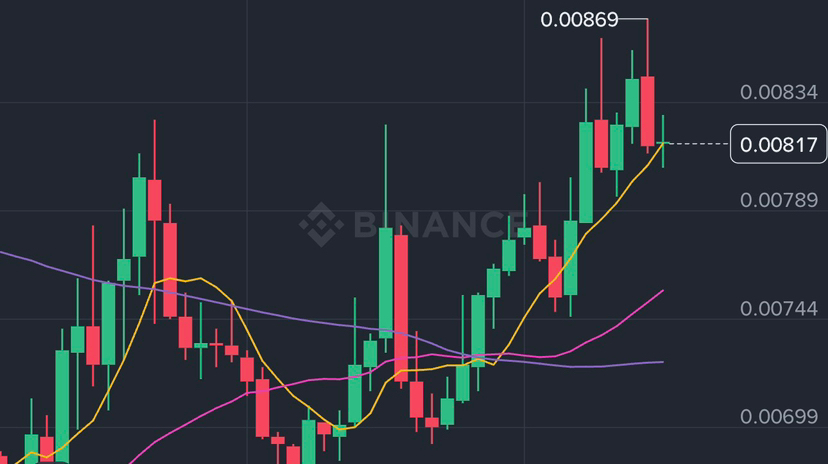
In a market driven by narratives, hype cycles, and short attention spans, it’s easy to miss what’s actually being built beneath the surface. The truth is, most tokens gain attention long before they gain traction. $PIXEL is taking the opposite route. Instead of leading with speculation, it is emerging from a foundation of real economic activity, and that distinction matters more than ever in today’s environment.
At its core, Pixel is undergoing a critical transformation. What started as a single game utility token is now expanding into a cross ecosystem rewards currency. That shift alone changes the entire value proposition. Rather than being tied to the lifecycle of one game, $PIXEL is positioning itself as a shared layer across multiple gaming experiences. As more titles integrate into the system, the token’s demand surface expands naturally. This is how network effects are built, not through forced narratives, but through increasing real usage.
And there is already proof that this model works. Stacked powered systems have contributed over $25M in revenue within the Pixels ecosystem. That number is not just impressive, it is rare in a space where many projects are still searching for sustainable monetization. It signals that #pixel is not operating in a vacuum. There is real user activity, real spending, and real economic flow backing the token’s evolution.
For seasoned crypto participants, this trajectory feels familiar. $BTC did not become dominant overnight. It gained strength over time as its utility, security, and network effects compounded. While Pixel operates in a completely different vertical, gaming infrastructure rather than digital money, the underlying principle is similar. Assets that embed themselves into systems with growing usage tend to capture value more effectively than those driven purely by speculation.
What further strengthens PIXEL’s position is the AI powered infrastructure supporting it. This is not just an add on feature, it is a fundamental upgrade to how games are operated. Traditionally, studios rely on delayed analytics and fragmented tools to understand player behavior. With this system, developers can instantly identify why players are dropping off, where reward budgets are inefficient, and what actions to take next. More importantly, they can execute those actions immediately within the same environment.
This creates a powerful feedback loop. Data is no longer static, it becomes actionable in real time. And within that loop, PIXEL plays a central role as the reward mechanism that drives engagement. The smarter the system becomes, the more efficiently $PIXEL is deployed, and the more meaningful its usage becomes across the ecosystem.
Another key piece of the puzzle is the redirection of ad spend. The traditional gaming industry spends billions annually on user acquisition, often with inconsistent and opaque returns. Stacked introduces a different model, one where that capital is redirected directly to players. Instead of paying for attention through intermediaries, studios reward actual engagement. This approach makes the entire system more transparent and measurable.
For Pixel, this is a major unlock. It positions the token at the center of a reward loop where value distribution is not arbitrary, but tied to real user activity. Every incentive becomes trackable, every outcome measurable. For investors and funds looking at the long term sustainability of Web3 gaming, this kind of auditable ROI is a significant step forward.
Equally important is how Pixel is now anchored to infrastructure rather than a single product. Stacked operates as a B2B layer for game studios, meaning its success scales with adoption across multiple titles. This reduces dependency on any one game’s performance and shifts the risk profile entirely. Instead of betting on a single hit, the model benefits from aggregate growth across the ecosystem.
This is where the bigger picture comes into focus. @Pixels is no longer just a token tied to gameplay, it is becoming part of a broader system that connects games, players, and incentives in a unified loop. Its value is reinforced by usage, expanded by integrations, and optimized by intelligent infrastructure.
And perhaps the most compelling part of this entire story is that it is already live. This is not a concept waiting to be built or a roadmap filled with hypotheticals. It is a system operating in production, generating revenue, and evolving in real time.
In a space crowded with promises, that distinction is everything. Pixel is not asking the market to believe in what could be. It is showing what already is, and quietly building toward what comes next.