

Chapter 22 Day 22
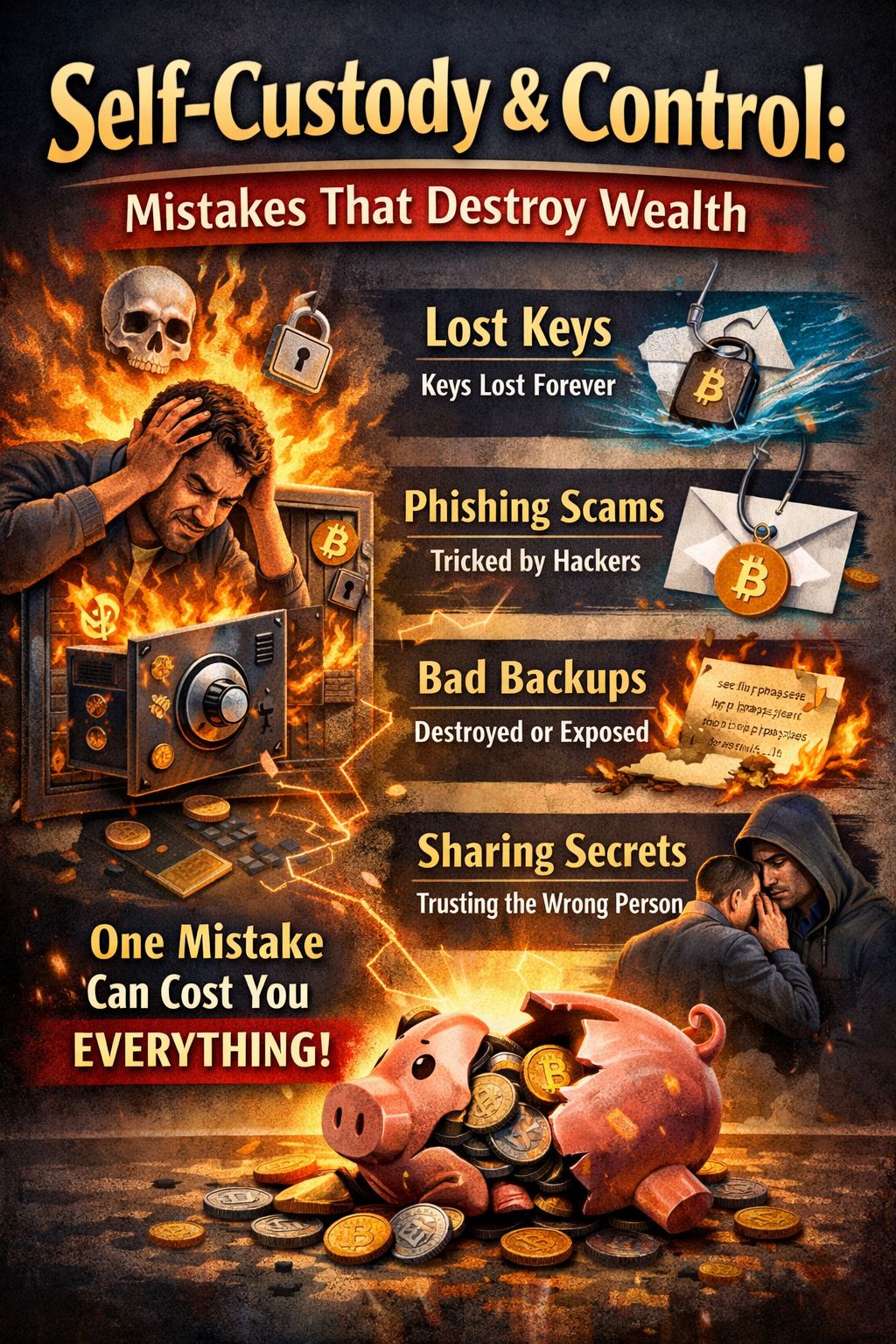
Self-Custody & Control: Mistakes That Destroy Wealth
The Delusion of "I’m Secure"
I can still recall the initial moment I experienced feeling “wealthy” in crypto.
It wasn't an excessive amount. Nothing transformative. Yet it belonged to me. Positioned perfectly within a trading account, digits shining bright, graphs fluctuating like a pulse. I monitored it every few minutes. Good morning. Evening. Even during the course of discussions.
And I said something risky to myself: “It’s secure.” “It’s located on a major exchange.”
That statement—straightforward, assured, at ease—is where the majority of wealth loss starts.
In cryptocurrency, what seems secure frequently isn't. What seems bothersome… is often the true safeguard.
Ownership vs Access: The First Mistake
Let’s make something painfully clear. If you don't have control over your private keys, you don't truly own your cryptocurrency. You merely possess access. That’s all, The initial error individuals commit is failing to grasp the distinction between ownership and permission. Exchanges provide a user-friendly interface, a password entry, and possibly two-factor authentication. It seems like a financial institution.
However, it’s not your financial account. It belongs to them. You are relying on them to:
Retain your money ,Handle your withdrawals, Remain financially stable, Remain safe, Remain truthful.
That’s a significant amount of trust for something meant to eliminate trust. And history has repeatedly demonstrated that this trust can shatter in an instant.
The “It Won’t Happen to Me” Trap
Every cycle, the same story repeats. A major exchange collapses. Funds are frozen. Withdrawals paused. Panic spreads. And suddenly, thousands—sometimes millions—of people realize: “I didn’t actually own anything.
But before that moment, those same people thought they were safe. This is mistake number two: believing you are the exception.
Human psychology is funny like that. We hear stories of hacks, scams, bankruptcies… but we quietly think:
“That’s for careless people.”
“That exchange was shady.”
“I use a trusted platform.”
Until one day, you wake up and your withdrawal request says: “Processing” And it never completes.
Convenience is Expensive
Here’s a hard truth most people don’t like:
Convenience destroys wealth.
Keeping funds on an exchange is easy:
No need to manage keys
No backups
No fear of losing access
Instant trading
It feels smooth.
Self-custody, on the other hand, feels… annoying at first:
You have to write down seed phrases
You worry about losing them
You double-check addresses
You move slower.
But that “annoyance” is actually security.
Most wealth isn’t lost because of complex hacks. It’s lost because people choose convenience over responsibility. And the cost of that convenience? Sometimes everything.
The Silent Killer: Carelessness
Not all mistakes are dramatic. Some are quiet. Slow. Almost invisible. Carelessness is one of the biggest wealth destroyers in self-custody.
It shows up like this:
Saving seed phrases in phone notes.
Taking screenshots of private keys.
Reusing passwords everywhere.
Clicking random links without thinking.
Nothing bad happens… at first. Days pass. Weeks. Months. Then one day, your wallet is empty. No warning. No reversal. No customer support. That’s the thing about crypto—it doesn’t forgive mistakes. And carelessness is a mistake that feels harmless until it isn’t.
The Screenshot Disaster
Let me tell you about a common story. Someone sets up a wallet. They see the seed phrase. Twelve or twenty-four words. They think: “I’ll just take a screenshot for now. I’ll write it down later.” But “later” never comes.
That screenshot sits in their phone gallery. Synced to cloud storage. Maybe even backed up automatically. Now think about how many apps, services and systems touch that data. One small breach. One malicious app. One compromised account. And those 12 words? That’s your entire wallet. Gone. This is mistake number four: treating private keys like regular data. They’re not. They are the keys to everything.
The Backup That Wasn’t
Some people go a step further. They write down their seed phrase. Good move, right? Not always. Because they make another mistake: poor backups.
Examples:
Writing it on a single piece of paper.
Storing it in one location.
Not protecting it from fire or water.
Leaving it somewhere obvious.
So what happens? A small accident—a spill, a move, a lost notebook—and suddenly:
Access is gone forever. No reset button. No “forgot password.” Your wealth disappears… not because someone stole it, but because you lost access. That’s the painful irony of self-custody:
You can lose everything in two ways: Someone else takes it, You lock yourself out, Both are equally final.
Overconfidence: The Dangerous Upgrade
After some time in crypto, something interesting happens. You get comfortable.
You’ve made transactions. Used wallets. Maybe even taught others. And slowly, confidence turns into overconfidence.
You stop double-checking addresses.
You rush through setups.
You trust your memory instead of verifying. This is when mistakes get bigger. Because experience doesn’t remove risk—it often hides it. The most dangerous person in crypto isn’t the beginner. It’s the semi-experienced user who thinks: “I know what I’m doing.”
Phishing: The Invisible Attack
Not all attacks are technical. Many are psychological. Phishing is one of the most effective ways people lose funds. It doesn’t break security—it tricks you into giving it away.
It looks like: A familiar website, A login page that feels real, A message that creates urgency
“Your account is at risk. Verify now.” “Limited-time reward. Connect wallet.”
“Security alert. Act immediately.”
And in that moment of pressure… you click. You connect your wallet.
You sign a transaction. And just like that, access is granted. No hacking required.
This is mistake number six: trusting what looks real without verifying.
In crypto, appearances mean nothing.
The Hardware Wallet Myth
Many people think buying a hardware wallet solves everything. It’s a great tool. But it’s not magic. A hardware wallet protects your private keys—but it doesn’t protect you from: Phishing, Signing malicious transactions, Poor backups, Social engineering, you can still lose everything using the most secure device in the world… if you don’t understand what you’re doing. Tools don’t replace awareness. They support it.
All Eggs in One Basket
Another classic mistake: not diversifying storage. People often keep everything in one wallet. It feels simpler. Easier to manage. But think about it: If something goes wrong—one mistake, one breach, one lost key—you lose everything. A smarter approach: Use multiple wallets,
Separate long-term storage from active funds, Keep only what you need in “hot” wallets
This way, even if something fails, it doesn’t wipe you out completely. Wealth isn’t just about growth. It’s about survival.
Ignoring the “Boring” Steps
Nobody likes boring steps. Writing backups. Testing recovery. Double-checking processes. It feels unnecessary… until it’s not. Many people skip: Testing if their seed phrase actually works, Practicing wallet recovery, Verifying addresses carefully And then, when something goes wrong, they realize: “I never actually checked this.” That’s a painful moment.Because prevention always feels optional… until it becomes urgent.
Emotional Decisions
Not all mistakes are technical. Some are emotional. Fear and greed can destroy wealth just as fast as bad security.
Examples: Panic transferring funds during market crashes, Rushing into unknown platforms chasing rewards, Trusting “guaranteed returns” In those moments, logic disappears. And mistakes multiply. Self-custody isn’t just about keys. It’s about discipline.
The False Sense of Small Amounts
“I don’t have much. It’s fine.” This is another silent trap. People treat small amounts casually:
Weak security, No backups, Risky experiments. But small amounts don’t stay small forever. And habits don’t magically improve when numbers grow. If you build careless habits early, they scale with your wealth. And when it finally matters… those habits cost you.
Learning the Hard Way
Most people in crypto have a story. A mistake. A loss. A moment that changed how they think. Maybe it was: Losing access to a wallet, Falling for a phishing link, Trusting the wrong platform. These experiences hurt. But they also teach. The goal isn’t to avoid every mistake—that’s impossible. The goal is to avoid the big ones. The ones that wipe you out completely.
The Real Shift
At some point, something clicks. You stop thinking like a user… and start thinking like an owner. You realize: There is no safety net, There is no customer support, There is no reversal
And instead of fear, you feel responsibility. That’s the shift. Self-custody isn’t just a tool. It’s a mindset.
Protecting Wealth the Right Way
So what actually works? Not perfection. Not complexity. Just consistent, thoughtful behavior: Store seed phrases offline, securely, Use hardware wallets properly, Double-check everything, Stay skeptical of urgency, Separate funds across wallets, Practice recovery before you need it, Simple things. But powerful.
Final Thought: Wealth is Easy to Lose
Building wealth is hard. Protecting it is harder. In traditional finance, mistakes can sometimes be fixed. In crypto, mistakes are final. That’s why self-custody matters so much.
Not because it’s trendy. Not because it’s technical. But because it puts the responsibility—and the power—back in your hands.
And with that power comes a simple truth:
Your wealth is only as safe as your habits.
So slow down.
Think twice.
Respect the process.
Because in this world… One small mistake can undo everything.
@Binance Square Official @Bitcoin $BTC $ETH $XRP
