
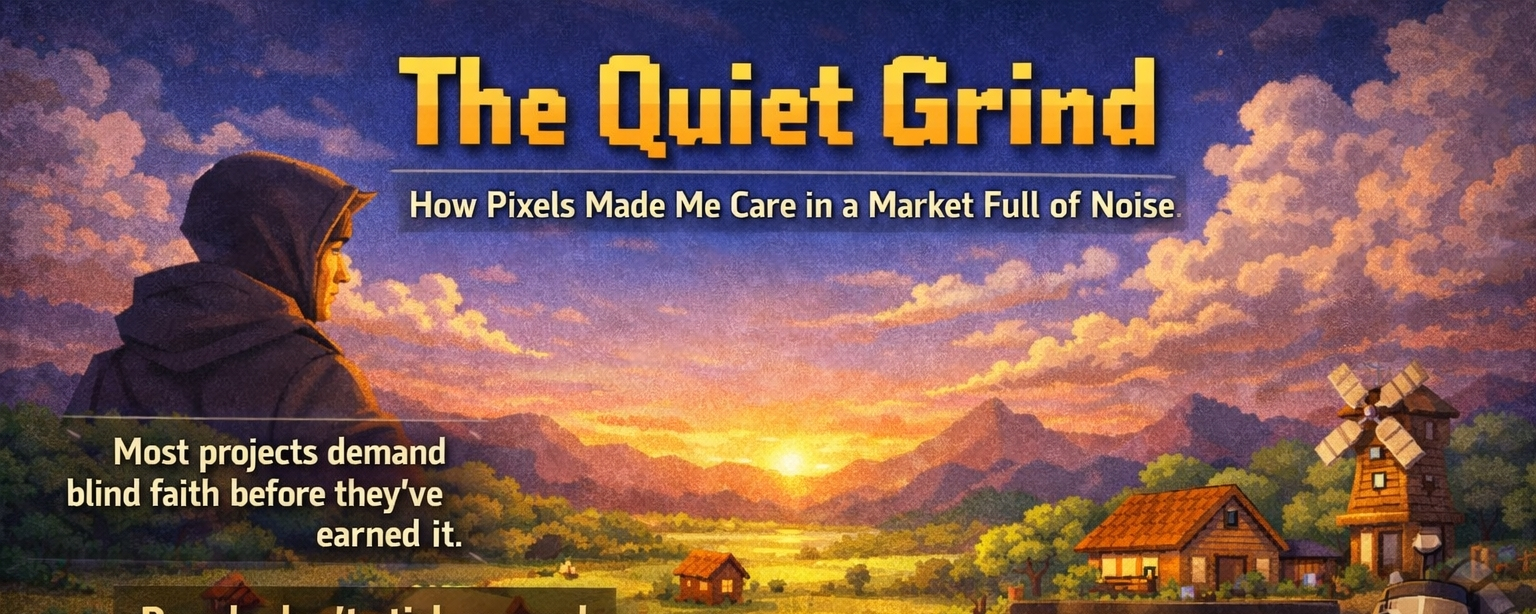
Honestly, in any other cycle, I would’ve scrolled right past Pixels.
Not because the art is bad or anything, but just out of pure fatigue. We’ve all seen this playbook a hundred times: the soft pixel art, the farming loop, the grand promises that this time the economy won't crash and the community will stick around. Usually, it's just a matter of time before the token turns into background noise in a market already drowning in recycled ideas.
That’s the prevailing mood in crypto right now, isn’t it? Just this low-grade, exhausting grind. So many projects demand your blind faith before they’ve done a single thing to actually earn your attention. So when I first looked at Pixels, I wasn't looking to be charmed. I was actively looking for the catch—the exact moment the "game" drops the act and turns into just another extraction machine.
But weirdly enough, it kept me hooked longer than I wanted to admit.
It’s not because it’s reinventing the wheel. It’s really not, and honestly, the word "innovation" has lost all meaning in this space anyway. What actually grabbed me is way more grounded. The team seems to get that people don’t stick around for abstract lectures about "digital ownership." They stay because the world remembers they were there. They stay when the work they put in yesterday is still standing today, feeling like a real foundation instead of just a rented illusion.
It sounds simple, but almost everyone misses it.
Most Web3 projects treat "ownership" like some magic spell. Mint this. Hold that. Put it on-chain and boom, it matters. Except it usually doesn't. It just becomes another piece of digital friction floating around. Pixels hits differently because ownership here is tied to your daily routine. It’s tied to labor—even if it's casual. Your little farm actually matters because you keep checking on it. Your space has weight because you’ve spent real time in it. It feels a lot more honest than the usual roadmap sales pitch.
I think that’s why it resonates with me. It isn’t begging me to buy into some grand philosophical thesis about the future of the internet. It just gives me a small, contained system where my effort actually accumulates and sticks. You’d think that would be normal online by now, but it’s not. Most platforms just eat your time, make you grind for their algorithms, and then one policy tweak wipes out the feeling that any of it belonged to you in the first place. Pixels quietly pushes back against that.
Now, I’m not saying it’s perfect. I’ve been in this space long enough to know how fast these digital worlds can unravel once the incentives get out of whack. And they always get distorted eventually. The rewards attract the wrong crowd, the token twists behavior, and suddenly everyone stops playing and starts optimizing. Next thing you know, spreadsheets take over, sell pressure mounts, and whatever soul the game had is dead. I’m always watching for that danger.
But the real test is whether a project can make its world matter more than the financial extraction layered on top of it. That’s where most fail—they build the casino before they build a reason to care. From what I can see, Pixels learned that the order matters. The world has to come first. The routine has to come first. Without that, "ownership" is just digital clutter.
I actually love how stubborn the game is about being ordinary. It doesn’t reek of desperation to impress you. It moves like something built entirely around repetition. Let’s be real, farming isn’t glamorous. It’s just maintenance. Patience. Doing the same small tasks over and over until they start to mean something. But that rhythm works because it mimics how human beings actually form attachments—not through one massive, hype-driven moment, but through familiarity. Through the quiet feeling that this place would notice if you didn't show up.
Crypto still massively struggles to grasp this. True ownership isn’t just holding an asset; it’s context. It’s memory. It’s social recognition inside a living system. Pixels gets closer to that ideal than almost anything else I’ve looked at recently. (Granted, the bar isn't exactly high right now, but still.)
It also helps that the project feels a bit bruised. It’s clearly had to navigate the messy reality of what happens when digital economies collide with actual users. Honestly? Good. I trust a project way more when it has taken a few hits and survived. It proves there’s real infrastructure holding it up underneath. Too many teams obsess over looking flawless on the surface while their internals are rotting. Pixels just feels... lived-in.
I wouldn’t call it completely "safe" or "solved." I’m still waiting for the cracks to show again, for the routine to get stale, or for the market to shift and make the ownership feel hollow. Maybe that’s just my own cynicism from watching too many promising economies collapse into dead incentives and noise. You learn to stop trusting smooth narratives and start bracing for stress.
But here’s the bottom line: I can see what Pixels is trying to protect. It’s just trying to make digital effort stick. Not in some high-minded philosophical way, but practically. You put your time in, and the world keeps a record of you being there. That should be the baseline for the internet, even if it isn't yet.
So yeah, I end up respecting the project a lot more than I expected to. Not because it’s flawless, and not because I think it entirely escapes the crypto grind. But because it remembers an old truth this industry keeps forgetting: people don’t stick around just because you told them to care. They stick around when a place finally starts to feel like theirs.
And in a market this exhausted, that might be the only thing actually worth paying attention to. Or maybe I’ve just grown too tired of everything else.
