
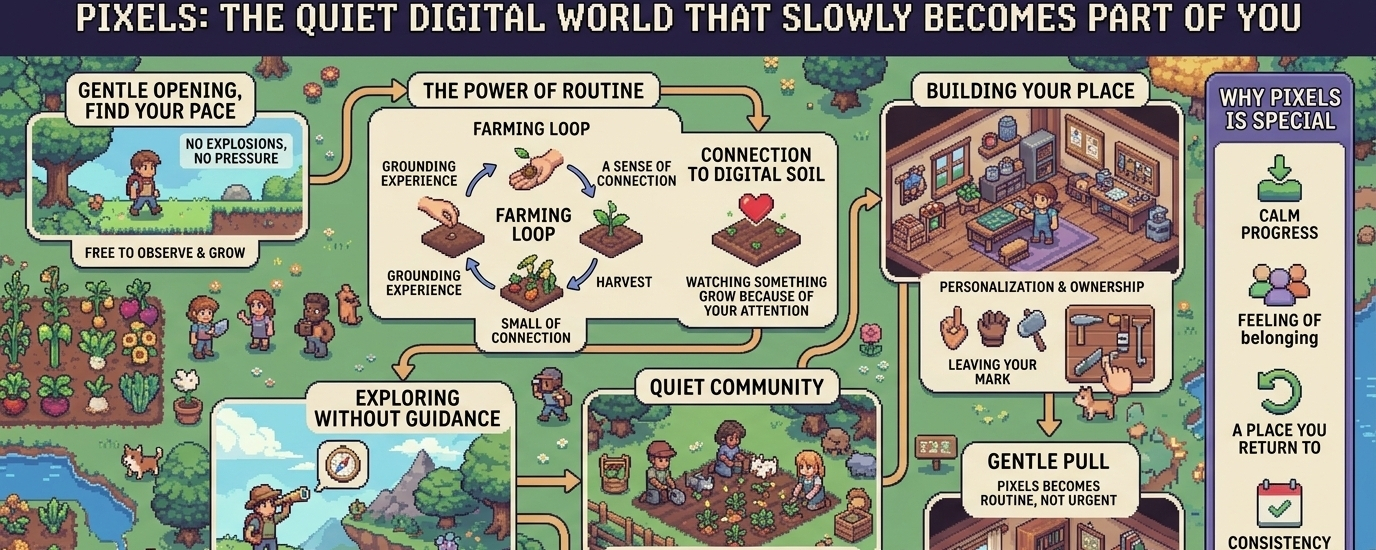
There is a certain kind of game that does not try to impress you immediately. It does not throw explosions at you, it does not rush you into action, and it does not overwhelm you with complex systems in the first few minutes. Instead, it opens gently and lets you find your own pace. Pixels belongs to that rare category, and that is exactly why it feels different from the moment you step into it.
At first, everything seems simple. You are placed in a pixel styled world with land to manage, crops to grow, and space to explore. There is no pressure pushing you forward, no voice telling you what you must do next. You are free to move slowly, to observe, and to figure things out in your own way. That freedom might feel small at the beginning, but it quickly becomes one of the strongest reasons people stay.
What makes Pixels stand out is not just what you do, but how it makes you feel while doing it. Farming, for example, is not just a mechanic. It becomes a quiet routine that grounds your experience. You plant seeds, you wait, you return, and you harvest. That loop is simple, yet it creates a sense of connection. You begin to notice your progress not in big dramatic jumps, but in small steady changes. Your land improves. Your effort shows. And over time, that small patch of digital soil starts to feel like something you genuinely care about.
There is something deeply human about watching something grow because of your attention. Even though it is happening on a screen, the feeling is familiar. It reflects a basic part of how people find satisfaction in real life. That is why the farming system in Pixels works so well. It does not try to be complicated. It simply gives you a rhythm that feels natural and rewarding.
Beyond farming, the world itself invites you to explore without forcing you into it. You are not guided by constant instructions or aggressive objectives. Instead, you move because you are curious. You walk through different areas, discover new spaces, and occasionally come across something unexpected. These moments are not always dramatic, but they are meaningful. They create a sense that the world exists beyond your immediate actions, and that makes it feel alive.
Another layer that quietly shapes the experience is the presence of other players. Pixels is a social game, but it does not push social interaction in an artificial way. You see people around you, working on their own farms, moving through the world, building their own spaces. You do not have to interact with them directly for their presence to matter. Just knowing that others are sharing the same world changes how the game feels. It adds a subtle sense of community, like being in a place where everyone is doing their own thing, yet still connected.
This kind of social design is powerful because it feels natural. It mirrors real life in a quiet way. You do not need constant conversation to feel part of something. Sometimes, just sharing space is enough. Pixels understands this, and it uses that understanding to create an environment that feels calm but alive at the same time.
Creation plays an equally important role in shaping the experience. The more time you spend in the game, the more opportunities you have to build, arrange, and personalize your space. These actions might seem small individually, but together they change your relationship with the world. You are no longer just passing through. You are shaping something. You are leaving your mark.
That sense of ownership is what turns casual play into something deeper. When you invest time and effort into creating a space, you naturally become attached to it. You want to see it grow. You want to improve it. And you want to return to it. Pixels does not force that attachment. It allows it to develop gradually, which makes it feel more genuine.
The Web3 aspect of Pixels adds another layer to the experience, but it does not overpower the core of the game. Built on the Ronin Network, Pixels exists within a system where digital ownership and player driven economies play a role. However, what makes it work is that the game does not rely on these elements alone. The world itself is engaging enough to stand on its own. The farming, exploration, and social interactions are meaningful even without focusing on the technical side.
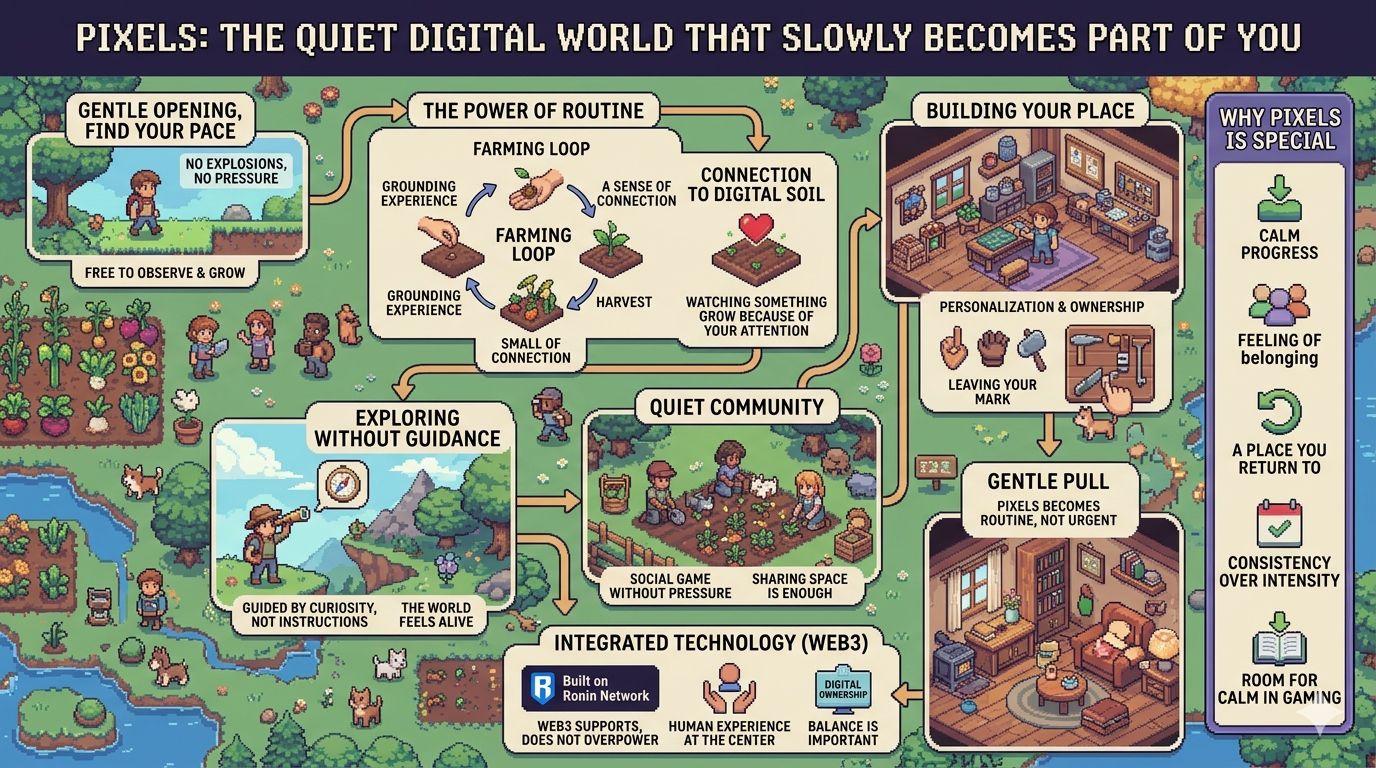
This balance is important. Many games that involve blockchain struggle because they focus too much on the system and not enough on the experience. Pixels avoids that mistake by keeping the human side of the game at the center. It understands that players stay because of how a game feels, not just because of what it offers on paper.
Over time, something interesting begins to happen. Pixels becomes part of your routine. You log in, not because you are chasing something urgent, but because you want to check on your world. You want to see your crops, make a small improvement, or spend a few quiet minutes exploring. There is no pressure, yet there is a gentle pull that brings you back.
That pull comes from consistency. The game gives you steady progress without overwhelming you. It creates a space where your actions matter, even if they are small. And in a world where many experiences feel rushed or fragmented, that kind of consistency feels surprisingly valuable.
Pixels also highlights an important idea about modern gaming. Not every experience needs to be intense or competitive to be meaningful. There is room for games that focus on calm, routine, and personal growth. There is room for worlds that feel like places rather than challenges. Pixels fits into that space, and it does so with quiet confidence.
In the end, what makes Pixels special is not a single feature or system. It is the way everything comes together to create a feeling. A feeling of calm. A feeling of progress. A feeling of belonging to a small but living world. It does not try to overwhelm you, and it does not demand constant attention. Instead, it offers something simpler and, in many ways, more lasting.
It gives you a place you can return to, grow within, and slowly make your own.