
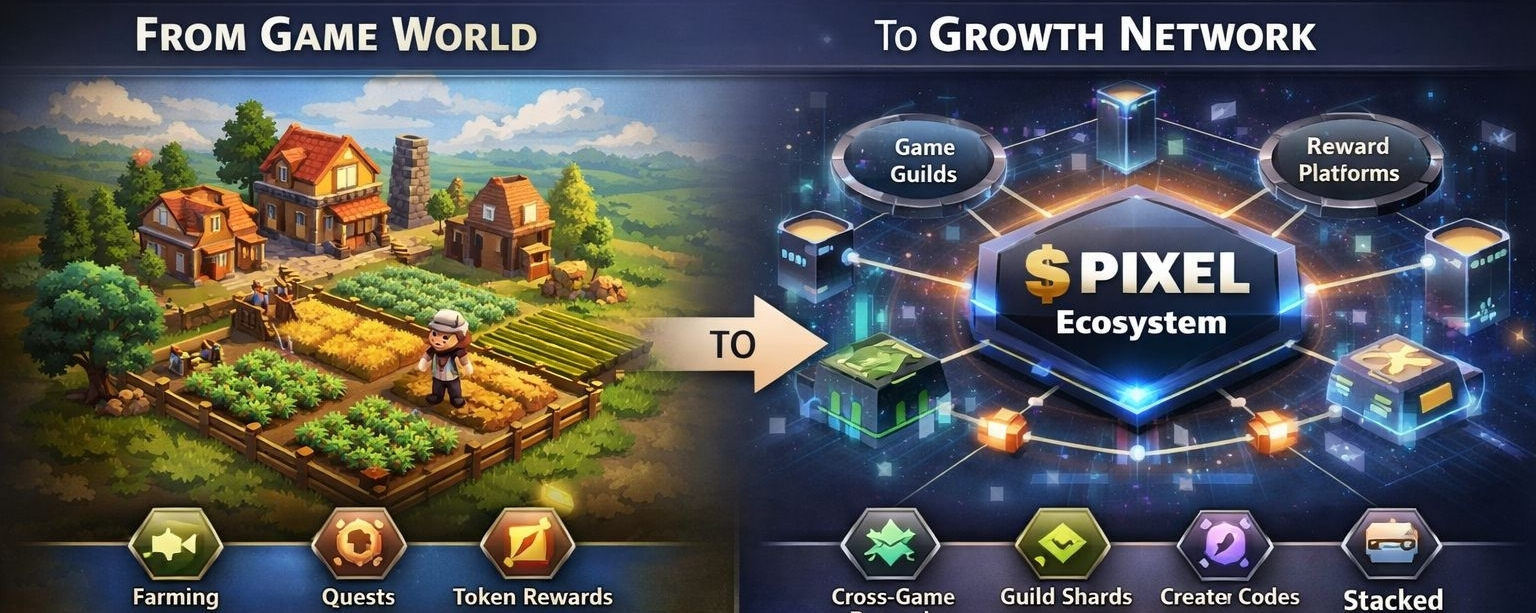

I keep coming back to the idea that Pixels is no longer easiest to understand as just a game world. My old picture of it was simpler: a browser-based farming game on Ronin, with land, quests, and token rewards arranged inside a bright social map. That picture still makes sense, but only so far. The more I look at what Pixels has been doing recently, the more it feels like the bigger story is a move away from a self-contained world and toward something more like a growth network — one that pushes players, money, and attention across games, guilds, creators, and reward loops instead of keeping everything inside a single farm.
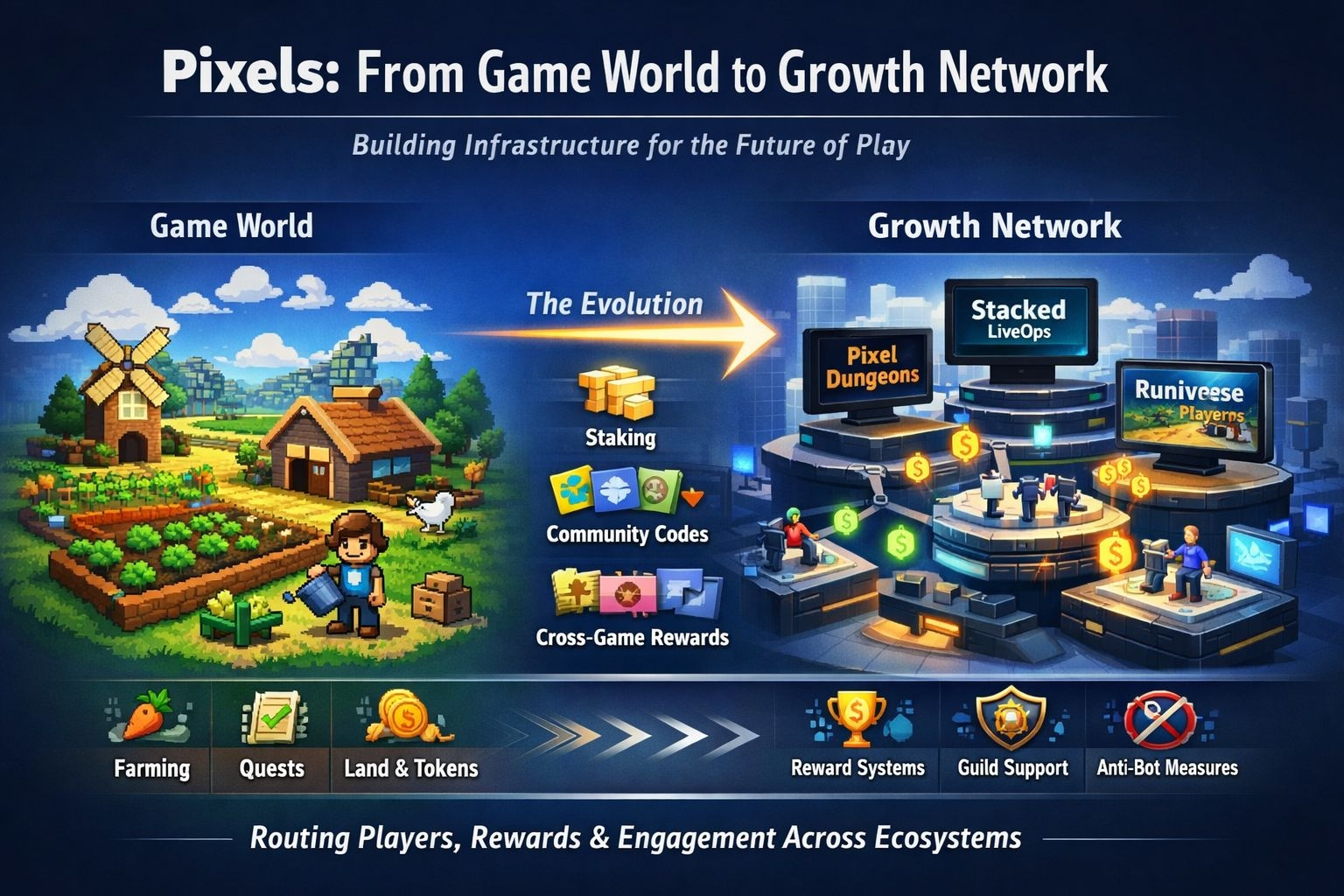
What makes me see it that way is not one dramatic announcement but a series of connected design choices. Pixels’ staking system is no longer framed as support for one game only; the official help pages describe staking $PIXEL into different game projects across the ecosystem. Ronin’s 2025 Runiverse event pushed the same logic further by letting players earn, spend, and claim $PIXEL in another game entirely. Even the smaller community mechanics point in this direction. Creator codes give players a discount while sending a share of the purchase to a creator or a guild treasury, and guild shards let people support a guild financially without that automatically meaning social membership. When I put those pieces together, I stop seeing Pixels as only a place to play and start seeing it as a network that is trying to coordinate communities around shared incentives.
I used to think the interesting part of projects like this was mostly ownership: land, items, wallets, and all the usual web3 furniture. What surprises me now is how much of the serious work is about controlling extraction. Pixels’ own update logs talk openly about tightening reputation systems to strengthen anti-botting measures and combat coin inflation, and about pinning the in-game Coin price at the bank to USDC. Outside coverage of Chapter 2.5 described the bigger trend more bluntly, saying that $BERRY had been replaced by off-chain Coins to reduce inflation and bot abuse. That probably sounds less exciting than farming or trading, but I think it explains why this angle is getting attention today rather than five years ago. The sector is less naive now. DappRadar’s 2025 reporting described a market where dozens of web3 games shut down because of weak retention and unsustainable token models, even while blockchain gaming still averaged millions of daily active wallets. In that climate, people care less about the dream of a “metaverse” and more about whether a game can direct rewards without wrecking its own economy.
That is why Stacked feels important. In official release messaging, Pixels describes Stacked as a rewarded LiveOps engine for games, and Ronin has presented it as a rewards app for players and a rewarded LiveOps engine for studios, built from what the team learned while scaling Pixels. I find it helpful to look at that as the clearest sign of the shift. A game world asks, “How do we keep players inside this map?” A growth network asks, “How do we use what we learned here to route rewards, behavior, and spending across many maps?” Once Pixels starts talking that way, the farm stops being the whole product and starts looking more like the proving ground. Pixel Dungeons fits that pattern too: it is a very different style of game, but it still plugs into the same wider $PIXEL ecosystem.
I do not think that makes the outcome obvious. A network can be more resilient than a single game, but it can also feel more managerial and less magical if every corner of play starts serving growth. That tension feels real to me. Still, the shift itself is hard to miss. Pixels is not abandoning the game world that got people in; it is trying to make that world do a second job. The goal is clearly to make the game enjoyable. But beyond that, it also seems designed to teach the broader system: how to reward participation, how to identify abuse, and how to transfer engagement into the next experience. Whether that proves durable or just temporarily effective is still hard to say. But I think that is the honest reason Pixels matters right now: it is no longer just building a place. It is testing whether a game can become infrastructure.
