I will admit something up front that might sound contradictory. I have a deep, almost instinctual distrust of anything that calls itself "play-to-earn." The phrase alone conjures images of spreadsheets with cartoon skins stretched over them, of clicking the same button ten thousand times while a number in the corner of the screen goes up by fractions of a cent. That was my mental model, my default setting, and it had served me well enough as a filter for the past few cycles. So when I found myself, a grown adult with responsibilities, genuinely upset that I had forgotten to harvest a patch of virtual wheat on a Tuesday afternoon, I knew something about @Pixels had slipped past my usual defenses.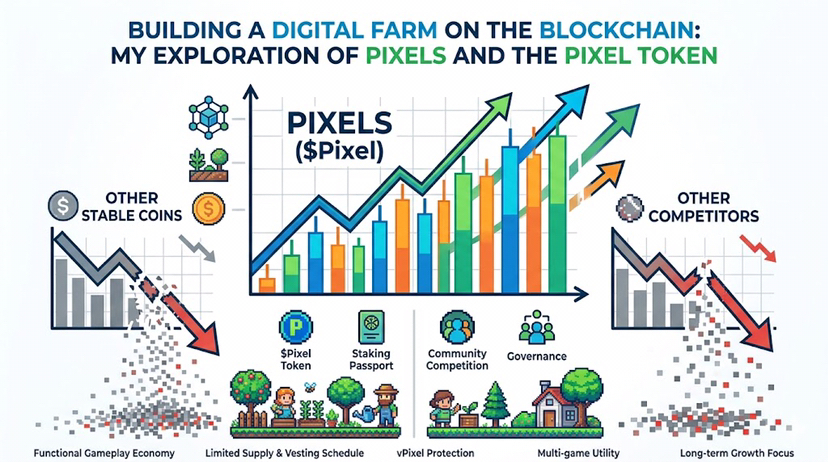
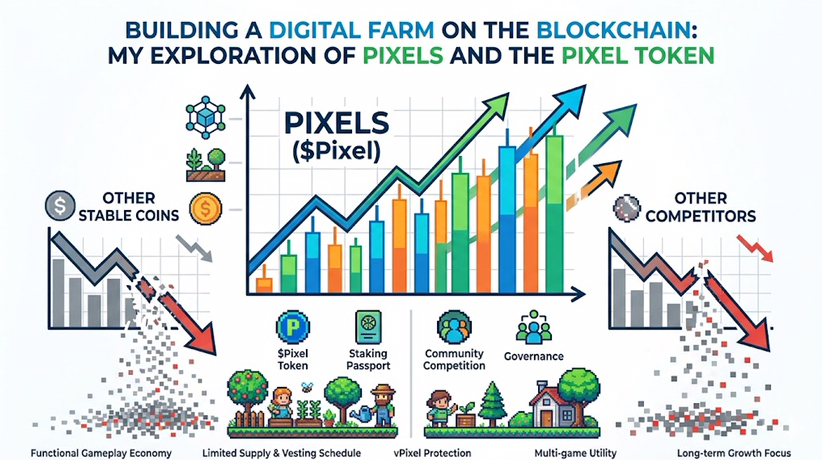
The project operates on Ronin, a chain that has quietly become the default rail for gaming endeavors that actually retain an audience beyond the first airdrop snapshot. And the token at the center of this particular universe is Pixel. I want to talk about that asset not as some ticker on a secondary market watchlist but as a functional piece of the machinery inside the game itself. My exploration here is less about price action and more about architecture. How do you build a digital economy that doesn't eat its own tail within six months?
The blueprint the team has laid out, both in their whitepaper and in the way the live product functions today, offers a few answers that I found surprisingly coherent.
The most glaring piece of data that separates this from the graveyard of failed projects is the supply schedule. I went looking for the tokenomics section not out of excitement but out of a kind of weary due diligence. The total number of Pixel tokens that will ever exist is fixed at five billion. That's the headline figure, but it's the footnote that matters more. As of the middle of April 2026, the actual circulating amount is hovering in the neighborhood of fifteen percent of that eventual total. The remainder is subject to a vesting framework that uses a cliff mechanism extending toward the final quarter of this decade. We are talking about 2029 before the last of the initial allocations hit the open market. In a sector defined by venture capital unlocking forty percent of a supply the moment a transfer restriction lifts, this is a different kind of signal entirely. It suggests a group of developers and backers who are not in a hurry to exit the passenger seat and find the nearest door.
What this slow trickle does to the daily experience of the game is palpable. In previous virtual worlds I've inhabited, the token you earned for completing a quest felt like a melting ice cube. You rushed to swap it for something stable because you knew next week's rewards would be larger and cheaper. Here, the opposite psychology starts to take root. I find myself holding the Pixel I earn through battle pass progression or community tasks. Not because I'm expecting a parabolic chart, but because I've glanced at the roadmap and I understand that the token functions less like a reward and more like a membership credential.
That distinction is critical and it's where the whitepaper's logic actually aligns with the user interface. You don't earn Pixel for breathing in this game. The primary gameplay loops—the farming, the foraging, the crafting of basic items—run on softer, internal resources. The premium token sits a layer above that daily grind. You need it to mint new assets when limited events drop. You need it to unlock the premium tier of a seasonal pass that houses the more desirable cosmetic upgrades. You need it to change your affiliation within the Union system if you decide you've backed the wrong horse in a community competition.
Spending fifty Pixel to switch sides isn't a trivial expense;
it's a small friction point that makes the social fabric of the game feel slightly heavier, slightly more consequential.
There is also a quiet evolution happening in the background that I think gets overlooked because it hasn't been accompanied by a massive marketing blitz. The team has been discussing the introduction of a new currency layer called vPixel. The plan, as I understand it from the developer notes and public AMA summaries, is to create an asset backed one-to-one by $USDC Pixel but with a crucial restriction. You cannot send it to an exchange. You cannot swap it on a decentralized pool. It exists solely within the game's economy to be spent or staked. This is a counterintuitive move. It deliberately limits liquidity, which in the traditional finance world sounds like a flaw. But in the context of a gaming economy that wants to avoid being drained by speculators who have no interest in owning a pixelated farm, it reads as a protective measure. It funnels value back into the actual play environment rather than letting it leak out into the wider crypto sewer.
Looking further out, the multi-game staking plan adds another layer of utility that I'm cautiously optimistic about. The idea is that a single $Pixel token won't just unlock features in the original farm game; it will serve as a passport across a portfolio of interconnected titles. I've seen this ambition before, usually from teams that haven't finished their first product. The difference here is that the first product actually exists, runs well, and has a stable base of people who log in daily to water their crops. That foundation gives the staking roadmap a bit more credibility than the typical vaporware promise.
Of course, I'm not here to write a love letter without acknowledging the cracks in the foundation. The ecosystem is still young. With such a large portion of the supply locked and waiting, the market can be nudged by a relatively small amount of volume. The transition toward a staking-dominant model is technically complex and carries the risk of alienating users who prefer a simpler, more liquid experience. And the general mood of the wider crypto environment always casts a shadow over any project, regardless of its internal merits.
Yet despite those caveats, I keep finding myself back in the game. I keep noticing the way the development updates in the official blog focus almost exclusively on game mechanics—new crop varieties, new building blueprints, new ways to interact with other players—rather than token price or partnership announcements. In a recent community conversation, the founder was asked directly about short-term value fluctuations. The response was a near-immediate pivot toward product iteration and sustainable growth. That kind of discipline is rare, and frankly, it's the only reason I'm still writing about this space at all.
Pixels and the Pixel token represent a wager that if you construct a place where people genuinely want to spend an hour decompressing after work, the economic layer will sort itself out over time. It's a bet on patience. And in my own small way, by holding onto the tokens I've accumulated and by keeping that beet patch watered, I suppose I've placed a tiny side bet on that same outcome. #pixel $PIXEL