
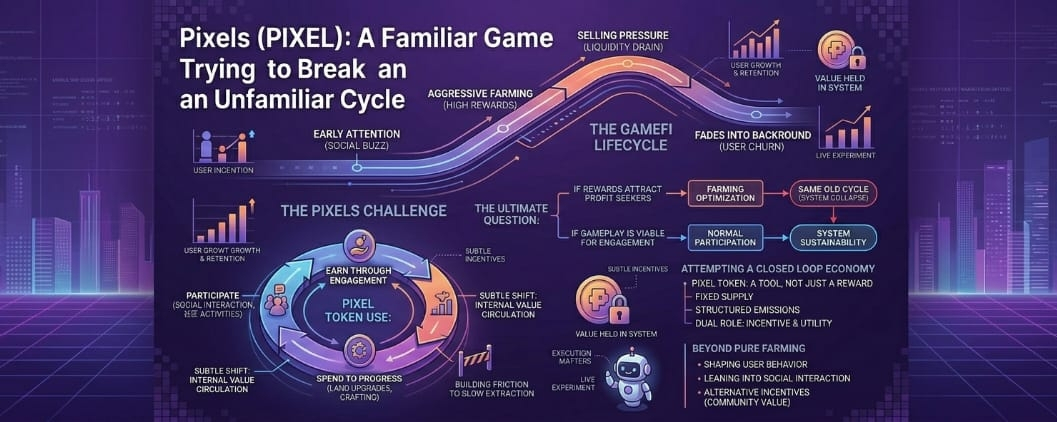

At first glance, Pixels looks like something I’ve already seen play out more times than I can count. A soft, charming farming game wrapped in Web3 mechanics, backed by a token, and quietly building momentum through social buzz. It’s the kind of setup that usually follows a predictable script: early attention turns into aggressive farming, farming turns into selling pressure, and eventually the whole thing fades into the background as users move on to the next opportunity. That pattern isn’t a theory anymore—it’s practically the default lifecycle of GameFi.
So naturally, the instinct here is skepticism.
Pixels doesn’t immediately try to fight that impression either. The surface-level experience is intentionally simple. You plant crops, gather resources, complete tasks, and slowly expand your presence in the game world. It’s approachable, almost disarmingly casual. There’s no steep learning curve, no overwhelming mechanics, nothing that screams technical innovation. And that’s exactly why it’s easy to underestimate what it’s trying to do underneath.
Because the more time you spend looking at it, the more it starts to feel like the simplicity is deliberate.
The core loop is straightforward, but it’s structured in a way that subtly reshapes player behavior. You earn rewards through activity, but you’re not simply encouraged to extract those rewards and leave. Instead, the system constantly nudges you to reinvest them back into the game. Whether it’s speeding up progress, upgrading land, crafting items, or unlocking new layers of interaction, the design pushes you toward participation rather than exit. It’s not forcing you to stay—but it’s definitely trying to make staying feel like the better option.
That’s where Pixels begins to separate itself, at least in intention.
Most Web3 games struggle because value flows in one direction. Players earn, then sell. Liquidity drains out faster than it comes in, and the system collapses under its own incentives. Pixels seems aware of that failure mode and is attempting to build friction into the process. Not enough to frustrate users, but enough to slow down the cycle of immediate extraction. The idea is to create a loop where value circulates internally before it ever reaches the point of being sold.
It’s a subtle shift, but an important one.
The PIXEL token itself doesn’t look revolutionary on paper. It has a fixed supply, a structured emission schedule, and allocations that resemble what you’d expect from a typical GameFi project. If you stop there, it’s easy to dismiss it as more of the same. But the nuance lies in how the token is actually used. It’s not just a reward—it’s a tool that connects different parts of the ecosystem. You earn it through engagement, but you’re also expected to spend it to progress, to participate, and to access deeper layers of the game.
That dual role matters more than it seems at first.
There’s also a noticeable effort to shape user behavior beyond pure farming. Pixels leans into social interaction in a way many Web3 games claim to but rarely execute well. Land ownership, shared spaces, and community-driven activities introduce a layer where value isn’t just tied to how efficiently you can extract rewards, but also to how you engage with others. It doesn’t eliminate optimization strategies—nothing ever does—but it creates alternative incentives that feel closer to actual gameplay than pure yield farming.
Still, it’s worth being honest about the limitations.
If the rewards are attractive enough, people will find ways to optimize for profit over experience. That’s not a flaw unique to Pixels—it’s a fundamental reality of any system with financial incentives. The real test isn’t whether farming exists, but whether the game can make normal participation competitive with it. If playing the game as intended feels viable compared to exploiting it, then the design is doing its job. If not, the same old cycle will reappear, just in a slightly different form.
Economically, Pixels is trying to walk a difficult line. It’s aiming for something that resembles a closed loop, where value is constantly reused within the ecosystem instead of immediately leaking out. But no system is truly closed. Value still needs to come from somewhere, whether it’s new players, external capital, or sustained interest over time. If that inflow slows down, the entire structure becomes fragile. Internal circulation only works as long as there’s something feeding into it.
That’s where execution becomes everything.
There are encouraging signs. The game has managed to attract real users, not just speculative attention. Its integration into the Ronin ecosystem gives it infrastructure and reach that many projects never achieve. And perhaps most importantly, it doesn’t feel like it’s rushing. The pacing, the design choices, and even the economy suggest a team that understands the usual pitfalls and is trying—carefully—to avoid them.
But understanding the problem and solving it are two very different things.
Pixels doesn’t reinvent Web3 gaming. It doesn’t introduce a completely new model or radically change the rules. What it does instead is more subtle. It takes the existing playbook and tries to adjust the incentives just enough to make the system behave differently over time. Whether that’s enough is still an open question.
Because in the end, this space doesn’t reward good intentions. It rewards systems that hold up under pressure.
Right now, Pixels feels less like a finished success story and more like a live experiment unfolding in real time. One that’s clearly aware of the mistakes that came before it, and is making a genuine attempt to move past them. That alone makes it worth paying attention to.
But it’s still early.
And in Web3 gaming, early optimism has a habit of being tested sooner rather than later.