
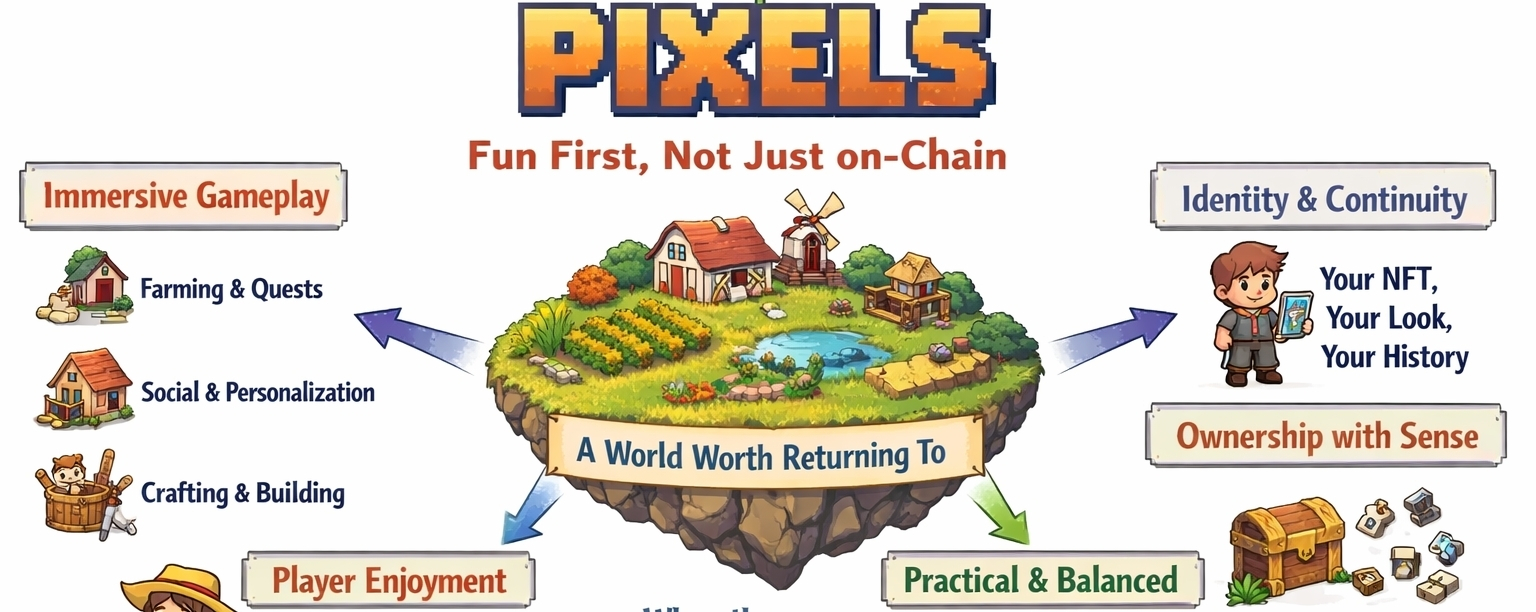
The more I look at Pixels the less it feels like a project obsessed with proving how
on_chain it is.
That is probably what makes it more interesting than a lot of blockchain games that talk louder.
There is a certain type of crypto game pitch that people know by now. It starts with ownership, moves quickly into decentralization, and treats the technology stack like the main event. The player is almost an afterthought in that version. The game exists, but mostly as a delivery system for a broader thesis. You can feel when that is happening. The language gets cleaner than the product. The architecture starts sounding more alive than the world itself.
Pixels doesn’t fully read like that to me.
What it seems to understand, maybe more than some of its peers, is that players do not stay because a design diagram is elegant. They stay because the place gives them a reason to return that is small, repeatable, and emotionally legible. A task to finish. A space to improve. A habit to fall into. Something to build on. Something to check. Something that feels slightly different today than it did yesterday.
That sounds obvious until you remember how many projects skipped that part and went straight to token logic.
What I find notable in Pixels is not that it mentions blockchain interoperability or decentralization. Of course it does. The more revealing part is the order of importance. It comes across like a project that knows a game cannot be rescued by infrastructure if the underlying experience feels thin. And honestly, that should be a basic lesson by now, but in this category it still isn’t.
The phrase “fun first” can sound disposable when you first see it. Every game says some version of that. But in crypto, it actually carries more weight than people give it credit for. It is not just a soft branding choice. It is almost a refusal. A refusal to let the reward layer become the only story being told.
That matters because once incentives become the headline, the shape of the whole world starts changing around them. Players stop asking whether something is enjoyable and start asking whether it is worth the time. Designers stop protecting the texture of the game and start tuning the output of the machine. The difference between those two mindsets is huge, even when the mechanics on paper look similar.
That is where so many blockchain games became strangely fragile. They were built to be used before they were built to be liked.
Pixels at least seems aware of that trap. It presents itself less like a financial system wearing a game skin and more like a game trying to figure out how ownership can add depth without swallowing everything else. I think that distinction is important. There is a huge gap between “ownership exists here” and “ownership is the center of meaning here.” A lot of projects blur that gap on purpose. Pixels, from the way it frames itself, seems more careful about it.
And that care shows up again in how it approaches decentralization.
The internet is full of projects that treat full decentralization as a kind of moral performance. Everything has to be pushed on-chain as quickly as possible because otherwise the ideology looks compromised. The problem is that players feel the cost of that long before they feel the elegance of it. They feel slowness. They feel friction. They feel the awkwardness of systems that were designed to satisfy a theory rather than support a living game.
Pixels seems more practical than doctrinal on this point. The message is not really “everything belongs on-chain now.” The message feels closer to “put the right things on-chain when doing so actually improves what the player owns, trusts, or carries with them.” That is a much more grounded position. It also sounds like a team that knows the difference between what is impressive in a whitepaper and what is sustainable inside a real product.
That kind of selectiveness makes sense to me.
A farming-and-quest world with land systems, crafting, social interaction, progression, personalization, and economic balancing is not a clean lab environment. It is messy by nature. It changes. It needs tuning. It needs responsiveness. If every part of that system is treated like it must become permanent too early, the game loses room to breathe. So when Pixels leaves some mechanics server-side while keeping ownership more legible, that does not strike me as compromise in the weak sense. It strikes me as product discipline.
The same goes for interoperability, which is another concept this space likes to flatten.
A lot of projects talk about interoperability as if simple asset portability is already a breakthrough. But moving an item between environments is not automatically meaningful. It only becomes meaningful when the item carries some memory, identity, or recognition with it. Otherwise it is just technical transport. The harder problem is not whether an asset can travel. The harder problem is whether a person feels continuous across digital spaces in a way that actually matters to them.
That is the version of interoperability that seems more alive in Pixels.
Not just “bring your NFT. More like: can your presence, your look, your sense of self, your visible history, your digital familiarity survive the jump from one environment to another? That is a much richer ambition. It shifts the conversation away from raw ownership and toward continuity. And continuity is closer to what people actually notice. Most users do not wake up hoping for better asset standards. They want their time, taste, and identity to accumulate into something that is not erased every time they move.
That is where Pixels starts to feel less like a single game and more like a broader design position.
Still, I don’t think this should be romanticized too quickly. There is a difference between having the right instincts and fully solving the tensions those instincts point to. A world can say it values fun first and still drift toward optimization pressure. A platform can talk about identity portability and still end up reducing that identity to visible assets. A project can embrace gradual decentralization and still discover that “gradual” becomes a permanent excuse for keeping meaningful control centralized.
Those are real tensions. They do not disappear just because the framing is better.
But better framing does matter, especially in a category that spent too long celebrating abstractions and calling them progress.
What makes Pixels worth paying attention to, at least from where I’m sitting, is that it seems less intoxicated by the technology than many of the projects around it. It does not come across like it wants to force a player to admire the plumbing. It seems more interested in whether the world itself can hold attention without constantly leaning on the token layer for significance.
That is a healthier starting point.
Because eventually every blockchain game gets asked the same uncomfortable question, whether it wants to answer it or not: if the speculative energy faded for a while, what would still be left that people genuinely cared about?
A lot of projects never survive that question.
Pixels, at least in how it thinks about itself, seems to know that this is the real one. Not how much can be moved on-chain. Not how quickly the system can be decentralized in theory. Not how elegantly ownership can be described in a pitch.
Just this: when the noise dies down a little, is there still a world here people would choose to stay in?
That is a much harder standard. It is also probably the right one.