

I didn’t expect much when I first looked at @Pixels
It felt like every other farming game plant something, wait, harvest, sell, repeat.
Simple loop. Low effort. Easy entry. The kind of thing you play casually and forget later.
But the more time I spent in it, the more I realized… this isn’t just a game loop. It’s the front door to something much deeper.
At the beginning, everything feels light:
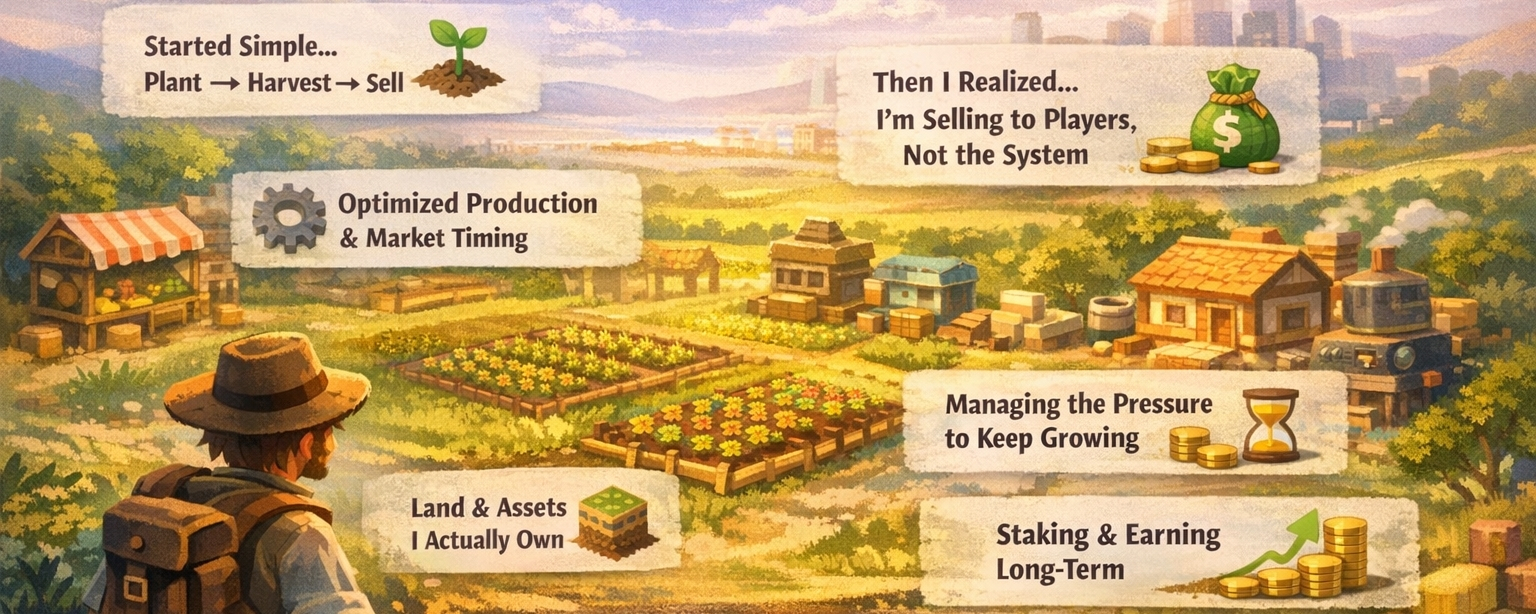
Plant → Grow → Harvest → Sell
Quick rewards, simple actions
No complexity, no pressure
That’s what makes onboarding smooth. Anyone can jump in and feel like they’re progressing.
But this loop isn’t the destination.
It’s the setup.
The Moment It Stops Feeling “Basic”
The shift happens when you notice one thing:
You’re not selling to the system.
You’re selling to other players.
And suddenly:
Prices aren’t fixed
Demand actually matters
Timing starts affecting your earnings
You begin to realIze that what you produce isn’t just game output it’s part of a live market.
That’s where Pixels separates itself. Most GameFi tries to simulate economies. Pixels lets one naturally form.
How Income Actually Starts Building
At first, I thought earning was just about grinding more.
But that’s not really how it works
Real progression starts when you move into layers:
Production thinking → optimizing what you grow and how efficiently you run your land
Market awareness → not selling instantly, but understanding when prices make sense
System building → using land, machines, and setups to scale output
At that point, you’re not just playing anymore.
You’re managing decisions.
The Ownership Shift
This is where it got interesting for me.
In most games, ownership is temporary. You upgrade things, but nothing really belongs to you in a meaningful way.
Here, ownership starts to feel… real.
Land isn’t just cosmetic
Slot systems limit and define your capacity
Assets directly affect your earning potential
And slowly, the experience changes.
It stops feeling like “I’m playing a game”
and starts feeling like
I’m running something.
The Pressure No One Talks About
This part surprised me the most.
As systems grow land, machines, staking, production there’s a quiet pressure that builds.
Not aggressive. Not forced. But it’s there.
You feel the need to stay active
You think about efficiency more often
You start planning instead of just playing
It becomes less about passing time…
and more about maintaining momentum.
That’s the moment where the line starts to blur.
The Hidden Layer Staking & Growth Thinking
Another thing that changed my perspective was realizing that not all earnings are active.
There’s a background system working quietly:
Holding and staying active is rewards
No manual staking needed
Long term growth depends on consistency
And honestly, most players miss this.
They earn → sell → repeat.
But the real edge comes from understanding:
growth > quick profit
So… Is This Still a Game?
That’s the question I keep coming back to.
Because Pixels doesn’t feel like a typical game anymore.
It feels like:
A system you participate in
A market you influence
A structure you grow inside
And maybe that’s the point.
Maybe games are slowly becoming more than entertainment.
Maybe they’re turning into small digital economies where behavior, strategy and time actually matter.
I’m not fully sure where that line is yet.
But Pixels is definitely sitting right on it.
And that’s exactly why it’s hard to ignore.