

There’s a phase every system hits where nothing is technically broken… but something feels off.
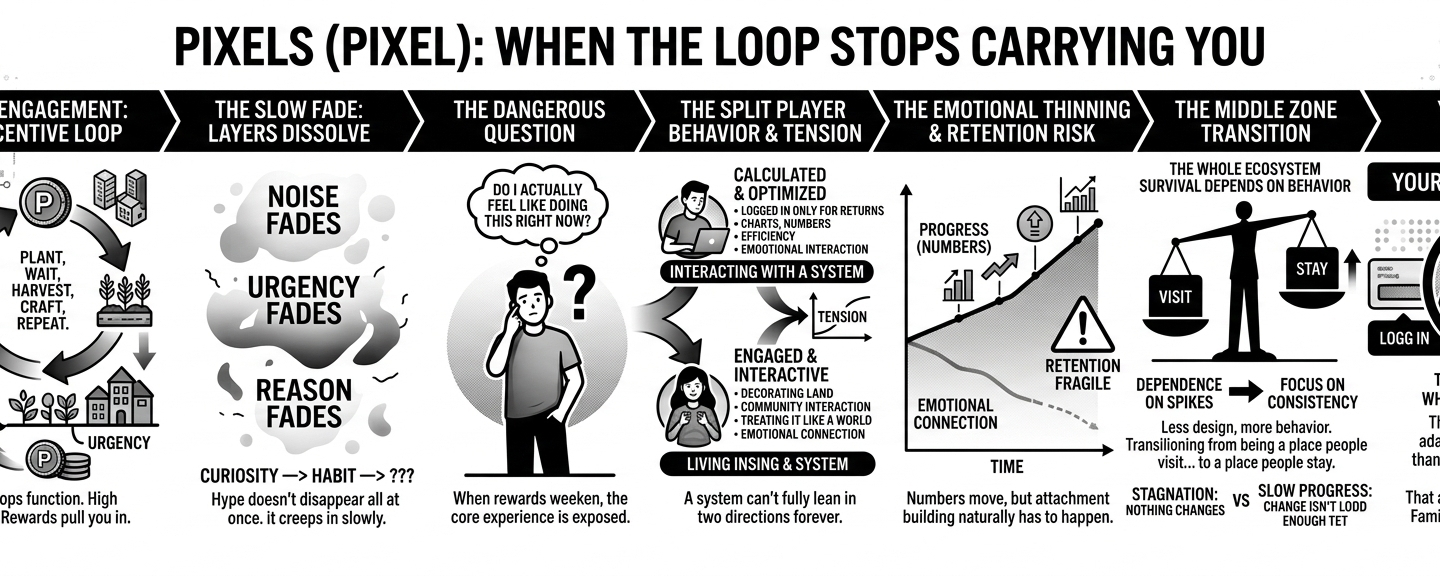
I felt it again logging into Pixels recently. Not frustration. Not boredom. Just a quieter version of the same routine. Plant, wait, harvest, craft. Repeat. The loop still works. But it doesn’t pull you in the same way anymore.
And that difference matters more than people think.
Because hype doesn’t disappear all at once. It fades in layers. First the noise goes. Then the urgency. Then the reason.
I didn’t notice it immediately. It crept in slowly. One day you log in out of curiosity. A few days later, it’s just habit. Then eventually, you pause for a second and ask yourself… do I actually feel like doing this right now?
That question is dangerous. Not because it kills the game instantly, but because it exposes what’s left when incentives weaken.
Pixels was always built on simplicity. That was its strength. No complicated mechanics, no overwhelming systems. Just a clean loop that anyone could understand. But simple systems don’t have much to hide behind. When the reward layer softens, you’re left face to face with the core experience.
And right now, that experience is being tested.
I’ve seen different types of players reacting to this phase. Some are still deeply engaged, decorating their land, interacting, treating it like a world. Others are more calculated, logging in only when it makes sense, optimizing what’s left of the returns.
Both behaviors exist at the same time. And that split creates tension.
Because a system can’t fully lean in two directions forever.
At one point, I leaned heavily into efficiency. Tracking cycles, maximizing output, trying to get the most out of every session. It worked. Progress felt measurable. But over time, it also started to feel mechanical.
Like I was interacting with a system… not living inside one.
That’s where the shift happens. Quietly.
The numbers still move. The economy still flows. But the emotional connection starts thinning out. And once that happens, retention becomes fragile in ways charts don’t show.
Pixels isn’t failing. But it’s not coasting either.
It’s in that middle zone where survival depends less on design and more on behavior. Not what the game offers, but why players choose to stay.
That’s a harder problem.
Because you can adjust rewards. You can tweak sinks. You can rebalance progression. But you can’t force attachment. That has to build naturally, over time, through small moments that make logging in feel normal instead of necessary.
Right now, it feels like Pixels is trying to transition into that. Less dependence on spikes. More focus on consistency. That’s the right direction. But it’s also slower, less visible, and harder to measure.

And in Web3, slow progress often gets mistaken for stagnation.
But they’re not the same thing.
Stagnation is when nothing changes. Slow progress is when change just isn’t loud enough to notice yet.
The real question is whether players stick around long enough to feel that difference.
Because without constant inflow, systems rely on something deeper than rewards. They rely on routine. Familiarity. A sense that even if nothing big happens today, it’s still worth showing up.
That’s not easy to build. And most projects never reach it.
Pixels might. Or it might not.
Right now, it’s balancing between being a place people visit… and a place people stay.
And those are two completely different outcomes.
So when you log in today, pay attention to that first second.
Not what you do. But why you’re doing it.
Because that answer tells you more about the future of the system than any metric ever will.
#pixel @Pixels $PIXEL $MYX $MBOX
#CZ’sBinanceSquareAMA #BitcoinPriceTrends #CryptoMarketRebounds #USInitialJoblessClaimsBelowForecast 
#pixels