
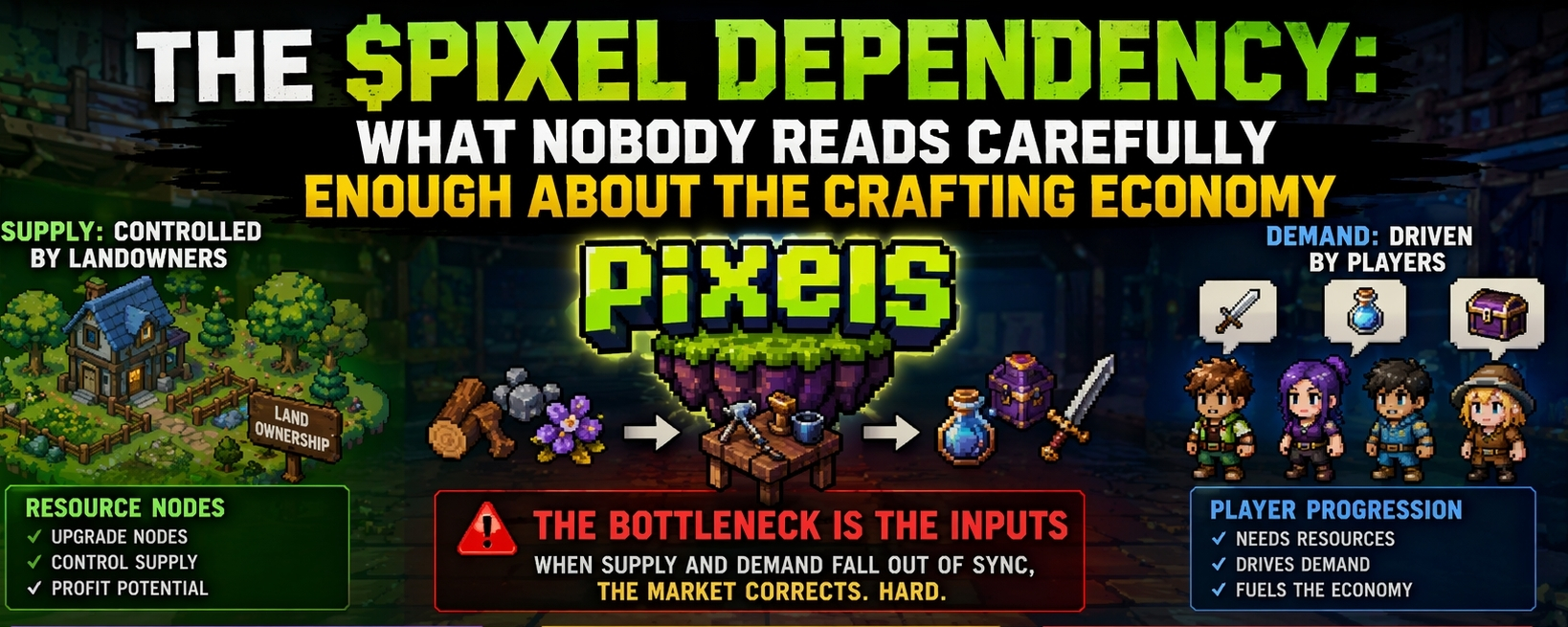
Man, I gotta be honest... I wasn't expecting to fall down this specific rabbit hole when I started looking into how Pixels structures its crafting and resource loop.
It’s not exactly skepticism or alarm. It’s more like that sinking realization you get when a "player-driven economy" is actually built on a massive dependency chain that most people jumping in haven't even tried to map out.
Web3 games have this habit of pitching crafting as pure, player-driven value creation. "Gather stuff, combine it, sell what people need." We just accept it. But a crafting economy in a play-and-own game is wildly different from something like WoW or Runescape. The items you make aren't just for leveling up your character—they feed directly into a live market where prices and demand are completely at the mercy of the entire player base fighting over the exact same resource pool.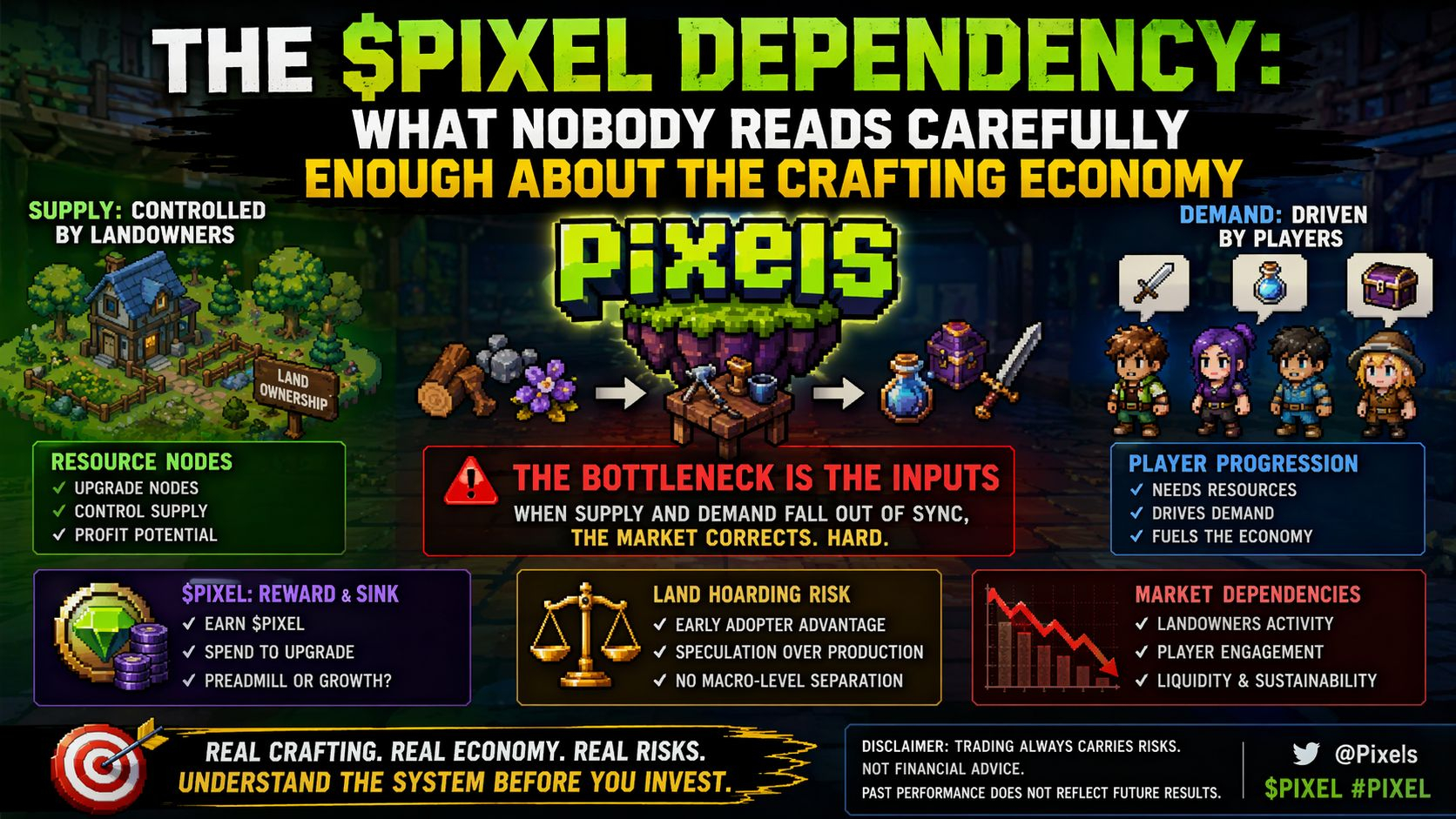
Don't get me wrong, what Pixels built is legit. Resource nodes are tied to land, recipes actually burn harvestable inputs, and the $PIXEL sinks for upgrades are real. The economy has actual interdependencies. It’s way more sophisticated than 99% of the blockchain games shipping right now.
So yeah, the crafting is real. But crafting was never the hard part.
The real bottleneck is the inputs. And this is the giant elephant in the room nobody seems to be looking at closely enough.
Think about it: raw materials mostly come from land. Landowners control the nodes and upgrade paths. F2P players rely on public spots and quests to get by. But what guarantees that supply will match demand? Supply depends entirely on how many landowners actually bother to run their nodes. Demand depends on players actively progressing through content. When those two curves inevitably fall out of sync, nothing in the whitepapers really explains what happens during the market correction.
And then, of course, we have to talk about liquidity.
This is where it gets tough to ignore. Pixel is the reward token and the primary sink currency. You earn it, but you also have to spend it to upgrade your land and keep producing. If you're earning $PIXEL and immediately reinvesting it just to keep your setup running, are you actually accumulating value, or are you just running on a treadmill? The tokenomics docs acknowledge this structure but neatly sidestep a direct answer.
There’s also an uncomfortable truth nobody really says out loud: the game is designed around land as the productive engine of the economy, but land is heavily hoarded by early adopters with the capital to buy in early. A healthy crafting economy needs landowners to actively farm, but holding land purely as a speculative asset is just as rational of a move. The system doesn't really have a mechanism to separate the two behaviors at a macro level.
All that being said, I have to give them credit.
Deciding to build a genuine crafting economy instead of a lazy "click-to-earn" token faucet shows a serious commitment to depth. A game where player choices actually impact market conditions is infinitely more interesting than a system where everyone earns at a flat, fixed rate. The resource interdependency creates actual, meaningful gameplay.
The real question is: do the people throwing money at land or inventory actually understand this full dependency chain? Or are they just treating it like a standard yield farm?
Because let's be real—realizing you misunderstood the economy hurts a lot more after you've dropped serious capital on a plot expecting passive yield, compared to when you're just sitting on the sidelines figuring out if the math makes sense for you.
Disclaimer: Trading always carries risks. Not financial advice. Past performance does not reflect future results.