
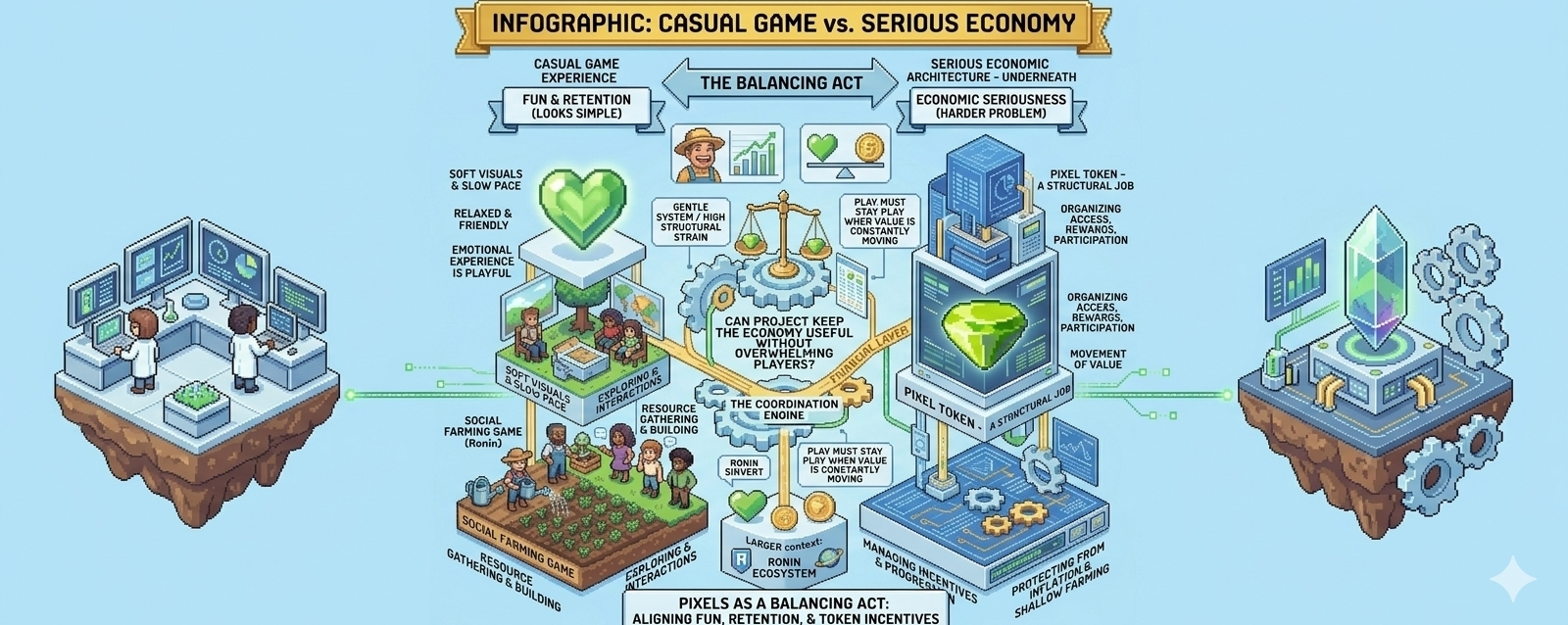
When I first looked at Pixels, I honestly did not think of it as a serious economic experiment. I saw the farming, the soft visuals, the slow pace, and my first instinct was that this was just another friendly Web3 game trying to make crypto feel more approachable. It looked light. Almost harmless. But the more I thought about it, the more I felt that first reaction was too shallow. In my opinion, Pixels is interesting precisely because it looks simple while carrying a much harder problem underneath.
What I think many people miss is that casual games with tokens are not easier to build. They are harder. A game like Pixels has to feel relaxed on the surface, but underneath it still has to manage incentives, progression, reward pressure, and player behavior in a way that does not break the experience. To me, that is the real challenge. Pixels is not just trying to make a game people enjoy. It is trying to make an economy function inside a world that does not want to feel like an economy all the time.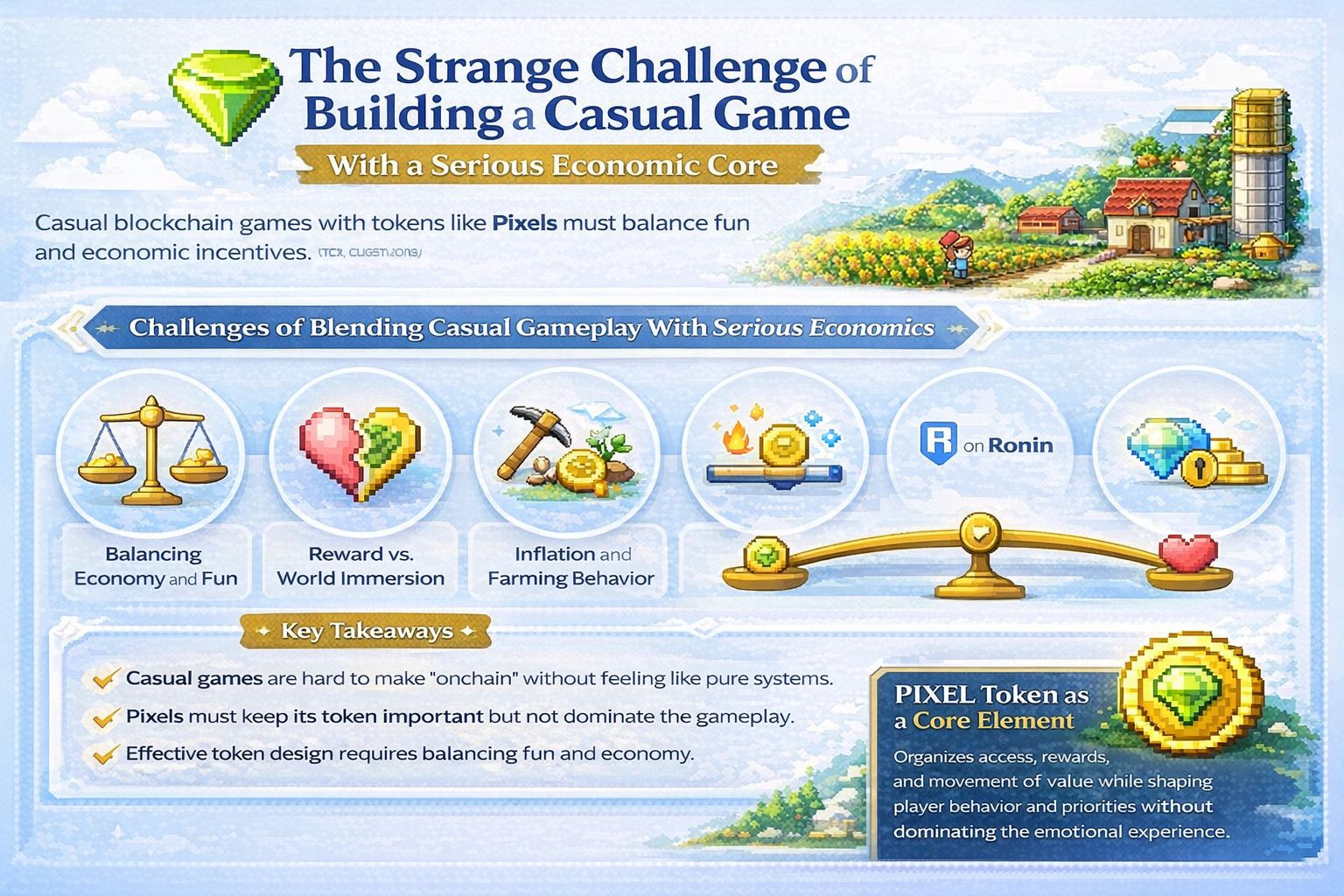 That tension is what keeps pulling me back to the project. On the surface, Pixels is easy to understand. It is a social farming game on Ronin where people gather resources, build, explore, and interact. But underneath, I think it is doing something much more delicate. It is trying to align fun, retention, and token incentives without letting the financial layer become too visible. And in my view, that is where most GameFi projects quietly fail. They start out talking about community and gameplay, but sooner or later the reward structure becomes the main character. Once that happens, the game stops feeling like a world and starts feeling like a system people are trying to extract from.
That is why I do not really see Pixels as just a cozy onchain game. I see it as a balancing act. The project has to make the token matter, because if the token has no meaningful role then the economy feels thin and artificial. But it also cannot let the token dominate the emotional experience, because the moment players start seeing everything through the lens of optimization and return, the softness of the world begins to disappear. In my opinion, that is the strange difficulty at the center of Pixels. It needs economic seriousness without making the player constantly feel economic stress.
I also think this is why the PIXEL token matters in a more structural way than people often admit. A lot of projects talk about token utility in a generic way, and I usually find that language pretty empty. But here, I think the token has a real job. It helps organize access, rewards, participation, and the movement of value through the system. That matters because it shapes how players behave, what they prioritize, and how deeply they stay connected to the game. At the same time, that is also the risk. The more effective a token becomes at directing behavior, the more likely it is to make players feel that every action has been turned into an economic decision.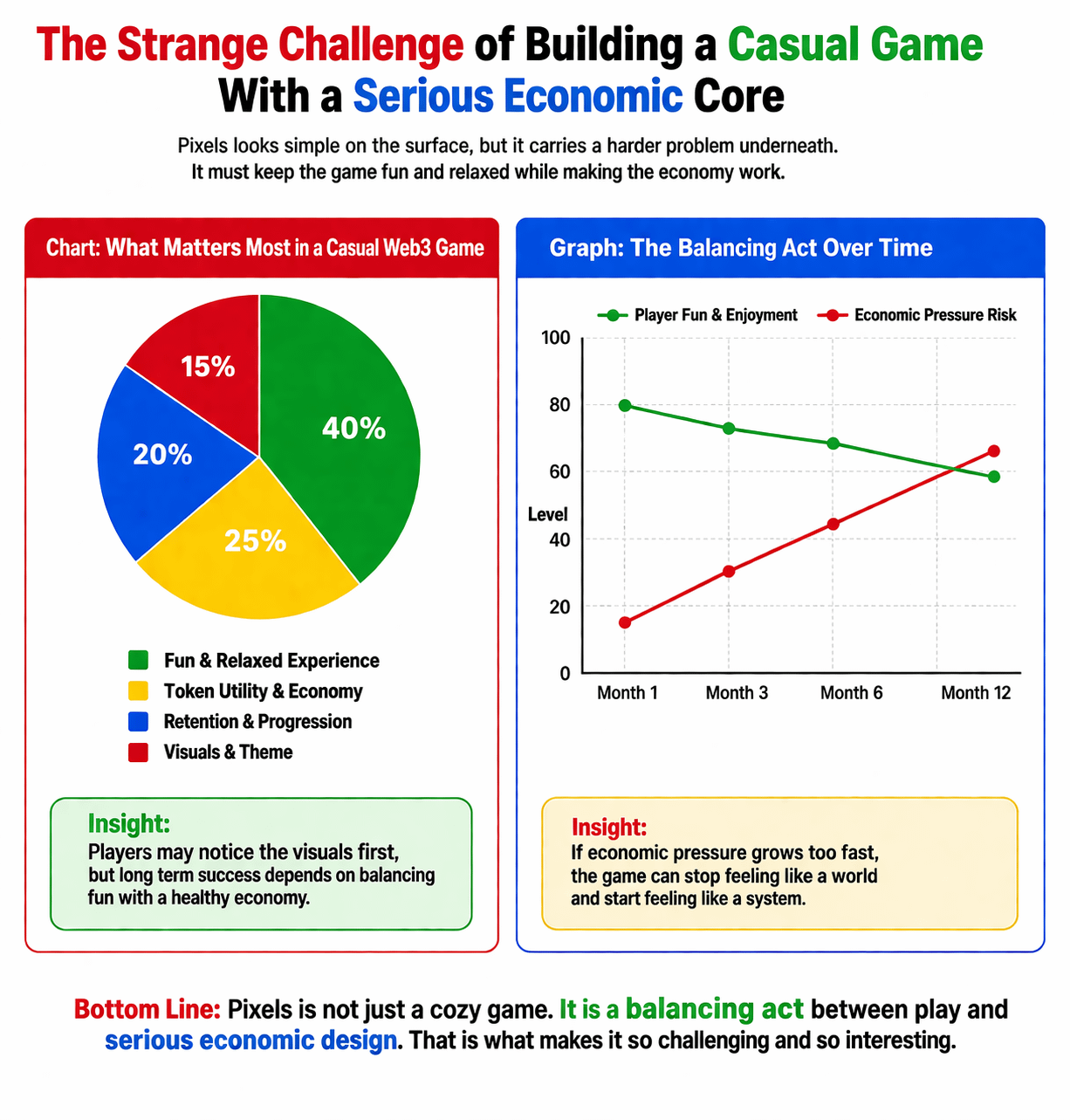 Personally, that is the part I find most fascinating. Pixels looks warm, but the design problem underneath it is cold and precise. The game can feel welcoming, yet the system still has to protect itself from inflation, shallow farming behavior, and the constant temptation to let rewards do too much of the work. In my view, this is where casual-looking crypto products often get misunderstood. People assume soft presentation means soft pressure. I think the opposite is often true. Sometimes the gentlest-looking systems are the ones under the most structural strain.
I also think Pixels matters because it sits inside a larger Ronin ecosystem that is trying to prove blockchain gaming can become something more durable than a short cycle of hype and token speculation. That context matters to me because it makes Pixels feel less like an isolated experiment and more like a real test case. If it works, it strengthens the argument that a game can be socially inviting while still carrying serious economic architecture. If it does not, then it becomes another reminder that financial incentives are very good at overpowering playful environments over time.
My honest view is that Pixels is most interesting when it is treated as a design problem, not just a game and not just a token. I do not think the core question is whether the visuals are attractive or whether the token has market activity. The deeper question, at least to me, is whether a project like this can keep the economy useful without letting it become emotionally overwhelming. Can the system support the world without exposing too much of itself. Can play stay play when value is constantly moving underneath it.
I am not fully convinced any project has solved that yet. But I do think Pixels is closer to the real problem than many others. That is why I keep coming back to it. Not because it looks soft, but because I think that softness hides one of the hardest coordination problems in Web3 gaming.
@Pixels $PIXEL #pixel