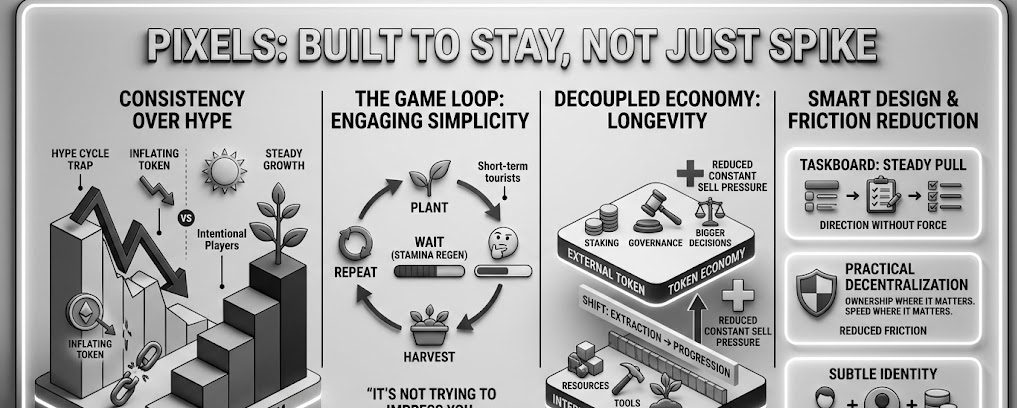

Here’s what most people still don’t get about Pixels… it didn’t win because it was better at launch. It won because it stayed consistent when everything else burned out.
While other Web3 games were chasing hype cycles, inflating tokens, and collapsing under their own emissions, Pixels just kept doing the unglamorous work. Adjusting systems. Tightening loops. Making sure that when someone logged in today, it felt slightly better than yesterday.
And yeah, I’ve spent enough time in it to notice the difference.
At the start, it’s almost laughably simple. You plant. You wait. You harvest. You run out of energy. Then you just… sit there for a second. Thinking about your next move while your stamina ticks back up. It shouldn’t be engaging. On paper, it’s repetitive. But in practice, it hooks you in a very specific way.
Because the loop isn’t trying to impress you. It’s trying to keep you.
That’s a very different goal.
One of the biggest turning points was the ecosystem shift. Moving into a player base that already understood grinding, asset value, and long-term progression changed the entire feel of the game. Suddenly, it wasn’t full of short-term tourists jumping in for rewards. It felt more like a system where people actually intended to stay.
You could feel it in the market activity. In player behavior. In how resources moved.
Then there’s the Taskboard. Simple idea, but incredibly effective. It gives you just enough direction to log back in without feeling forced. Not overwhelming. Not empty. Just a steady pull back into the loop.
That balance matters more than people think.
What really stands out though is how the game handles its economy.
Most Web3 titles make the mistake of putting the token front and center. You log in and everything revolves around extracting value as fast as possible. That mindset kills longevity. Players stop playing the game and start playing the system.
Pixels avoids that trap.
You can spend hours inside the game loop without even thinking about the token. And that’s intentional. The day-to-day experience runs on its own internal logic, while the token sits in a more serious layer tied to staking, governance, and bigger decisions.
That separation changes behavior.
When constant sell pressure isn’t baked into every action, players stop rushing. They start optimizing. Building. Planning. The game shifts from extraction to progression.
And that’s where it starts to feel different.
There’s also a subtle identity layer forming. Avatars, assets, small flexes that hint at something bigger. It’s not trying to force a “metaverse” narrative, but it’s quietly building toward the idea that your presence and items might carry weight beyond a single session.
Not fully there yet. But it’s grounded.
Even the approach to decentralization feels more practical than ideological. Not everything needs to be on-chain to prove a point. Ownership where it matters. Speed where it matters. The result is a smoother experience, and honestly, that’s what keeps people around.
Players don’t care about purity. They care about friction.
Pixels reduces friction.
That’s the real reason it’s still here.
It didn’t rely on explosive growth. It built a loop that people don’t mind repeating. A system that doesn’t punish you for staying. And an economy that doesn’t collapse the moment rewards shift.
If you’re looking at it from the outside, it might seem too simple. Too slow. Maybe even boring.
But that’s kind of the point.
Because what looks simple at first is actually stable underneath. And in Web3 gaming, stability is rare.
So the real question isn’t whether Pixels can spike again.
It’s whether this quiet, consistent loop can keep pulling people back day after day, without needing to constantly bribe them to stay.
If it can, that’s where the real value builds.
Not in moments.
In habits.