
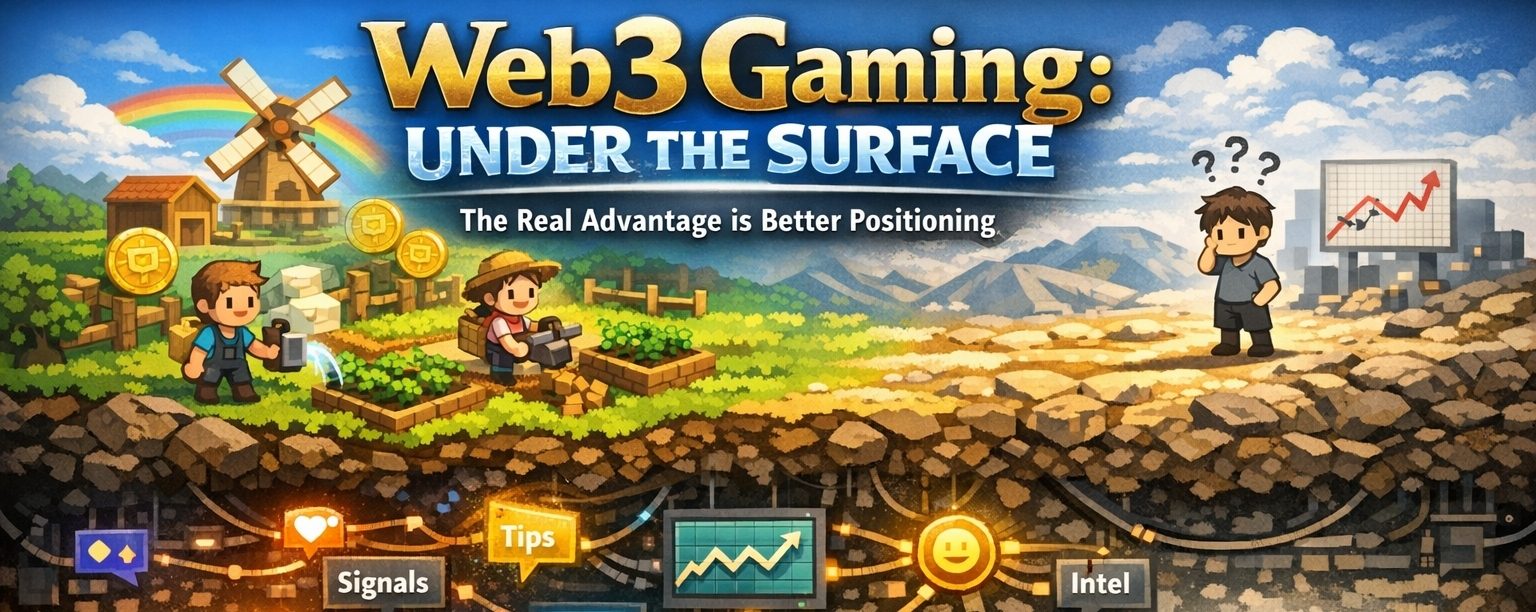
The thing that keeps bothering me in games like Pixels is how often the nicest words are used to describe what is actually a very practical advantage.
A lot of the language sounds harmless enough. Community. Ownership. Participation. Social coordination. Player voice. None of those terms are false, exactly. That is what makes them effective. They describe something real, but they also soften what is happening underneath. And underneath, a lot of these systems are not just rewarding enthusiasm or loyalty or even skill in the simple sense. They are rewarding players who are better positioned inside the game’s information and support structure.
That is a different claim.
In theory, blockchain games like to present themselves as more open than traditional games. You own your assets. You hold the token. You can trade, vote, participate, build, earn. The pitch is clean. The player is not just spending time in a closed world. The player has a stake. Maybe even some agency. That story has appeal for a reason. Compared with older gaming models, it does feel like a meaningful shift.
But once you spend enough time around a live tokenized game economy, the cleaner version of that story starts to feel incomplete.
Because holding an asset and being in a position to use it well are not the same thing.
A player can own the token and still move through the game in a much weaker way than someone with better coordination around them. They can have access, technically, while still carrying more friction, more uncertainty, more bad timing, more expensive trial and error. Another player, with roughly the same surface-level tools, can operate with less waste simply because they are plugged into better signals. Better reads. Better warnings. Better corrections before a small mistake becomes an annoying one.
That is where the tone of these games gets interesting to me. The surface remains friendly, open, almost idealistic. The actual advantage starts looking much more operational.
This is especially obvious in economies where so much depends on timing, sourcing, route efficiency, and knowing when not to do something. That last part matters more than people admit. In these systems, value does not only come from action. It also comes from avoiding the wrong action early enough. Not buying the overpriced input. Not forcing the weak task. Not following the obvious route after it has already become a bad one. A well-connected player avoids those little losses more often, and over time those little losses are not little anymore.
That does not mean the game is broken. It means the real game is wider than the interface.
And honestly, that is where some of my skepticism comes in. Web3 gaming still loves to describe itself in moral language when a lot of its outcomes are shaped by structure. If one player is participating with their own limited read of the board, the market, and the token, while another is participating with a constant stream of shared context from a smarter circle around them, those two players are not really experiencing the same system in the same way. They may be inside the same map. They may even be doing similar tasks. But one is absorbing friction privately, and the other is distributing it across a network.
That is not just community in the soft sense. That is practical insulation.
I do not think that makes the social layer fake. In some ways it makes it more real. People helping each other, sharing resources, passing context, correcting bad decisions before they land — that is meaningful. It is one of the few parts of these ecosystems that actually feels alive instead of purely financial. But it also deserves clearer language. Sometimes what gets praised as community is partly a player-built efficiency layer sitting on top of a rough economy.
That distinction matters because it changes how we think about fairness, governance, and even player ownership.
The same issue shows up again when projects talk about governance as if token access automatically creates meaningful voice. It does not. Voting power is one thing. decision quality is another. A holder with deep knowledge of the game’s live economy, player behavior, and design tradeoffs is bringing something very different to governance than a holder who mostly watches price and votes from distance. Both may count. That does not mean both are equally informed. And yet blockchain projects often flatten that difference because it sounds cleaner to say the community decides.
Sometimes the community decides. Sometimes the most organized, attentive, and economically aligned part of the community decides.
I do not say that as a rejection of the model. There is still something genuinely interesting here. I like that these games experiment with ownership, open economies, and more visible links between player activity and system design. I like that players are not always treated as passive users. There is real ambition in that.
But ambition does not remove the need for honesty.
The more time I spend looking at games like Pixels, the less I think the core divide is between players who own and players who do not. The more important divide is between players who hold assets and players who also have the coordination, context, and support needed to make those assets work in their favor.
That is a more grounded way to look at it.
And maybe a more useful one too. Because once you stop romanticizing the social layer, you can finally see how much of the advantage in web3 games comes from something much less glamorous than the marketing language suggests.
Not just ownership.
Not just participation.
Better positioning inside the mess.