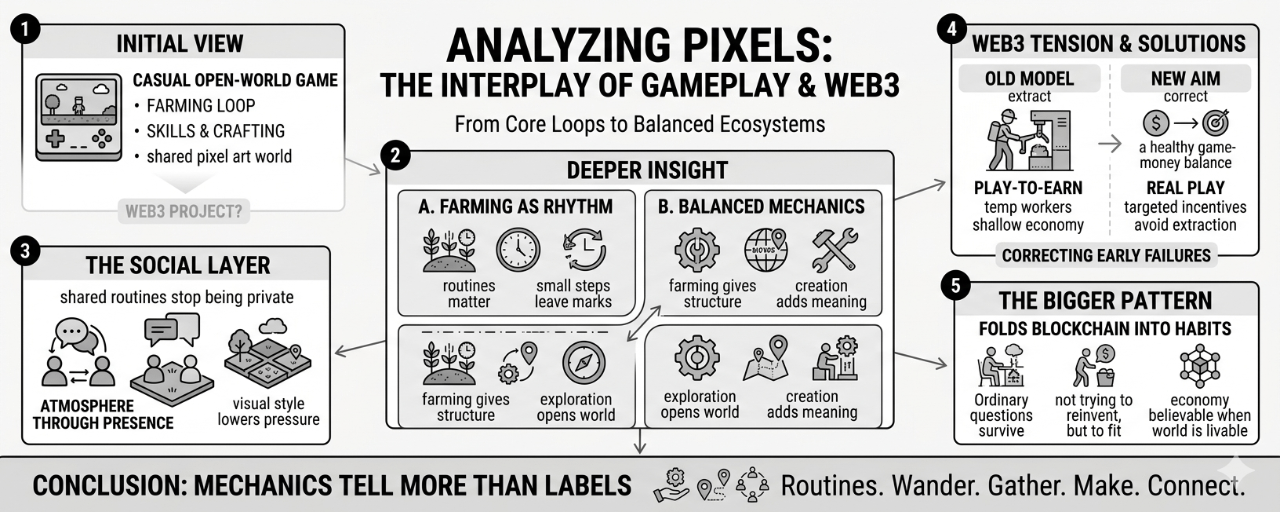
To be honest, On the surface, it is pretty simple. It runs as a social, casual, open-world game on the Ronin Network, and the basic loop is built around farming, exploration, crafting, quests, and meeting other players in a shared pixel-art world. The official descriptions keep coming back to the same core idea: gathering resources, building skills, making things, and moving through a world that mixes game progress with blockchain ownership.
That part is easy enough to say. But it does not really explain why the game stands out, or at least why people keep returning to it.
What @Pixels seems to understand is that farming games were never just about crops. They are about rhythm. Small routines. A sense that your time leaves marks somewhere. Plant something, wait, come back, collect, replant. Walk a little farther out. Notice a different patch of land. Trade with someone. Rearrange a space. Do the next quest. None of this sounds dramatic when you write it down. That is probably the point.
A lot of games push you to chase something loud. Bigger battles, sharper competition, some constant pressure to optimize every move. Pixels leans in another direction. You can usually tell pretty quickly that the appeal is not really speed. It is repetition with enough variation to keep it from going dull. Farming gives you the structure. Exploration opens it up. Creation gives you a reason to care about what you collect.
That balance matters more than it sounds.
If a game is only about farming, it can start to feel like a checklist. If it is only about wandering around, it can feel empty after a while. If it is only about building, it risks becoming a sandbox without much shape. Pixels sits in the middle of those things. You gather, then you move. You move, then you find materials or people or quests. You bring those back into crafting or upgrading or some other kind of progress. It loops, but it does not feel fully closed.
That is where things get interesting.
Because once a world is shared, routine stops being a private thing. A crop is still a crop, sure, but the game becomes more social almost by accident. You run into other players. You compare what people are doing. You notice which spaces feel busy and which ones feel quiet. A simple task in a single-player farming game is just a task. In a social game, it becomes part of an atmosphere.
And atmosphere does a lot of work here.
Pixels has the kind of visual style that lowers the temperature a bit. The #pixel art helps. Not because retro automatically makes a game good, but because it removes some pressure. It tells you this world is supposed to be readable, approachable, a little soft around the edges. That matters in a web3 game especially, because those can sometimes feel overloaded with systems before they feel like places. Pixels seems aware of that problem. Even the official material puts gameplay first in the way it describes the world: farming, exploration, story, skills, relationships. The ownership layer is there, but it is not the first thing your eyes land on.
I think that is one reason it has lasted in people’s attention longer than a lot of similar projects.
With most web3 games, the first question used to be, “What can I earn here?” After a while, that question usually changes to, “Would I still open this if the rewards felt smaller?” And that question is harder. It exposes whether there is an actual game underneath the economy.
Pixels seems to have been built around that tension from the start, or at least it has had to respond to it in a very visible way. The broader framing around the project now points toward trying to reward real play and make the in-game economy less shallow than the old play-to-earn model that burned through attention fast. Even its more recent token material describes the goal as correcting the problems that earlier blockchain games ran into, with more targeted incentives and stronger alignment between player activity and rewards.
That sounds abstract until you sit with it for a minute.
What it really means is that Pixels is trying to avoid becoming a place where every action feels like extraction. That old pattern was everywhere in web3 games for a while. People would enter, grind, sell, leave. There was no real texture to the world because the world was mostly a machine for outputs. It becomes obvious after a while when a game is designed mainly around that. Players stop behaving like players. They behave like temporary workers.
Pixels does not fully escape that tension. No blockchain game really does. The token is part of the identity. Ronin is part of the identity. Ownership is part of the identity. The project still lives in that space where game design and economy keep leaning on each other. But the difference here is that the game seems to understand that the economy only feels believable if the world feels livable first. Ronin gives it the chain infrastructure, and Pixels builds the daily texture on top of that through play, progression, and community.
And maybe that is the real pattern underneath everything.
Not that Pixels is trying to reinvent farming games. It is not, at least not in some dramatic way. The farming part is familiar on purpose. The exploration part is familiar too. Quests, resources, skill progression, trading, social spaces — none of that is strange. What changes is the setting around those features. They are being used to test a quieter idea: whether blockchain elements work better when they are folded into habits people already enjoy, instead of being presented as the main event.
That feels closer to the truth of the game than most big claims about the future of web3.
Because when you watch people play something like this, they are usually not thinking in grand terms. They are thinking about whether their crops are ready. Whether a route is worth repeating. Whether a certain area is worth visiting. Whether talking to other players makes the space feel alive. Whether the game gives them a reason to come back tomorrow. Those are ordinary questions. But ordinary questions are usually the ones that decide whether a game survives.
So Pixels ends up being less about novelty than about fit. Farming fits repetition. Exploration fits curiosity. Creation fits ownership better than pure speculation ever did. Social play fits a persistent world. Ronin fits the technical side of moving those systems around. Put together, it starts to make sense why the project gets described the way it does: not just as a farming game, and not just as a web3 platform, but as a place trying to make those two identities sit together without fighting all the time.
Whether that balance holds over time is a different question.
But for now, Pixels feels like one of those cases where the mechanics tell you more than the label does. People farm. They wander. They gather. They make things. They bump into each other. They settle into routines. And somewhere inside those routines, the bigger idea is still there, but quieter than you expect. Just enough to notice, not enough to settle the whole thing.
$PIXEL

Άρθρο
Pixels makes more sense when you stop seeing it as crypto first.
Αποποίηση ευθυνών: Περιλαμβάνει γνώμες τρίτων. Δεν είναι οικονομική συμβουλή. Ενδέχεται να περιλαμβάνει χορηγούμενο περιεχόμενο. Δείτε τους Όρους και προϋποθέσεις.