
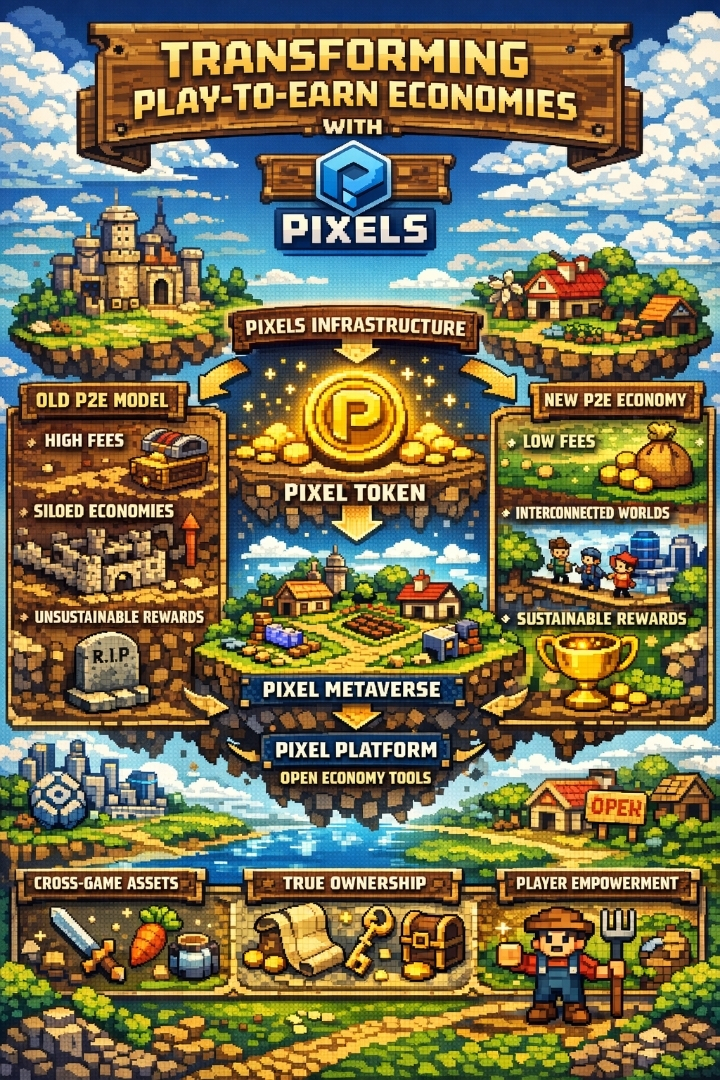
“The biggest failure in early Web3 gaming wasn’t technology. It was economics.”
For a moment, play-to-earn looked like the future of gaming.
Players could earn tokens while playing. Communities formed around shared ownership. Entire digital economies appeared almost overnight.
But then something unexpected happened.
Many of those economies collapsed.
Tokens crashed. Bots flooded reward systems. Game economies drained faster than they could regenerate.
What looked like a revolutionary model revealed a fundamental problem: most play-to-earn systems were never designed to survive real player behavior.
Understanding why they failed is the first step toward understanding why a new system, built by the team behid Pixel may represent a more sustainable path forward.
The Structural Problem Behind Play-to-Earn
At first glance, rewarding players for participation sounds simple.
But game economies are complex systems.
When rewards are distributed without careful design, several things happen quickly:
Bots begin farming rewards
Players optimize for extraction rather than engagement
Token emissions outpace real value creation
Economies inflate and eventually collapse
This pattern repeated across dozens of early Web3 games.
The issue was not that rewards existed.
The issue was how those rewards were distributed.
“If every action in a game generates rewards, the fastest system to exploit those rewards will always win.”
And in digital systems, bots are always faster than humans.
Without fraud resistance, behavioral analytics, and intelligent reward distribution, reward systems become unsustainable.
The challenge wasn't rewarding players.
The challenge was rewarding the right players, at the right moment, for the right behaviors.
Learning the Hard Way
The team behind Pixel experienced these challenges firsthand while building their own game ecosystem.
Instead of abandoning the model, they decided to study it.
Years of experimentation inside the Pixels ecosystem revealed something critical:
Player rewards could work, but only if the reward system itself was intelligent.
“The problem was never rewards. The problem was giving rewards without understanding players.”
From those lessons, the team built something new.
Not another quest board.
Not another reward app.
But a deeper infrastructure layer designed to manage game economies.
Enter Stacked: A New Reward Infrastructure
At the center of this system is Stacked.
Stacked functions as a rewarded LiveOps engine designed for modern game economies.
Instead of distributing rewards blindly, it allows studios to launch reward campaigns targeted toward specific player behaviors and measurable outcomes.
The goal is simple in concept but powerful in execution:
Deliver the right reward to the right player at the right time.
This dramatically changes how rewards function inside a game economy.
Instead of becoming inflationary giveaways, rewards become strategic tools for growth and retention.
The AI Layer: A Game Economist at Scale
One of the most important innovations in Stacked is its AI-driven analytics layer.
Game studios can analyze player cohorts, identify behavioral patterns, and experiment with reward strategies using real data.
The system can help answer questions like:
Why are high-value players dropping off after day three?
Which player behaviors correlate with long-term retention?
Where is reward budget being wasted?
Rather than relying on guesswork, developers can measure the impact of every reward decision.
“The future of game economies isn’t about giving more rewards. It’s about giving smarter ones.”
This ability to move from insight to action is what transforms Stacked from a reward tool into a live economic management system.
Built in Production, Not in Theory
One reason the Stacked system stands out is that it wasn’t designed in a whitepaper.
It was built inside a live gaming ecosystem.
The Pixels ecosystem has already:
Processed hundreds of millions of player rewards
Supported millions of players
Helped contribute to over $25M in ecosystem revenue
These results matter because Web3 audiences have grown cautious of infrastructure that exists only in concept.
Stacked, by contrast, was built through years of live experimentation with real players.
That experience created something many systems lack:
A defensive moat.
Fraud prevention systems.
Anti-bot mechanics.
Behavioral analytics at scale.
Most teams can launch quests.
Very few can build reward systems that survive adversarial environments.
Expanding the Role of $PIXEL
As the ecosystem grows, the role of PIXEL is also evolving.
Originally associated primarily with the Pixels game economy, $PIXEL is now positioned to function as a cross-ecosystem rewards currency.
Inside the Stacked framework, rewards can take multiple form< but $PIXEL remains a central component of the system.
As more games potentially integrate with the infrastructure, the token’s utility may expand beyond a single title and into a broader network of game experiences.
This shift represents an important evolution:
From game token to ecosystem reward layer.
And in Web3 economies, expanded utility often translates into expanded demand surfaces.
Redirecting Value Back to Players
Another powerful idea behind Stacked challenges the traditional gaming industry model.
Every year, game studios spend billions of dollars on advertising and user acquisition.
Most of that money goes to ad networks and marketing platforms.
Stacked proposes a different approach.
Instead of paying ad platforms to acquire players, studios can redirect that value directly to players themselves.
Engaged players earn rewards for meaningful in-game actions.
Studios gain measurable engagement and retention.
And players receive a share of the value they help create.
“The next evolution of game growth isn’t buying attention. It’s rewarding participation.”
If successful, this model could fundamentally change how gaming economies distribute value.
A New Direction for Web3 Gaming
The first generation of play-to-earn experiments revealed an uncomfortable truth:
Economic systems cannot rely on incentives alone.
They must also include intelligence, data, and resilience against exploitation.
What the team behind @undefined has built with Stacked suggests a new approach — one where reward systems are treated as live economic infrastructure rather than simple engagement mechanics.
And as this infrastructure expands, the ecosystem surrounding $PIXEL may continue evolving alongside it.
“The next generation of game economies won’t be built on speculation.
They will be built on systems that understand players.”
If that vision holds true, the future of Web3 gaming may not be defined by who launches the next big game.
It may be defined by who builds the systems that make game economies sustainable.
And that is exactly the problem Stacked was designed to solve.
$PIXEL
#pixel