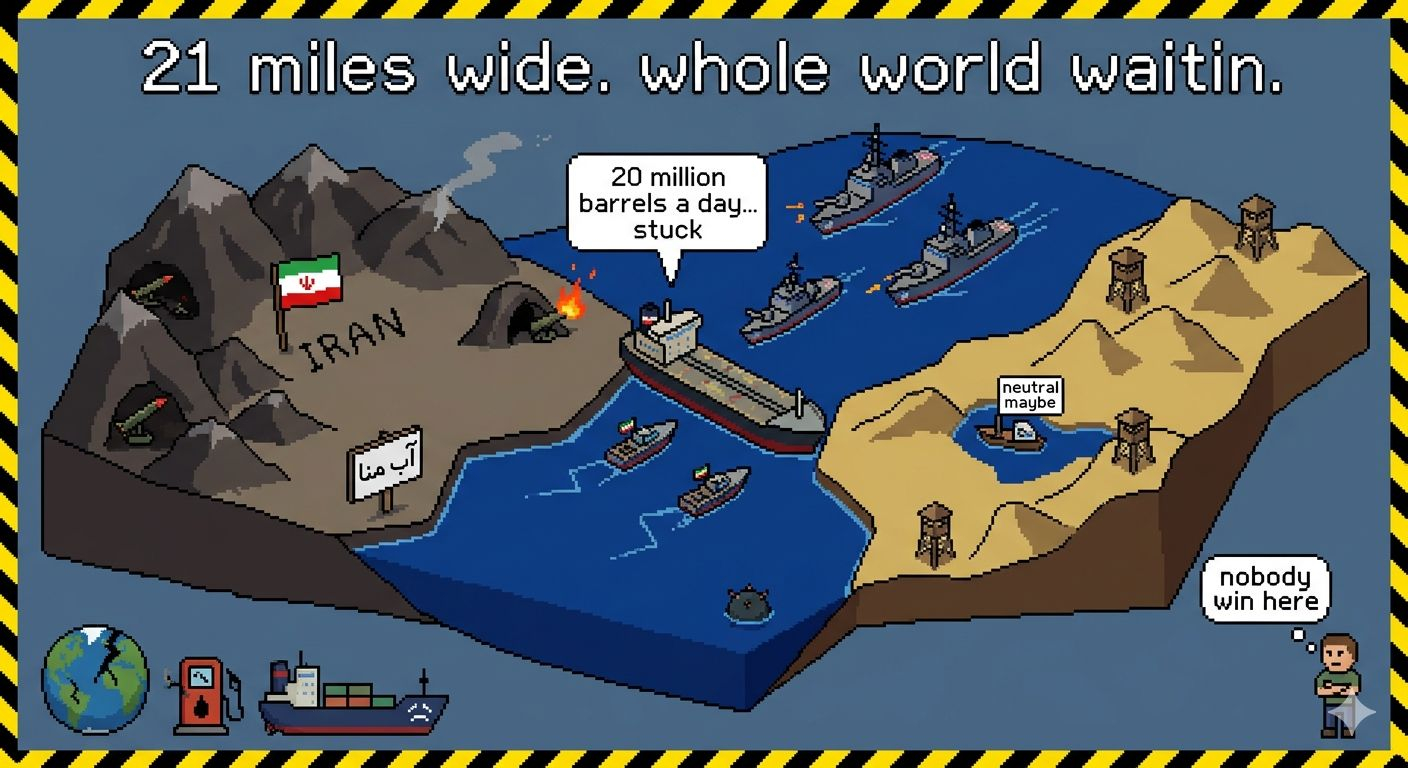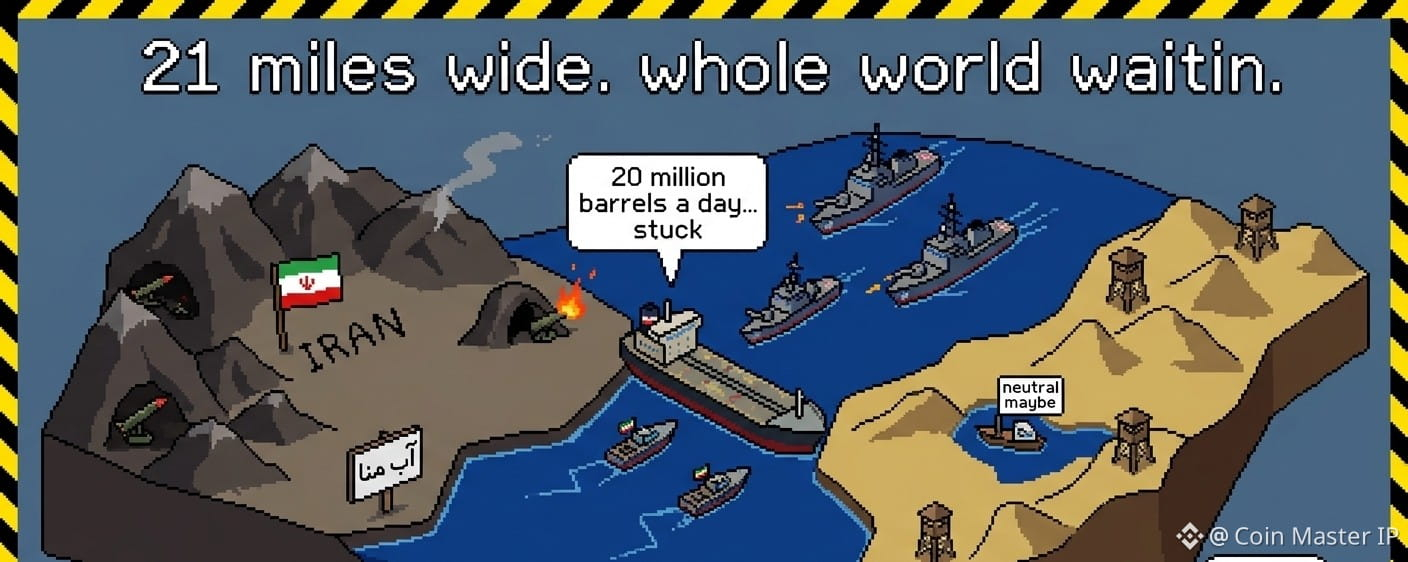
One narrow waterway. 21 miles wide at its smallest point. And yet, somehow, this little strip of sea between Iran and Oman has become the single most dangerous place on Earth right now.
Let me break it down for you.
What Actually Is the Strait of Hormuz?
Picture this: on one side, Iran's southern coast. On the other, the Musandam Peninsula of Oman. In between, a passage so narrow you could technically swim across it if you were insane enough (don't try it) .
This isn't just any waterway. About one-fifth of the entire world's oil — roughly 20 million barrels every single day — squeezes through this bottleneck. Add to that a huge chunk of global liquefied natural gas (LNG) and about one-third of the world's fertilizer shipments .
So yeah. When someone threatens to block it, the entire global economy holds its breath.
What's Happening Right Now?
Here's where it gets messy.
On February 28, 2026, the US and Israel launched military strikes against Iran. The Strait of Hormuz has been effectively shut down since then .
But wait — it gets more complicated.
On April 12, President Trump announced the US Navy would begin blockading the strait. His exact words? "Any Iranian who fires at us, or at peaceful vessels, will be BLOWN TO HELL!" .
The stated goal: prevent Iran from controlling the waterway and force them back to the negotiating table over their nuclear program .
The Problem With Blockading a Bottleneck
Here's what nobody seems to talk about enough.
The Strait of Hormuz is 21 nautical miles wide at its narrowest. That's not a lot of room to maneuver warships. The Iranian coastline overlooking the strait has natural caves where small forces can hide and fire missiles. The mountainous terrain gives them elevated positions to watch every single ship that passes .
Iran has spent decades preparing for exactly this scenario. They can't match the US Navy ship-for-ship, so they built an asymmetric arsenal instead :
· Anti-ship cruise missiles
· Naval mines (some of them mobile/drifting)
· Shahed drones that fly low over water (hard to detect)
· Fast attack boats
· Unmanned surface and underwater vessels
One Iranian military advisor recently threatened they could "sink US ships" operating in the waterway .
The Legal Mess Nobody's Talking About
Here's something interesting. Under international law — specifically the 1982 UN Convention on the Law of the Sea — the Strait of Hormuz is considered an "international strait" where ships have the right of "transit passage." That means Iran technically can't just block it or charge tolls .
But here's the catch: Iran never signed that treaty. Neither did the US, actually.
Iran claims the strait falls under its territorial waters and insists on the "innocent passage" standard from the older 1958 Geneva Convention. Under their interpretation, they can regulate who passes through and even charge fees .
In March, Iran reportedly tried to impose transit fees of up to $2 million on certain vessels. Shipping experts called it "global extortion" .
Who's Still Moving Ships?
Despite the blockade and the war, some ships are still getting through.
Data shows tankers from China, India, Malaysia, Vietnam, Pakistan, and Thailand have all transited the strait since the conflict began .
China, notably, has multiple very large crude carriers (VLCCs) passing through. One Chinese foreign ministry spokesperson said three Chinese ships recently sailed through "after coordination with relevant parties" — without specifying what that coordination actually involved .
India and France just had a phone call where their leaders agreed on the "urgent need" to restore safe navigation .
Meanwhile, CENTCOM claims they've turned back 10 vessels in the first 48 hours of the blockade. But maritime tracking data shows at least seven Iran-linked vessels still made it through. So someone's numbers don't add up .
What Happens If This Gets Worse?
Let me paint you a picture.
If the strait stays closed or even partially blocked for an extended period, here's what happens :
1. Oil prices spike — not just because supply is disrupted, but because uncertainty alone drives prices up
2. Shipping insurance skyrockets — making it too expensive for many operators to even try
3. Food prices jump — because fertilizer shipments pass through here too
4. Manufacturing slows — energy costs hit every part of the supply chain
5. Your electronics get more expensive — yes, even semiconductor production depends on stable energy prices
The effects ripple outward. Europe, already sensitive to energy prices, gets hit hard. China, as the world's largest importer of Gulf energy, sees this as a direct threat to its economic security .
The Deeper Question Nobody's Answering
Here's what keeps me up at night about all of this.
The US is trying to control a waterway that the entire global economy depends on. But can any single country realistically guarantee the stability of a system this interconnected?
The answer is probably no.
Every tanker that gets turned back, every mine that gets laid, every warship that moves into position — it all adds to the risk. And at some point, the risk becomes so high that the global economy starts breaking in ways we can't easily predict.
Where Do We Go From Here?
There's a ceasefire right now. Talks happened in Pakistan. They failed .
Israel's Prime Minister Netanyahu says the goals are clear: remove enriched material from Iran, eliminate their enrichment capability, and reopen the strait .
Iran's parliamentary speaker says they put forward "constructive initiatives" but the US didn't earn their trust .
Meanwhile, Russia's Putin has offered to mediate. The EU says diplomacy is "essential." Everyone talks, nobody agrees, and the strait stays blocked .
My Take
The Strait of Hormuz isn't just a military problem. It's not just an economic problem. It's a global governance problem.
We built a world economy that depends on a 21-mile-wide passage between two hostile nations. And now we're discovering that nobody actually has a good answer for what happens when that passage gets blocked.
The US can send all the warships it wants. Iran can threaten to sink them. But neither side can actually "win" here — because the real loser, every single time, is the global system that keeps food on our tables and fuel in our cars.
Until someone figures out how to truly internationalize this waterway — with enforceable rules that everyone actually follows — the Strait of Hormuz will remain exactly what it is right now:
A tiny bottleneck with the power to bring the world to its knees.
And that should scare all of us.