
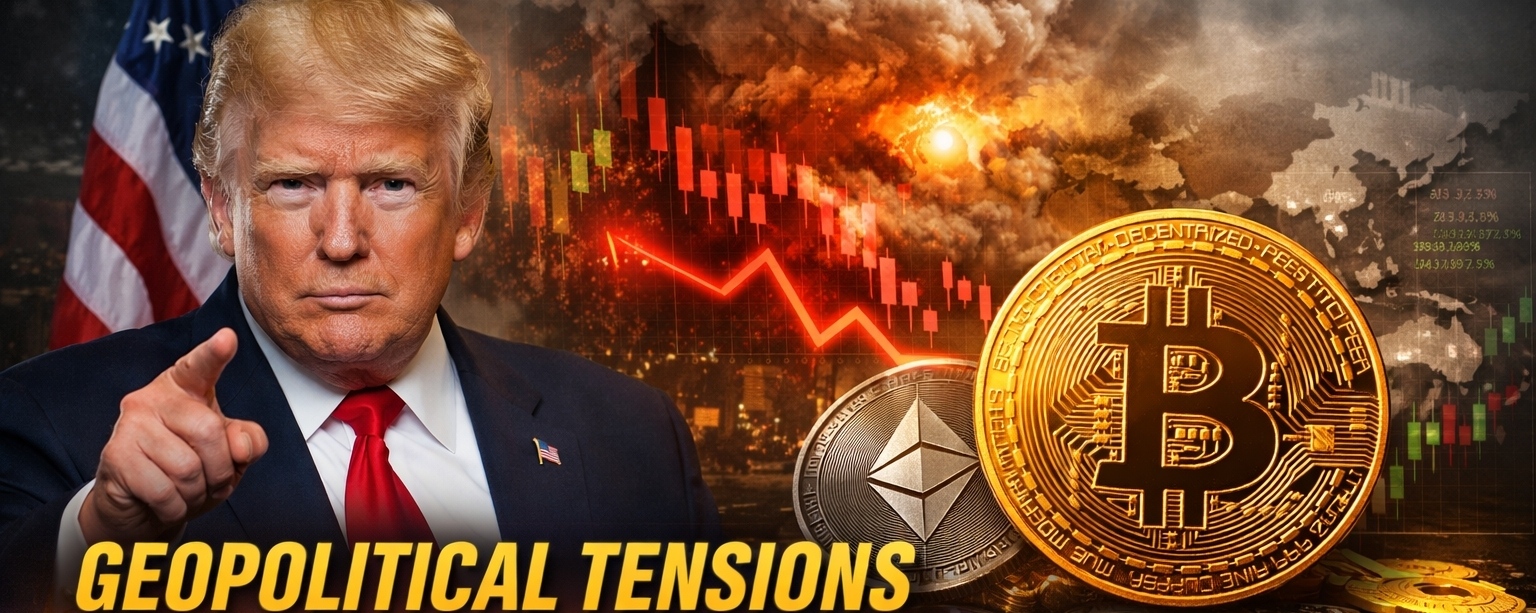
Global financial markets are once again facing uncertainty after recent geopolitical developments and a strong statement from Donald Trump. Historically, such events have triggered immediate reactions across traditional markets, but in recent years, the cryptocurrency sector has also become highly sensitive to macroeconomic and political signals.
As tensions rise, investors typically shift toward safer assets, leading to temporary pressure on risk-based markets. This reaction is now clearly visible in crypto, where major assets like Bitcoin are experiencing increased volatility near key levels, while Ethereum is struggling to maintain short-term bullish momentum. The broader altcoin market is witnessing even sharper declines, mainly due to reduced liquidity and panic-driven selling.
In the short term, the market is expected to remain highly volatile. Sudden price spikes, fake breakouts, and liquidity sweeps are likely as traders react emotionally to the news flow. However, such conditions often create inefficiencies in the market — something institutional players tend to exploit.
From a broader perspective, geopolitical uncertainty does not necessarily weaken crypto; instead, it often strengthens its long-term narrative. As trust in centralized systems fluctuates, decentralized assets gain attention as alternative stores of value. This dynamic has been observed multiple times during past global crises, where initial panic was followed by strong recovery phases.
Looking ahead, if the situation stabilizes, the market may regain structure within the coming weeks, with stronger assets leading the recovery. On the other hand, if tensions continue to escalate, volatility will persist, creating both risk and opportunity for traders.
At this stage, the key is not to react emotionally but to stay aligned with market structure and liquidity. The market does not move purely on news — it moves on how participants respond to that news.$BTC $PEPE $BNB