
There is a thing that happens in every AI Pro session that I had not named until recently.
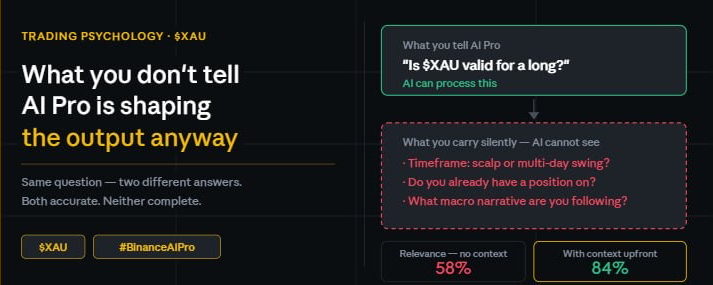
You bring assumptions into the session that you never state out loud. Not because you are hiding them. Because they feel so obvious to you that articulating them would seem unnecessary. You know what timeframe you are trading. You know your risk tolerance. You know what macro narrative you have been following for the past two weeks. That context is so present for you that it barely feels like context. It feels like reality.
AI Pro does not have access to any of it.
It receives the question you typed. It processes that against available market data. It returns an output that is accurate and coherent given what you asked. What it cannot do is account for the invisible frame you brought with you, the assumptions sitting behind the question that you never said.
I first noticed this clearly when I compared two AI Pro sessions I had run on the same $Xau question in the same week. A friend had asked essentially the same question about the same setup at roughly the same time. Our outputs were different. Not contradictory, just oriented differently. Mine emphasized the short-term technical structure. His came back more focused on the macro environment.
We had asked the same question. But we had not asked it from the same place.
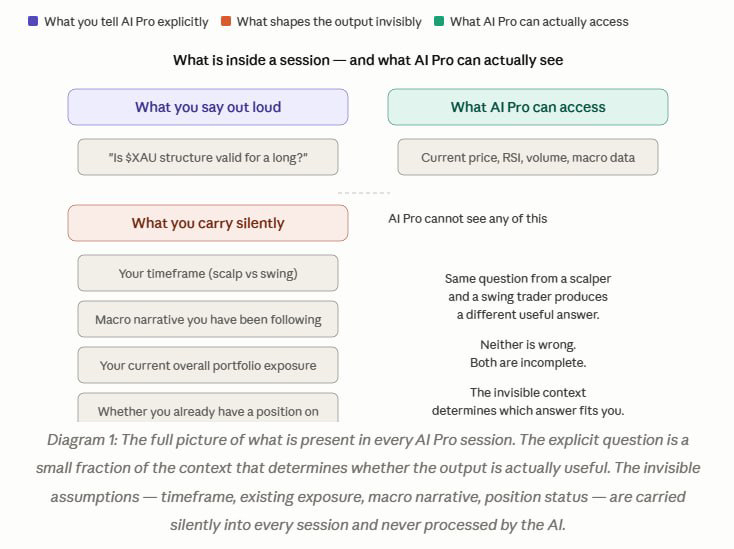
I was trading $XAU on a short timeframe. He was holding over several weeks. The same technical question meant something completely different in each context. For me, the short-term structure was the whole picture. For him, the macro environment was the frame that everything else sat inside.
The AI had no way of knowing that. We had not told it. And because we had not told it, the output oriented itself around what the question implied, which in both cases was slightly different because the framing we each naturally used carried the invisible signature of our different contexts.
The output was shaped by assumptions we never stated. We just did not notice, because those assumptions were so obvious to us that they did not feel like assumptions at all.
This matters because it means two people can receive accurate, useful, well-constructed outputs from the same question and walk away with opposite understandings of what the market is telling them. Neither is wrong. Both are working from incomplete information. The incompleteness is the invisible part, the context that was present in the room but never made it into the query.
I started testing what happened when I made the invisible visible. Before asking anything about the setup, I would open the session with one sentence of context: I am trading short-term, I am currently flat, I have been watching the dollar weaken this week, and my risk on this trade is limited to X.
The difference in output quality was immediate and significant.
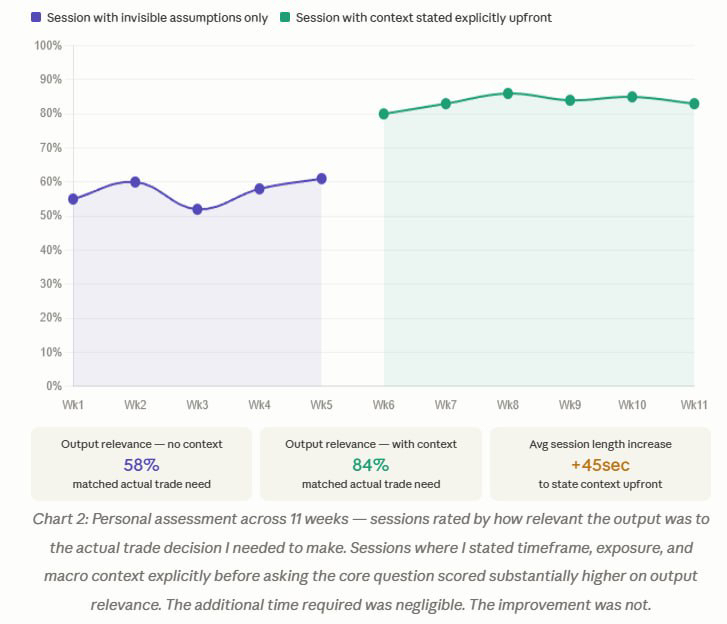
Not generic relevance. Relevance to my actual situation, the one I had been carrying silently into every previous session without stating it.
The output had always been accurate. Now it was accurate and applicable. That is a different thing.
What I state at the start of every session before asking anything specific:
My timeframe for this trade — scalp, intraday, or multi-day swing.
Whether I currently have a position on or am evaluating entry.
One sentence on the macro narrative I have been tracking — what I think the dominant driver for $Xau is right now and why.
My approximate risk on this trade.
That takes about forty-five seconds to write. The output that comes back is oriented to my actual situation rather than a generic reading of the market. The AI did not become smarter. I just stopped making it guess the context I had been withholding.
The invisible assumption is not dishonesty. It is the natural product of how obvious your own context feels to you. You have been thinking about $XAU for three days. The narrative is so present that articulating it would feel redundant. But the AI has none of that. Every session begins without it.
You are the only one who can close that gap. And closing it costs almost nothing.
The output you have been receiving is accurate. The question is whether it has been accurate for you specifically, or accurate for a generic reader of the same market data. That distinction is entirely in your hands.
#BinanceAIPro @Binance Vietnam $XAU
Giao dịch luôn tiềm ẩn rủi ro. Các đề xuất do AI tạo ra không phải là lời khuyên tài chính. Hiệu quả hoạt động trong quá khứ không phản ánh kết quả trong tương lai. Vui lòng kiểm tra tình trạng sản phẩm có sẵn tại khu vực của bạn.