


Lesson 24 Day 24
Trading & Investing: Risk management is the real game
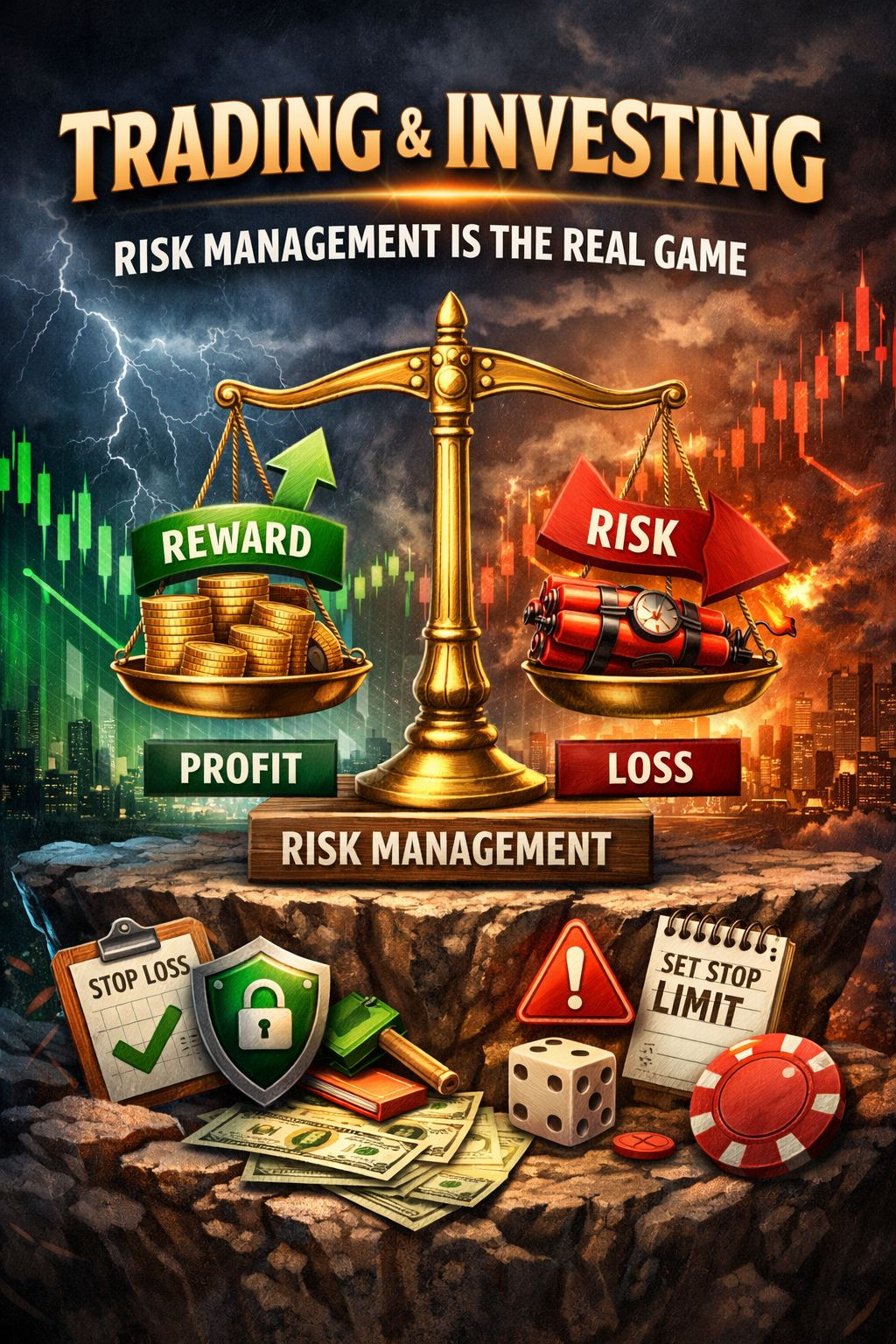
Introduction: The goal is to survive, not to win
Making money quickly is the primary goal of most novices who start trading or investing. Social media is filled with "success tales," charts are thrilling and profits appear simple.
However, this is the unsettling reality:
The hardest part is not making money. preserving it.
It is not knowledge, good fortune, or even strategy that separates those who survive in the market from those who vanish. It's considerably less glamorous:
risk control.
The market will eventually teach you how to manage risk if you don't—by stealing your money.
Investing vs. Trading: Different Rates, Similar Risk
Before diving into risk management, let’s clarify something important.
Trading
Short-term focus (minutes to months)
Frequent buying and selling
Relies on price movement
Emotion-heavy if unmanaged
Investing
Long-term focus (years to decades)
Focus on fundamentals and growth
Less frequent decisions
Requires patience more than speed
Despite these differences, both share one common reality:
👉 Both can destroy your capital if risk is ignored.
What Exactly Is Risk?
For most people, danger equates to financial loss. That's not all of it.
Actually, risk consists of:
Too much money lost
Not being consistent
Emotional exhaustion
Missing chances as a result of inadequate allocation
Risk is about unpredictability and survival as much as loss.
The Golden Rule: Never Take Any Chances
Professionals and gamblers are distinguished by one rule:
Never risk a sum that can wipe you out.
It may seem straightforward, but the majority of individuals consistently break this guideline.
Example:
You have $1,000.
It takes 11% to recover if you lose 10%.
You need 100% to recover if you lose 50%.
You need 900% to recover if you lose 90%.
Give that some thought.
👉 Recovering from a deeper loss is more difficult.
Position Sizing: The Quiet Weapon
The amount of money you invest in a single trade or investment is known as position sizing.
This is where most individuals make mistakes.
Beginner's perspective:
"I'll go all in; this deal looks strong."
A professional attitude:
"I could be mistaken. Permit me to reduce my risk.
The 1–2% Rule
A common approach:
Risk only 1–2% of your total capital per trade
Example:
Total capital = $1,000
Risk per trade = $10–$20
Even if you lose 10 trades in a row, you still survive.
👉 Survival is the first goal. Profit comes later.
Stop Loss: Your Safety Net
A stop loss is a predetermined departure point for a lost trade.
Many traders steer clear of stop losses due to:
"The market will return."
"I'm not ready to accept defeat."
This kind of thinking is risky.
Reasons to Stop Loss
Not using a stop loss:
Little losses grow into large ones.
Large losses turn into tragedies
Using a stop loss
Loss is managed.
Emotion is diminished
Capital is safeguarded
Real Example
You buy a coin at $100.
Set stop loss at $90 → max loss = 10%
Without stop loss → price drops to $50 → loss = 50%
Same trade. Different outcome.
The difference? Discipline.
Risk-Reward Ratio: Think Like a Business
Every trade or investment should have a clear risk-reward ratio.
What is it?
How much you risk vs how much you expect to gain
Example:
Risk = $10
Target profit = $30
Ratio = 1:3
Why It Matters
You don’t need to win every trade.
Even with: 40% win rate You can still be profitable if your rewards are bigger than your risks.
Diversification: Don’t Put Everything in One Basket
Putting all your money into one asset is not confidence—it’s exposure.
Smart diversification:
Different assets (stocks, crypto, commodities)
Different sectors
Different strategies
But Be Careful
Too much diversification = confusion.
You don’t need 50 assets.
You need controlled exposure.
Emotional Risk: The Invisible Enemy
This is the most underestimated risk.
Markets don’t destroy people—emotions do.
Common Emotional Traps
1. Fear
Selling too early
Avoiding good opportunities
2. Greed
Holding too long
Over-leveraging
3. Revenge Trading
Trying to recover losses quickly
Increasing position size irrationally
4. FOMO (Fear of Missing Out)
Entering late
Buying tops
Solution?
You don’t eliminate emotions—you manage them.
Have a plan before entering a trade
Follow rules, not feelings
Accept losses as part of the game
Leverage: Double-Edged Sword
Leverage allows you to control larger positions with smaller capital.
Sounds great… until it’s not.
Example
You use 10x leverage:
Price moves 10% against you → your position is wiped out
That’s how fast things can go wrong.
Rule
If you don’t fully understand leverage,
👉 Don’t use it.
Even professionals respect leverage. Beginners abuse it.
Drawdown: Measure Your Damage
Drawdown = how much your portfolio has dropped from its peak.
Example:
Portfolio grows to $2,000
Drops to $1,500 → 25% drawdown
Why It Matters
Large drawdowns:
Destroy confidence
Lead to bad decisions
Require bigger recovery effort
Goal
Keep drawdowns small.
Consistency beats aggressive growth.
Risk Management for Investors (Long-Term)
Investors often think they don’t need risk management.
That’s a mistake.
Key Strategies
1. Asset Allocation
Spread investments across asset classes
2. Time Horizon
Don’t invest money you need soon
3. Rebalancing
Adjust portfolio periodically
4. Fundamental Analysis
Understand what you’re investing in
Biggest Investor Mistake
Holding bad investments out of hope.
Hope is not a strategy.
Risk vs Reward Mindset Shift
Most people ask:
👉 “How much can I make?”
Professionals ask:
👉 “How much can I lose?”
This one shift changes everything
Building a Risk Management System
Let’s make this practical.
Step 1: Define Risk per Trade
Example: 1% of capital
Step 2: Set Stop Loss
Based on structure, not emotion
Step 3: Define Target
Minimum 1:2 or 1:3 ratio
Step 4: Track Performance
Keep a journal
Step 5: Review Mistakes
Learn, adapt, improve
The Role of Discipline
Risk management is simple. But not easy.
Because it requires:
Patience
Self-control
Consistency
Reality Check
Most traders fail not because:
They don’t know strategy
But because:
They don’t follow rules
Story: Two Traders
Let’s make this real.
Trader A
Risks 50% per trade
No stop loss
Trades emotionally
Result:
Wins big once
Loses everything later
Trader B
Risks 1% per trade
Uses stop loss
Follows system
Result:
Slow growth
Long-term survival
Consistent profits
Who wins?
Not the one who wins fast.
👉 The one who doesn’t lose everything.
Risk Management in Crypto vs Stocks
Crypto
High volatility
Fast moves
Higher risk
Stocks
More stable (generally)
Slower growth
Lower risk (relatively)
What Changes?
Your risk control must adjust.
In crypto:
Smaller positions
Tighter discipline
Common Risk Management Mistakes
Let’s call them out clearly:
Going all-in
Ignoring stop loss
Overtrading
Using high leverage blindly
Chasing losses
Following hype
If you recognize yourself in these, good.
That’s where improvement starts.
The Real Secret: Longevity
The goal is not: One big win
The goal is: Stay in the game long enough
Because:
👉 Opportunities never stop
👉 But your capital can
Final Thoughts: Play Defense First
Consider investing and trading as a game.
The majority of individuals simply pay attention to offense (earnings).
Professionals, however, concentrate on defense.
Remember:
Keep your money safe.
Manage your risk
Acknowledge minor losses
Prevent significant losses
One Line to Never Forget
"Profits will take care of themselves if you manage risk."
@Binance Square Official @Bitcoin $BTC $ETH $BNB
