

Lesson 25 Day 25
Trading & Investing: Market Psychology
Chapter 1: The Invisible Force Driving Markets
At first glance, markets look like numbers—charts moving up and down, green candles, red candles, percentages, indicators. But beneath all of that lies something far more powerful and unpredictable: human emotion.
Markets are not just driven by data. They are driven by people. And people are emotional.
Every buy order comes from hope.
Every sell order comes from fear.
That’s the real engine.
You might think markets move because of news, earnings, or global events—and yes, they do. But those things only trigger movement. The real cause is how people react to those events.
Two traders can read the same news.
One panics and sells.
The other sees opportunity and buys.
Same information. Different psychology. Different outcomes.
This is why mastering charts without mastering your mind is like trying to win a race with a fast car but no steering wheel.
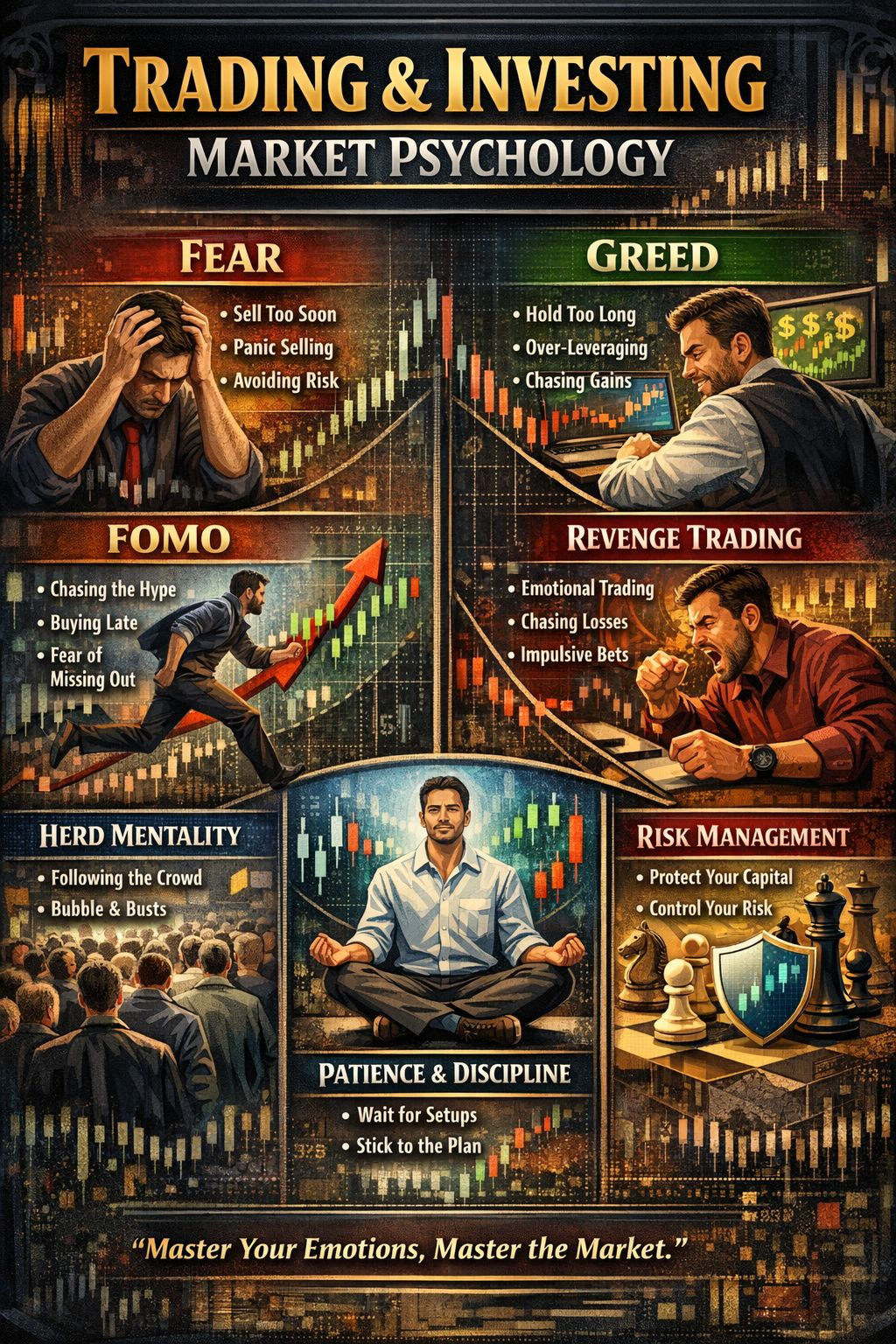
Chapter 2: Fear — The Silent Wealth Killer
Fear is the most powerful emotion in the market.
It shows up quietly.
You enter a trade with confidence. Everything looks perfect. But then the price drops slightly. Suddenly your thoughts start racing:
“What if I’m wrong?”
“What if it crashes?”
“I should exit before it’s too late.”
So you sell. Small loss. Feels safe.
Then the market reverses… and shoots up.
You sit there watching, feeling regret. Not because you were wrong—but because you let fear take control.
Fear causes:
Selling too early
Avoiding good opportunities
Not entering trades at all
In investing, fear often appears during market crashes. Prices fall sharply, news becomes negative, everyone around you is pessimistic.
That’s usually when the best opportunities exist.
But fear doesn’t let you see that.
Instead, it whispers: “Wait. It’s too risky.”
And by the time fear disappears… the opportunity is gone.
Chapter 3: Greed — The Sweet Trap
If fear makes you exit too early, greed makes you stay too long.
Greed feels good. That’s what makes it dangerous.
You enter a trade. It goes up. You’re in profit. You feel smart. Powerful. In control.
Then you think:
“What if it goes higher?”
“I’ll just hold a bit longer.”
“This could be a big win.”
But markets don’t reward emotion. They punish it.
Instead of taking profits, you hold. Price peaks… then drops.
Now greed turns into hope.
“It will come back.”
“I’ll exit when it reaches my target again.”
But it keeps falling.
What was once a profit becomes a loss.
Greed causes:
Holding too long
Over-leveraging
Ignoring risk
The irony? Most traders don’t lose money because they’re wrong. They lose money because they don’t know when to stop being right.
Chapter 4: FOMO — The Fear of Missing Out
FOMO is the emotion of chasing.
You see a chart exploding upward. Social media is full of excitement. Everyone is talking about profits.
You feel left out.
So you jump in.
Not because you planned it.
Not because your strategy says so.
But because you don’t want to miss the opportunity.
That’s FOMO.
And here’s the harsh truth:
By the time you feel FOMO… the move is usually already over.
Markets move in cycles:
Early buyers enter quietly
Smart money accumulates
Price starts rising
Public notices
FOMO kicks in
Late buyers enter
Smart money exits
FOMO buyers often become exit liquidity for early investors.
This leads to:
Buying at the top
Entering late
Poor risk-reward decisions
FOMO doesn’t care about logic. It only cares about emotion and urgency.
Chapter 5: Revenge Trading — The Emotional Spiral
Losses are part of trading. But how you react to them defines your future.
Revenge trading happens when you try to recover losses quickly.
You lose a trade. It hurts. Your ego gets involved.
Instead of stepping back, you think:
“I need to recover this.”
“I’ll take another trade immediately.”
“I can’t end the day in loss.”
So you enter another trade. Bigger position. More risk.
But now you’re not trading—you’re reacting.
Emotion replaces strategy.
Most of the time, this leads to bigger losses.
Revenge trading is dangerous because:
It increases position size irrationally
It ignores analysis
It turns trading into gambling
It’s not about money anymore. It’s about proving something.
And markets don’t care about your ego.
Chapter 6: Herd Mentality — Following the Crowd
Humans are social creatures. We feel safer when we follow others.
In markets, this creates herd behavior.
When everyone is buying, it feels safe to buy.
When everyone is selling, it feels safe to sell.
But the market doesn’t reward safety. It rewards timing and discipline.
The crowd is usually:
Late to enter
Late to exit
Why?
Because the majority reacts, not anticipates.
Think about bubbles. Whether it’s stocks, crypto, or real estate—the pattern is always the same:
Early adopters invest quietly
Prices rise slowly
Media attention increases
Public rushes in
Prices peak
Market crashes
The crowd buys at the top and sells at the bottom.
Not because they’re unintelligent—but because they follow emotion instead of logic.
Chapter 7: Patience — The Underrated Edge
In a world of fast profits and instant results, patience feels outdated.
But in trading and investing, patience is a superpower.
The best traders don’t trade all the time.
They wait.
They wait for:
Clear setups
Proper risk-reward
Confirmation
Most of the time, the best decision is doing nothing.
But that’s hard.
Because inactivity feels like missing out.
Silence feels like losing time.
Yet, overtrading is one of the biggest mistakes traders make.
Patience allows you to:
Avoid bad trades
Stick to your plan
Stay emotionally stable
It’s not about how many trades you take.
It’s about how good those trades are.
Chapter 8: Discipline — The Bridge Between Knowledge and Results
You can know everything about trading—strategies, indicators, risk management.
But without discipline, none of it matters.
Discipline is doing what you know you should do, even when you don’t feel like it.
It means:
Following your plan
Respecting stop-losses
Taking profits when needed
Not chasing the market
Most traders fail not because they lack knowledge—but because they lack consistency.
They change strategies too often.
They break their own rules.
They act on impulse.
Discipline turns average strategies into profitable ones.
Without it, even the best strategy will fail.
Chapter 9: Risk Management — Controlling the Mind Through Structure
Risk management is not just a financial tool—it’s a psychological shield.
When you know your risk is controlled, your emotions become calmer.
You don’t panic as easily.
You don’t feel desperate.
Good risk management includes:
Position sizing
Stop-loss placement
Risk-to-reward ratio
For example, risking only 1–2% of your capital per trade means no single loss can destroy you.
This reduces emotional pressure.
Without risk management:
Fear increases
Greed increases
Mistakes multiply
With it:
Confidence grows
Decisions improve
Longevity increases
In trading, survival is more important than profit.
Because if you survive long enough… profit becomes inevitable.
Chapter 10: The Difference Between Traders and Investors
Both traders and investors deal with market psychology—but in different ways.
Traders:
Short-term focus
More emotional pressure
Frequent decisions
They must control emotions daily.
Investors:
Long-term focus
Less frequent decisions
Must handle patience and conviction
Their challenge is not panic during volatility.
Both require mental strength.
But the timeline changes the psychology.
A trader fears short-term loss.
An investor fears long-term uncertainty.
Understanding your role helps you manage your emotions better.
Chapter 11: Self-Awareness — The Ultimate Edge
The market is unpredictable.
But you are not.
Your habits, reactions, and patterns can be understood.
Ask yourself:
Do I panic easily?
Do I get greedy after wins?
Do I overtrade after losses?
Self-awareness turns weaknesses into strengths.
For example:
If you know you are prone to FOMO, you can create rules to avoid chasing trades.
If you know you get emotional after losses, you can take breaks before re-entering.
The goal is not to remove emotions.
That’s impossible.
The goal is to manage them.
Chapter 12: Building a Strong Trading Mindset
A strong mindset is not built overnight.
It comes from:
Experience
Mistakes
Reflection
Every loss teaches something.
Every mistake reveals a weakness.
The key is to learn, not repeat.
A strong trader:
Accepts losses calmly
Follows a system
Thinks long-term
Controls emotions
They don’t chase perfection.
They focus on consistency.
Because in trading, consistency beats brilliance.
In summary, "Master the Market, Master the Mind"
At the end of the day, trading and investing are not just financial activities.
They are psychological battles.
Not against the market—but against yourself.
Charts will always be there.
Opportunities will always come.
But your mindset determines whether you benefit or suffer.
If you can control:
Fear
Greed
Impulse
Ego
You gain an edge that no indicator can provide.
Because the real secret of success in markets is simple:
The market rewards those who can control what others cannot—their own mind.
@Binance Square Official @BNB Chain @Bitcoin $BTC $BNB
