
Coming Back to Pixels Feels Less Like Playing a Game and More Like Testing a System
I came back to Pixels after a few weeks expecting the usual—minor tweaks, maybe a new feature added on top of the same loop. But this time, it didn’t feel like one update stood out. It felt like something underneath was shifting.
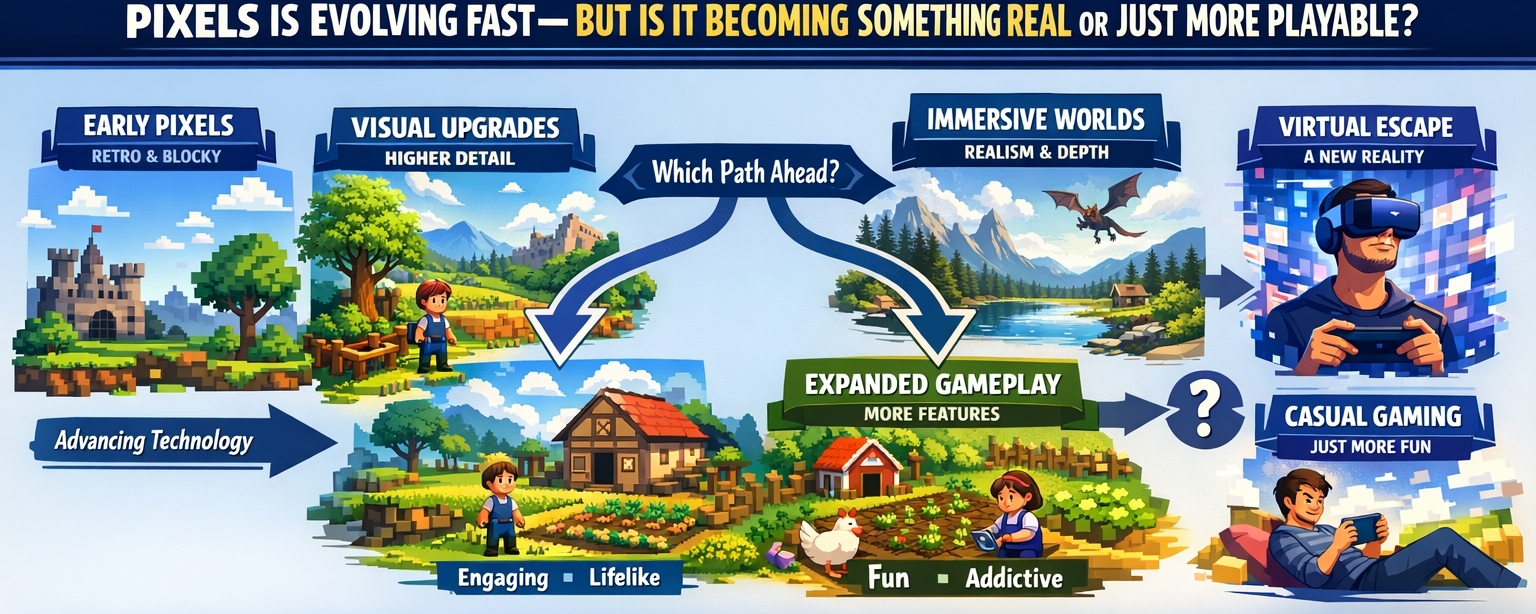
So the question I kept coming back to was simple: is Pixels actually becoming something useful beyond just being a game, or is it just getting better at keeping players inside its own loop?
One of the first things that caught my attention was the onboarding change. The Binance Pay integration into Ronin isn’t flashy, but it quietly fixes one of the biggest problems—getting money into the system. Before, you needed intent. You had to know what you were doing. Now, it’s much easier. That changes who enters the system and how they behave. More casual users can step in, and builders can design for people who aren’t deeply “crypto-native.” But easier access also means speculation can move faster. It’s not purely positive or negative—it just raises the stakes.
Then there’s the introduction of guilds. At first glance, it looks like a normal game feature. But it actually changes how people interact. Instead of everyone grinding alone, players can organize, coordinate, and depend on each other. That’s a big shift. It turns simple activity into something closer to structured collaboration. If Pixels ever becomes economically meaningful, it’ll likely come from groups acting together—not individuals playing solo. But right now, it still feels early. The structure is there, but the incentives haven’t fully matured.
The move to Ronin is also starting to show real effects. Lower fees and smoother performance are no longer just promises—they’re visible in how the system runs. Activity has scaled, and the network isn’t breaking under pressure. That matters, because most projects never even get past that stage. Still, working infrastructure doesn’t automatically mean the system itself is valuable. It just removes a major limitation.
Then there’s the token. The price action has been intense—huge spikes, massive volume. That kind of movement brings attention, and attention brings users. But it also changes behavior. When the token becomes the focus, the game starts to feel less like something you play and more like something you position around. For builders, that creates uncertainty. It’s hard to design stable systems on top of something so volatile. Right now, it feels like the token is moving faster than the actual product.
Another shift that’s easy to miss is happening at the network level. Ronin is starting to favor builders more than passive stakers. That’s important. It means value is slowly being pushed toward people who are actually creating and contributing, instead of just holding and earning. If that continues, it could help the ecosystem move toward real usage instead of passive participation. But it’s still just a direction—not a guarantee.
Looking at everything together, some things have clearly improved. It’s easier to get started. Social coordination is beginning to matter. The infrastructure is holding up. And incentives are slowly aligning toward creation rather than just holding.
But there are still big questions. The balance between the token and the product isn’t stable yet. It’s unclear whether social systems will create real economies or just more efficient grinding. And it’s still uncertain if players will stick around when the financial upside cools down.
What’s changed for me isn’t blind confidence—it’s where I place it. I trust the foundation more now. But I’m more cautious about the hype and price signals.
Pixels isn’t stuck anymore. It has cleared some of the biggest barriers—onboarding, infrastructure, and early growth. That’s real progress.
But it still hasn’t proven the hardest part: whether the system can stand on its own without relying on speculation.
For me to fully change my view, I wouldn’t need another feature or partnership. I’d need to see guilds creating consistent, meaningful economic activity. I’d need to see players stay even when rewards drop. I’d need builders to create things others truly depend on. And I’d need the conversation to shift away from the token and back to the system itself.
Right now, Pixels feels like it’s in transition. Not just improving as a game, but trying to become something more.
It’s closer than it was.
But it’s still not there yet.
And maybe that’s the most interesting part—this moment where it could go either way.
Where it either evolves into something people rely on… or fades back into just another loop people outgrow.
You can feel the tension building beneath the surface.
Not in the charts, not in the hype—but in how people choose to stay, or quietly leave.
Because in the end, systems don’t prove themselves through spikes…
they prove themselves through survival.
And Pixels hasn’t proven that yet—but it’s finally close enough that it might.
