
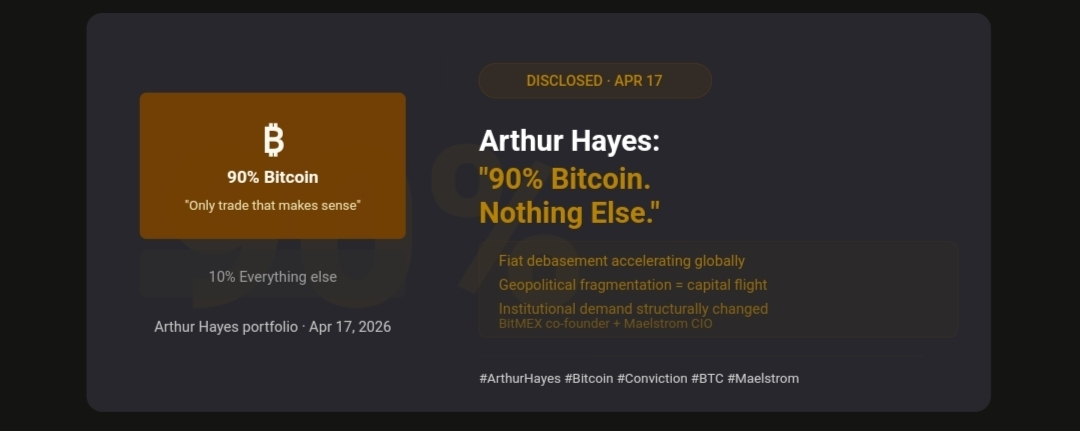
Yesterday, as Bitcoin was breaking out past $77,000, Arthur Hayes — co-founder of BitMEX and CIO of Maelstrom — disclosed publicly that his personal portfolio is currently 90% Bitcoin.
Arthur Hayes publicly disclosed holding a 90% Bitcoin position as part of recent market updates, highlighting a significant allocation toward the cryptocurrency amid the current geopolitical environment.
This isn't Hayes being flippant. When someone who has traded through every major crypto cycle since 2014 — Mt. Gox collapse, the 2018 bear, FTX, the 2022 crash — puts 90% of their personal capital into a single asset, it's worth understanding the reasoning.
His thesis has three pillars. First, fiat debasement. Every major central bank on earth has spent the last five years expanding their balance sheet. The Iran war oil shock is now feeding into inflation, which is feeding into political pressure on central banks to both fight inflation and prevent recession simultaneously — an impossible task. Bitcoin's fixed supply of 21 million coins is the only monetary instrument that mathematically cannot be debased.
Second, geopolitical fragmentation. Bitcoin faces significant liquidation pressure levels — $1.17 billion in short liquidation pressure above $77,000 and $1.277 billion in long liquidation pressure below $73,000 — yet Hayes is adding to his position precisely because geopolitical fragmentation increases demand for assets outside the control of any nation-state. Fantom When the Strait of Hormuz can close for six weeks, when sanctions can cut countries off from SWIFT, when allies become adversaries — capital increasingly seeks neutral ground. Bitcoin is stateless by design.
Third, institutional demand has structurally changed the market. The combination of spot ETF flows, Morgan Stanley's MSBT, Schwab Crypto launching this week, and Strategy's relentless accumulation has created a demand floor that didn't exist in 2022. Hayes sees this as a regime change, not a cycle.
The counterargument deserves equal space: concentration risk is real. 90% in any single asset — even Bitcoin — means if BTC drops 40%, your portfolio drops 36%. Hayes has the risk tolerance and liquidity runway for that. Most people don't. His 90% might be your 10% — sized appropriately for your actual circumstances.
But the intellectual framework behind the bet is sound. In a world of money printing, geopolitical chaos, and institutional adoption — Bitcoin's case as a reserve asset has never been stronger.