
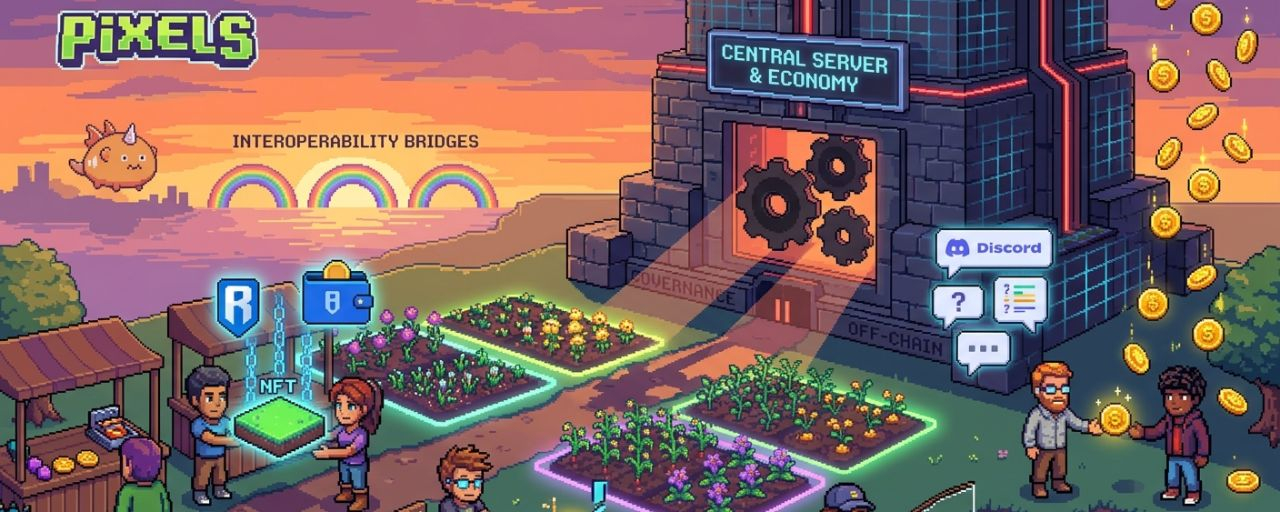
In the busy world of blockchain gaming, Pixels stands out. It’s a colorful, farming-based multiplayer game that has attracted thousands of players. The main appeal of Pixels, like many Web3 games, is decentralization. This means giving power, ownership, and control back to players instead of keeping it with a single company. But how much of Pixels do players actually own? Let’s take an honest look at the game’s mechanics to separate hype from reality.
First, it’s key to understand what "player ownership" means in a game. In traditional games like World of Warcraft or FarmVille, you might spend hours earning a rare sword or a unique crop. But the game company owns everything. They can change your item’s stats, ban your account, or even shut down the servers at any time. True player ownership means having assets that exist independently of the game developer assets you can sell, trade, or use elsewhere, even if the game changes.
The clearest example of ownership in Pixels is its use of non-fungible tokens (NFTs). In the game, land plots are NFTs on the Ronin blockchain. When you buy land in Pixels, you are not just renting server space. You hold a unique token in your own crypto wallet. That token proves your ownership, and no one not even the Pixels development team can take it away from you without your private keys. This is a significant move toward real decentralization.
Additionally, many in-game items are NFTs. Tools, decorative objects, and certain animals exist as tokens on the blockchain. This means you can take your rare “Golden Sheep” and sell it on a public marketplace like OpenSea or the Pixels internal market. The game developers do not control that secondary sale. You, the player, receive the full value of your digital property. For artists and collectors, this is a powerful change from the old model where all items were locked within one game's ecosystem.
However, owning an NFT does not guarantee that a game will run indefinitely. The Pixels game itself—the code, graphics, and servers that allow you to plant seeds and chat with neighbors—is controlled by a central team. If the developers decide to shut down the servers, your land NFT would still exist on the blockchain, but it would be useless. You would own a deed to a virtual plot in a world you can no longer access. This is the hidden drawback of many Web3 games: asset ownership without functional gameplay is meaningless.
Another important aspect is the game’s currency and resources. Pixels uses a token called $BERRY, which is a standard cryptocurrency. Players earn $BERRY by completing tasks, farming, and crafting. Since it’s on the Ronin chain, you can trade your $BERRY for other cryptocurrencies or cash. This gives your in-game work real, transferable value. Unlike gold in Runescape, $BERRY is not stuck in Pixels; it can move with you in the broader crypto economy.
But centralization returns here. The Pixels team controls the token’s in-game economy. They decide how many $BERRY you get for each action, how much items cost at NPC shops, and the requirements for new crafting recipes. They can adjust the game’s economic rules anytime. If they suddenly make $BERRY harder to earn, your previous earnings become more valuable, but your future earnings decrease. This isn't true decentralization; it's a centrally planned economy dressed as blockchain.
Now let’s discuss governance, which is another part of decentralization. True player ownership means players should have a say in how the game develops. At the moment, Pixels has made small moves towards this through community feedback channels and polls on Discord. However, there is no complete on-chain governance system where token holders can vote on changes to game code or economic parameters. Major decisions like new features and balance changes are still made by the core team. This is understandable for a live game, but it keeps ultimate control centralized.
What about interoperability, the ideal of using your game items across different games? Right now, your Pixels land and tools cannot be used in other blockchain games. They exist on the same Ronin chain as games like Axie Infinity, but there’s no technical bridge to make them function elsewhere. So, while you own the NFTs, they remain locked to one game’s software. True cross-game ownership is still a future goal, not a current reality. Owning a Pixels plot today is similar to owning a McDonald’s uniform—it’s yours, but only useful in one specific system.
The good news is that Pixels gives players more freedom than traditional games. Because assets are on a public blockchain, you can lend, rent, or use them as collateral in decentralized finance (DeFi) protocols. For example, you could use your land NFT as collateral to borrow another cryptocurrency. You can also rent out your land to others for a share of their $BERRY earnings. These acts of ownership are impossible in FarmVille or Stardew Valley. In that sense, Pixels is undoubtedly more decentralized than any mainstream farming game.
However, a significant risk remains: the game’s central servers. Every time you log in to Pixels, you connect to a company-run server that validates your actions and keeps the game state. If that server goes down, you cannot play. If the company bans your account for a rule violation even a mistaken one you lose access to the game, even if you still own the NFTs. This is called “off-chain gatekeeping,” and it undermines the concept of true player ownership. You own the assets, but the company controls access to the world where those assets matter.
Another aspect of centralization is evident in the game’s upgrade and evolution system. The Pixels team can and does change the utility of your NFTs. For instance, they might decide that a certain tool NFT can no longer harvest a rare resource or that a piece of land now has different farming bonuses. They can also introduce new NFTs that reduce the value of your old ones. This is similar to how traditional games nerf items. The only difference is that you can still sell the old NFT to someone else but at a lower price. So your ownership is real, but the functionality of your items remains subject to the developer’s updates.
So, how much of Pixels do players truly own? The most honest answer is: the static assets are player-owned, but the dynamic experiences are not. You own your land, tools, and $BERRY tokens as immutable blockchain records. No one can take those tokens from you. However, you do not own the game rules, access to the servers, or future development plans. The Pixels team holds total control over the game’s software and economy. It is a mixed model: blockchain-backed ownership of objects in a centrally-run world.
In conclusion, @Pixels is a meaningful step toward decentralization, but it is not a fully decentralized game. It offers players real property rights that surpass traditional gaming. You can sell, trade, and even lend your assets without permission. Yet, the game still relies on a central team for its operation, updates, and server access. For most players, this is probably acceptable most just want to enjoy the game and feel their items are secure. But for those seeking a truly player-owned universe, Pixels is still a work in progress. The future of gaming may lie in this middle ground: player-owned assets within developer-governed worlds. For now, that is what Pixels provides.