
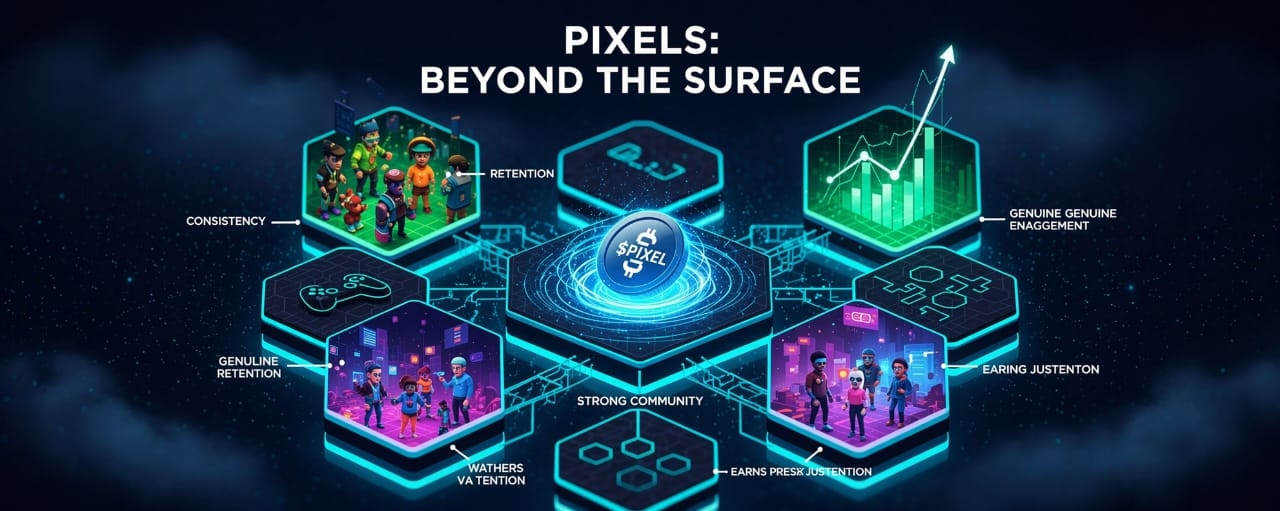
At first, I honestly thought Pixels was just another game trying to ride the Web3 wave. The farming style looked simple, the world felt light, and from the outside it seemed like one more project built to catch attention for a while and then disappear behind the next trend. That is how a lot of people look at these things in the beginning. They see bright colors, tokens, and a playful world, and they assume it is all surface. But Pixels becomes more interesting the longer you sit with it, because what looks simple at first starts revealing something much deeper underneath.
That is the part people should pay attention to.
Pixels is not only about gameplay. It is about how a digital world can slowly become a place people return to with real consistency. And that matters, because in Web3, attention is everywhere, but real retention is rare. Many projects know how to attract users. Very few know how to keep them. They launch with noise, incentives, and excitement, but once that initial rush fades, the weakness in the experience becomes obvious. People leave as quickly as they arrived. Pixels feels different because it seems to understand that lasting value does not start with hype. It starts with habit, comfort, and a reason to come back even when nothing is being forced.
That is where $PIXEL becomes more interesting too.
A token only matters when it belongs to something people genuinely care about. If the world around it feels empty, then the token eventually starts feeling empty too. But if the experience has life, if the environment feels active, social, and worth spending time in, then the token begins to represent more than speculation. It becomes connected to participation. It becomes part of a system people are actually using. That is an important difference, and I think Pixels understands it better than many other projects in the Web3 gaming space.
What makes Pixels stand out is that it does not feel obsessed with proving itself too loudly. It does not need to scream value every second. Instead, it lets the user discover that value over time. You log in, you play, you build, you explore, and without realizing it at first, you begin to see that the real strength of Pixels is not just in what you can earn, but in how naturally it keeps people engaged. There is something powerful about that. In an industry where so many projects try to buy attention, Pixels seems more focused on earning presence.
And presence is stronger than noise.
The world of Pixels feels accessible in a way many blockchain games still do not. That accessibility matters more than people think. When a game is easy to enter, it lowers friction. When it is easy to understand, people stay longer. When it feels social and alive, people start building routines around it. This is where Pixels stops looking like “just a game” and starts feeling like an actual experience. It becomes a space where gameplay, economy, community, and digital ownership begin to connect in a more natural way.
That is why the project deserves a more serious look.
A lot of Web3 gaming failed because it got the order wrong. It tried to make people care about rewards before giving them a world worth caring about. Pixels seems to reverse that. It gives people an environment first, then lets the deeper value reveal itself through continued participation. That approach feels healthier. It feels more sustainable. And in my view, that is where the future of projects like this will be decided. Not by who can create the biggest short-term excitement, but by who can build something people genuinely want to be part of.
$PIXEL gains meaning from that larger picture. Its long-term value is not only tied to price movement or short-term market sentiment. It is tied to whether Pixels can keep doing what it already does well: turning simple interaction into steady participation. If it continues building on that foundation, then it has a better chance than most of staying relevant while others fade.
So yes, Pixels may look simple at first glance. But sometimes the most important things do. What matters is not how loud a project appears in the beginning. What matters is whether it keeps revealing depth the closer you get to it. Pixels does that. And that is why I no longer see it as just a game. I see it as something much more complete a living experience that understands where Web3 gaming is going, and why the projects that last will be the ones people genuinely enjoy returning to.
