

Now let's imagine a company with $200 in the bank. No marketing team. No VC-backed hype campaign. Just a small group of people building a 2D pixel art farming game in the middle of a pandemic lockdown.
Nobody gave it a second look....
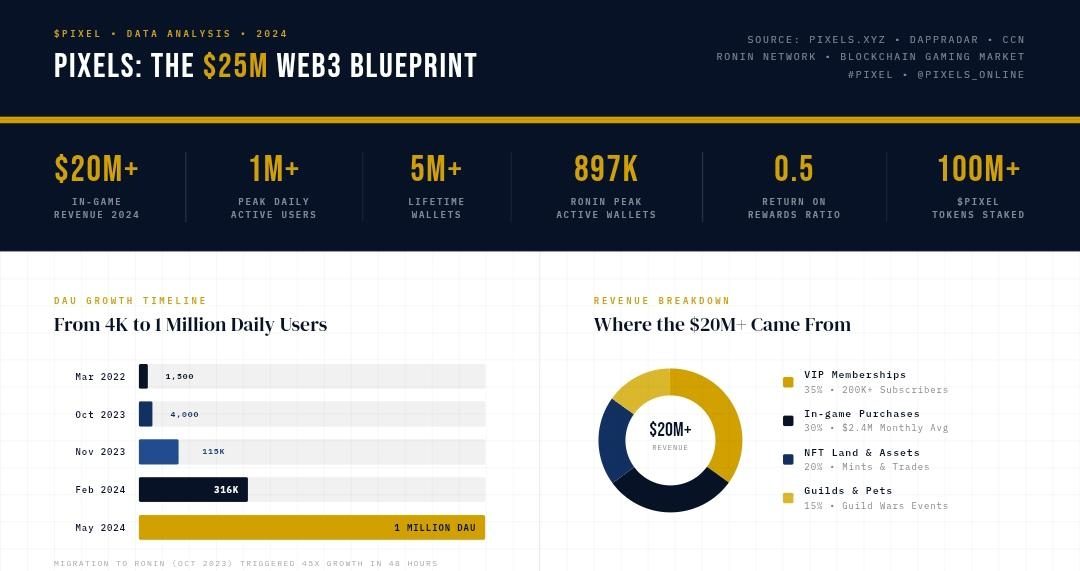
And then it made over $20 million in revenew. In a single year. Entirely from in-game purchases.
That is the Pixels story. And if you are running a fund that evaluates web3 gaming infrasturcture, this is not optional reading. This is the entire pitch written in one real-world proof.
Luke Barwikowski started building what would become Pixels during the 2020 lockdown. He wanted a place where people could just exist together online. Farm things. Talk. No pressure. The first public version was live on November 17, 2021. The company wallet had $200 in it that day. Within 24 hours the community had $2.4 million into the ecosystem through NFT activity.
No roadmap could have predicted that....
But the real turning point was started in October 2023. Pixels migerated from Polygon to the Ronin Network. What happened next should be framed and hung in every investment office that touches gaming.
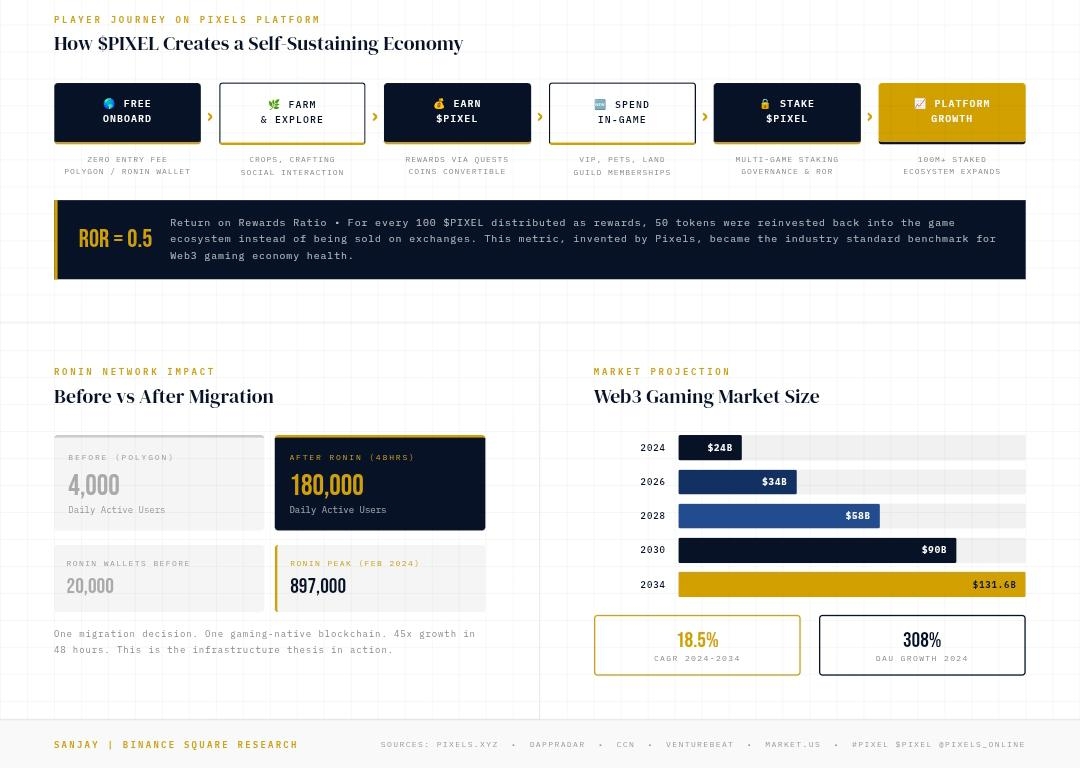
Can you believe within 48 hours of going live on Ronin, daily active users jumped from 4,000 to 180,000. A 45x increase. In two days. The Ronin network itself saw active addresses climb from 20,000 to a peak of 897,000. One game. One infrastructure decision. An entire Blockchain network lit up overnight.
This is the proof of concept that Web3 gaming infrasturcture investors have been quietly waiting for.
Ronin was purpose-built for gaming. Lower gas fees. Faster settlement. A dedicated base of users who had already onboared through Axie Infinity and were looking for the next thing. When Pixels plugged into that rail, the system held perfectly. No crashes. No broken transactions. Just scale.
And by February 2024, Pixels had 316,800 weekly unique active wallets. And by May 2024, daily active users crossed 1 million, making it the largest Web3 game by Daily Active Users at that time. Over 5 million lifetime wallets registered. More than 200,000 Playes paying for monthly VIP memberships.... and average in-game monthly spend was $2.4 million.
Started with $200. Ended the year at $20 million.....
Now here is where it gets really interesting for anyone evaluating this space.
Most web3 games fail not because the game was bad. They fail because the underlying tokenomics are broken. Rewards outpace spending. The sustanable economy never materializes. Players extract and exit. Pixels actually studied this problem and built a metric around it. They called it Return on Rewards, or ROR. It measures how many tokens get reinvested versus how many get sold off on exchanges.
Think about what Fortnite did. Free to play. No entry fee. But people spent billions on cosmetics because the game made them feel something.... Pixels did the same thing on-chain. VIP memberships, guild wars, land NFTs, pet mints. Nobody was forced to spend. They chose to.
That is the entier business model in one sentence. And funds should take note.
Pixels is not just a game anymore. It is a platform. The $PIXEL token now powers a multi-game ecosystem that includes pixel Dungeons, The Forgotten Runiverse, and Sleepagotchi on Telegram. Over 100 million $PIXEL tokens are already staked. That is not speculation. That is ecosystem commitment built over time.
The ROR metric they invented became an industry benchmark. Other Web3 games started measuring themselves against it....
The global web3 gaming market is projected to reach $131.6 billion by 2034 according to market research data. Daily active users across the industry grew 308% in 2024 alone. Those are massive numbers. But Pixels made those numbers personal.
One team. One right infrastructure call. One game that pulled nearly a million wallets onto a single network in under two weeks.
Any fund evaluating Web3 gaming infrasturcture and not putting Pixels at the center of their thesies is looking at the wrong data.
The revenue story is not the ending. It is chapter one....
Chapter 2 is live. The multi-game staking platform is expanding. The $PIXEL ecosystem is crossing into new genres and new distribution channels. And the same team that built all of this starting from $200 is now building what could become the user acquisition infrastructure layer for the entier Web3 gaming industry.