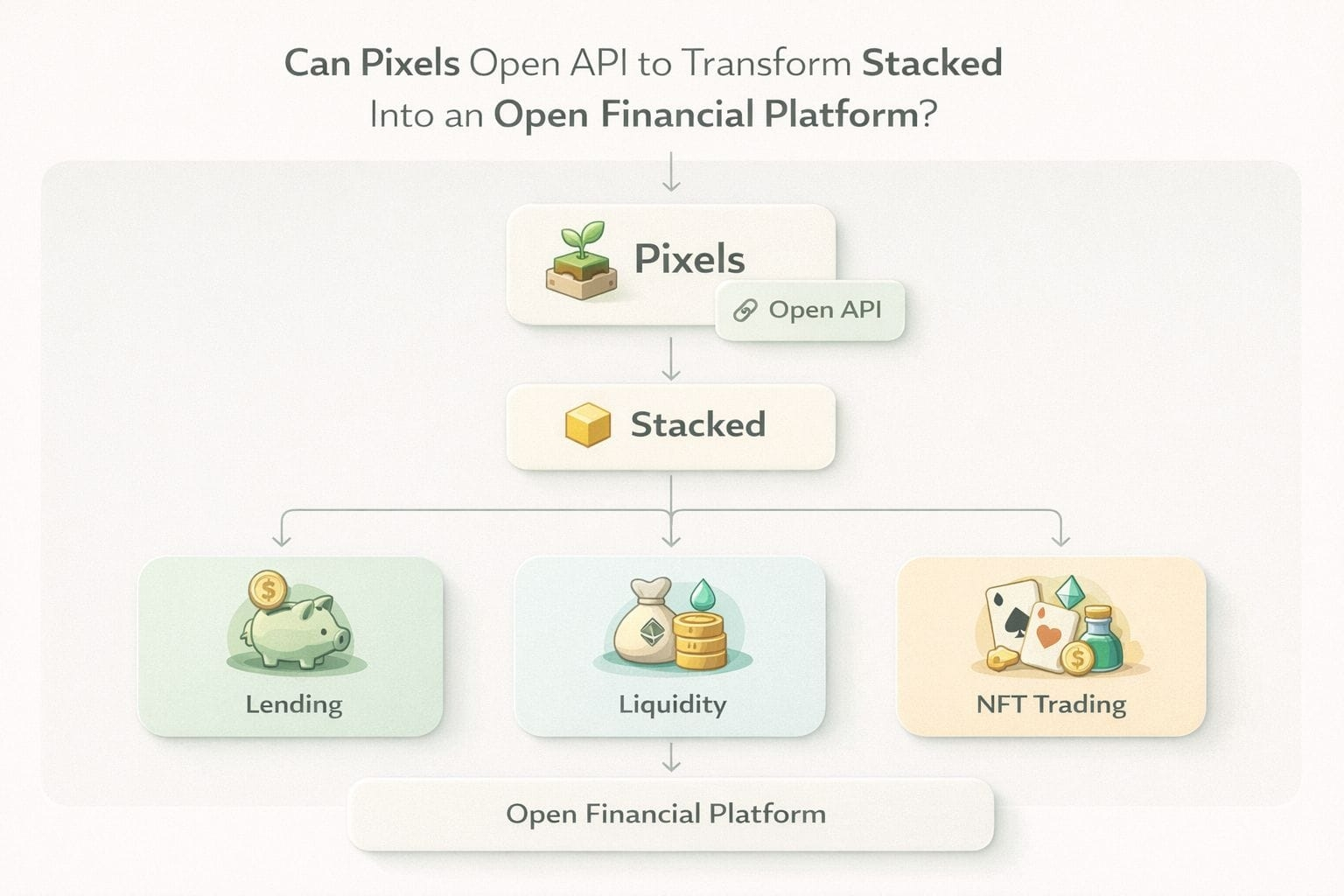
Tonight I was reconnecting a few ideas around Stacked, and one question stood out to me: if Pixels keeps pushing forward, could they eventually open an API that turns Stacked from an internal system into an open financial platform for games?
From my perspective, the answer is yes—and honestly, it feels like one of the most logical long-term directions if the team wants to transform its experience with rewards, retention, and game economy design into a broader infrastructure layer.
But the real question is not simply whether they should open an API.
The real question is what that API should be built for, how much access should be allowed, and whether Stacked is strong enough to become a reliable foundation for other systems.
At first glance, an API sounds like just another technical upgrade. But for Stacked, it represents a much bigger shift in positioning.
An internal tool only needs to help the Pixels team run operations more efficiently.
An open platform has to do something much harder: it must be usable, trusted, measurable, and easy for others to integrate into their own systems.
That means Stacked would no longer just be a support layer for Pixels. It would need to evolve into infrastructure that other games, apps, or ecosystems could rely on as a service.
To me, that is the real discussion.
Because if Stacked opens its API in a structured way, it stops being only a system for optimizing Pixels’ own incentives.
It could become the reward and LiveOps engine that other games use to design campaigns, distribute incentives, improve retention, optimize LTV, and even evaluate growth quality.
At that point, Stacked shifts from being a product into becoming an operational protocol layer.
That is a massive step.
What makes this idea feel realistic is that Stacked already behaves more like infrastructure than a normal game feature.
It is not just about sending rewards.
It is about deciding who gets rewarded, when rewards should happen, how incentives are distributed, and how behavior changes afterward are measured.
That kind of logic fits perfectly with an API model.
Once the system is centered around rules, data, and value allocation, it becomes something that can be packaged and used externally.
Game A could call the API to create return-player campaigns.
Game B could use it to improve old-user retention.
A marketplace could use it to stimulate liquidity while still controlling behavior quality.
This modular structure is exactly what gives Stacked the potential to become an open platform.
Another reason this matters is because if Stacked successfully opens its API, Pixels stops being seen only as a strong game operator.
It starts being viewed as a team that owns financial infrastructure for gaming ecosystems.
That difference is huge.
A game—even a successful one—is often valued based on product cycles.
But an open platform can be valued based on integrations, usage volume, and the quality of value flowing through the system.
If Stacked reaches that point, it no longer depends entirely on Pixels’ growth alone.
It can sustain itself through partner integrations, campaign volume, and how much external systems depend on its incentive engine.
That is a very powerful upside.
Of course, opening the API is not just about writing code.
For something like Stacked, the API only makes sense if it comes with strong control mechanisms.
If it opens too widely, it risks becoming a farming machine where anyone can exploit rewards, spam campaigns, or damage ecosystem quality.
If it opens too narrowly, it loses the value of being a platform.
So in my opinion, the hardest challenge is not technical integration—it is governance design.
Who gets access to which layer?
What actions are allowed?
What data can be shared?
Which endpoints are read-only?
Which ones can trigger rewards?
And most importantly, who takes responsibility if misuse damages the economy of the integrating partner?
This is where the real difficulty begins.
I also believe Stacked can only become a true open financial platform if it proves three things.
First, repeatability.
What works inside Pixels must also work across different games and ecosystems.
Second, measurement.
An open platform cannot rely on “it feels better.”
It must prove improvements in retention, revenue, LTV, and user quality with clear data.
Third, safety.
The more open the system becomes, the greater the risk of abuse.
Without these three elements, the API risks becoming only a “paper open system” instead of real infrastructure.
If done properly, however, opening the API creates one major advantage: network effects.
When multiple games use the same incentive engine, the system becomes smarter through accumulated data and operational learning.
Each new integration is not just another customer.
It is another source of insight that improves future reward distribution.
At that point, Stacked grows not only through revenue, but through the intelligence of the system itself.
And in game economies, a tool that gets better at optimization over time is incredibly valuable.
That is what makes the open platform vision attractive to me.
Not because it sounds bigger—but because it creates stronger long-term accumulation.
That said, I still think caution is necessary.
Opening the API does not mean making everything fully permissionless.
For Stacked, I believe a semi-open model makes far more sense.
There should be APIs, integrations, and external partners—but still with enough standardization and control for Pixels to protect system quality.
That feels much healthier than opening everything without limits.
Because this is not a social app or a dashboard tool.
This is the layer directly connected to incentives and value flow.
One wrong move can quickly turn openness into abuse.
If I had to summarize it in one sentence:
Pixels can absolutely open Stacked’s API and turn it into an open financial platform—but it only becomes truly meaningful if that API transforms Stacked from an internal reward system into a trusted incentive engine for many games while preserving control, measurement, and growth quality.
If that happens, it is not just another feature.
It is the moment Stacked stops being a product and becomes infrastructure.
And that is when the Pixels story becomes much bigger than just one game.