


Lesson 27 Day 27
Trading & Investing: Long-Term Strategy
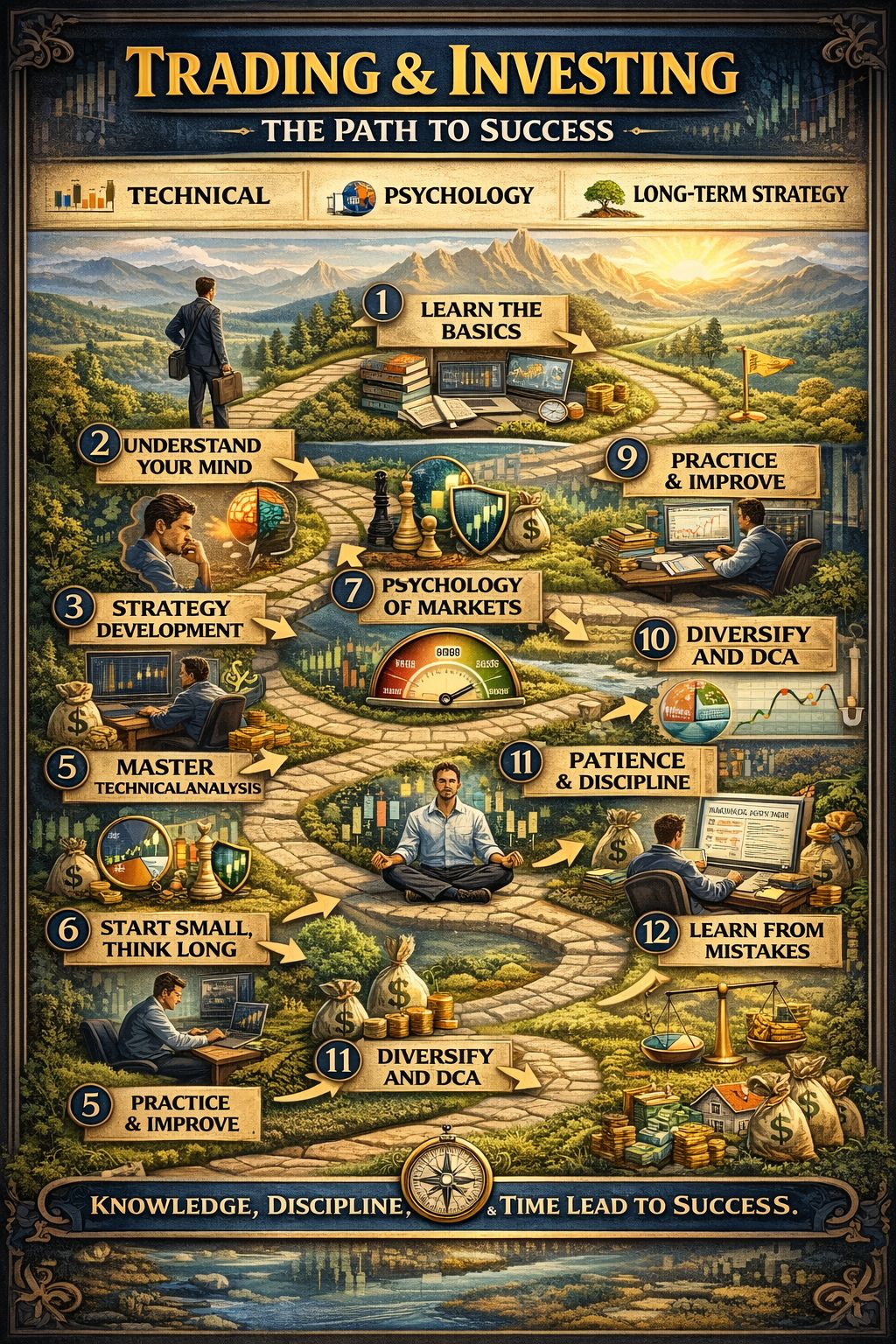
Chapter 1: The Truth About Long-Term Wealth
Most people enter the market chasing speed.
Fast profits. Quick wins. Overnight success.
But wealth—real, lasting wealth—is rarely built that way.
It is built slowly. Quietly. Consistently.
Long-term investing is not exciting. It doesn’t give you daily adrenaline. It doesn’t make you feel like a genius every week.
But it works.
And the reason it works is simple:
Time is the most powerful force in investing.
When you combine time with compounding, even small investments can grow into something meaningful.
The problem is, most people underestimate time and overestimate their ability to time the market.
They try to be right now instead of being consistent over years.
That’s the first mindset shift:
You are not here to win today.
You are here to win over time.
Chapter 2: The Power of Compounding
Compounding is often called the eighth wonder of the world—and for good reason.
It means your money earns returns… and those returns earn returns… again and again.
At first, growth looks slow.
Very slow.
But then something interesting happens.
It accelerates.
Let’s simplify:
Year 1: You invest and earn profit
Year 2: You earn profit on your original + previous profit
Year 5, 10, 20: Growth becomes exponential
This is why starting early matters more than starting big.
Even small amounts, invested consistently, can outperform large one-time investments made later.
But compounding has one requirement:
Patience.
If you keep interrupting your investments—buying, selling, reacting—you break the compounding cycle.
Long-term investors protect compounding like it’s gold.
Because it is.
Chapter 3: Investing vs Trading — Choosing Your Game
Before building a strategy, you must decide what game you’re playing.
Trading:
Short-term focus
Frequent buying and selling
Higher emotional stress
Investing:
Long-term focus
Holding assets for years
Requires patience and conviction
There’s nothing wrong with trading.
But long-term investing is where most sustainable wealth is created.
Why?
Because it removes noise.
Daily fluctuations don’t matter.
Short-term fear doesn’t matter.
Only the long-term direction matters.
And historically, strong assets tend to grow over time.
The key is choosing wisely—and staying committed.
Chapter 4: Asset Selection — What You Invest In Matters
A long-term strategy begins with choosing the right assets.
Not everything is worth holding for years.
Strong long-term assets usually have:
Real value or utility
Strong fundamentals
Consistent growth potential
Demand over time
Examples include:
Quality stocks
Index funds
Real estate
Strong cryptocurrencies (with real use cases)
Avoid:
Hype-driven assets
Short-term trends
Projects with no fundamentals
In long-term investing, selection is everything.
Because once you choose, you commit time.
And time amplifies both good and bad decisions.
Chapter 5: Diversification — Don’t Put Everything in One Place
One of the simplest but most powerful principles in investing is diversification.
It means spreading your investments across different assets.
Why?
Because risk is unavoidable—but it can be managed.
If you put all your money into one asset and it fails, you lose everything.
But if you spread it:
Some assets may underperform
Others may outperform
Overall risk reduces
Diversification doesn’t eliminate risk.
But it prevents catastrophic loss.
Think of it like this:
You’re not trying to hit one perfect investment.
You’re building a system where multiple investments work together.
Chapter 6: Dollar-Cost Averaging — The Discipline Strategy
Timing the market is difficult—even for professionals.
That’s where Dollar-Cost Averaging (DCA) comes in.
It means investing a fixed amount regularly, regardless of price.
For example:
Invest monthly
Buy whether the market is up or down
This has two benefits:
Reduces emotional decision-making
Averages your entry price over time
When prices are low, you buy more.
When prices are high, you buy less.
Over time, this smooths volatility.
DCA is not about being perfect.
It’s about being consistent.
And consistency beats timing.
Chapter 7: Market Cycles — Understanding the Bigger Picture
Markets move in cycles.
They don’t go up forever—and they don’t go down forever.
Typical cycle:
Accumulation (smart money buying quietly)
Uptrend (public interest grows)
Distribution (smart money exits)
Downtrend (panic selling)
Long-term investors don’t panic during downturns.
They understand cycles.
In fact, they often see downturns as opportunities.
Because buying during fear often leads to strong long-term gains.
The challenge?
It feels uncomfortable.
Buying when everyone is scared goes against human instinct.
But that’s where opportunity lies.
Chapter 8: Emotional Control — The Real Challenge
Long-term investing sounds simple.
Buy good assets. Hold them. Wait.
But emotionally, it’s difficult.
You will face:
Market crashes
Negative news
Doubt
Pressure from others
You will question your decisions.
You will feel tempted to sell.
That’s where emotional control matters.
Successful investors don’t react to every movement.
They stick to their strategy.
They trust their research.
They stay calm when others panic.
Because they understand:
Short-term noise does not define long-term outcomes.
Chapter 9: Risk Management — Protecting Your Future
Even long-term investors need risk management.
It’s not just for traders.
Good risk management includes:
Not over-investing in one asset
Keeping emergency funds
Avoiding leverage
Understanding downside risk
Never invest money you can’t afford to leave untouched.
Long-term investing requires patience—and sometimes waiting through difficult periods.
If you need the money urgently, you may be forced to sell at the worst time.
Risk management protects your ability to stay invested.
And staying invested is where the real gains happen.
Chapter 10: Rebalancing — Keeping Your Portfolio Healthy
Over time, your portfolio changes.
Some assets grow faster than others.
This can create imbalance.
For example:
One asset becomes too large
Risk increases
Rebalancing means adjusting your portfolio back to your desired allocation.
This may involve:
Selling a portion of high-performing assets
Adding to underweighted ones
It keeps your strategy aligned.
And it forces you to:
Take profits
Avoid overexposure
Rebalancing is not frequent—but it is important.
Chapter 11: Long-Term Vision — Thinking Beyond Today
Most people think in days.
Successful investors think in years.
Ask yourself:
Where will this asset be in 5 years?
What trends will shape the future?
What industries will grow?
Long-term investing is about vision.
It’s about seeing beyond current noise.
Technology, innovation, global shifts—these create opportunities.
Those who identify them early and stay patient benefit the most.
Chapter 12: Consistency Over Perfection
You don’t need perfect timing.
You don’t need perfect analysis.
You need consistency.
Invest regularly.
Stay disciplined.
Avoid emotional decisions.
Even average strategies can produce strong results if applied consistently over time.
But even the best strategies fail without discipline.
Consistency turns small actions into big outcomes.
Chapter 13: Learning from Mistakes
Every investor makes mistakes.
Bad investments. Wrong timing. Missed opportunities.
That’s normal.
What matters is learning.
Ask:
Why did this investment fail?
Was it emotional or logical?
What can I improve?
Mistakes are not losses if they teach you something.
They become part of your growth.
Chapter 14: The Role of Patience and Time
Time is not just a factor.
It is the foundation.
Without time:
Compounding doesn’t work
Growth doesn’t happen
Strategy doesn’t play out
Patience allows time to work.
But patience is difficult in a fast-paced world.
You will feel slow.
You will feel behind.
But remember:
Wealth is not built in months.
It is built in years.
Conclusion: The Quiet Path to Wealth
Long-term investing is not flashy.
It doesn’t make headlines.
But it builds something powerful:
Financial freedom.
It allows you to:
Grow wealth steadily
Reduce stress
Focus on long-term goals
The secret is not complexity.
It’s simplicity + discipline + time.
If you can:
Choose strong assets
Stay consistent
Control emotions
Think long-term
You already have an edge.
Because most people won’t do these simple things consistently.
And in investing, simple done well beats complex done poorly.
If you want, I can next:
Combine Technical + Psychology + Long-Term Strategy into a complete book
Translate this into Nepali
Or create a visual roadmap / infographic