
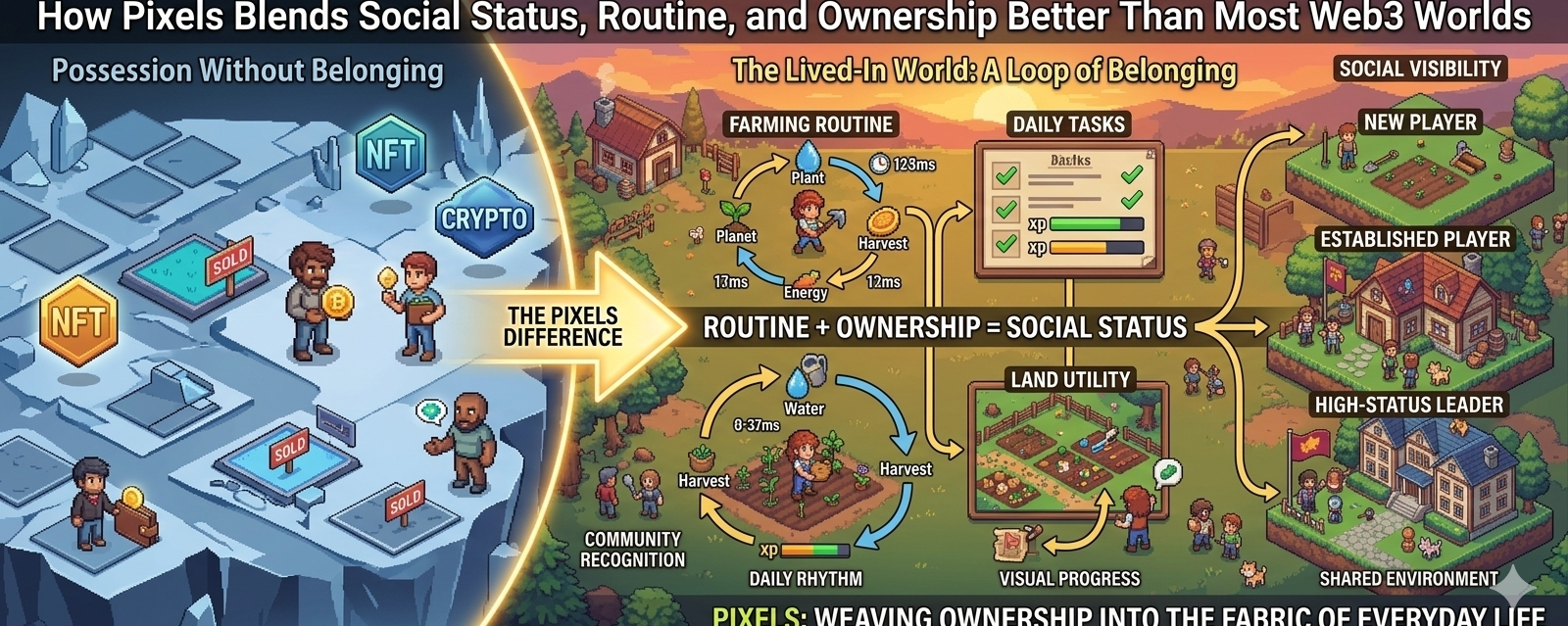
Most Web3 games made the same mistake early on. They assumed ownership was enough.
Give players land, pets, items, and tokens, put them onchain, and the rest would somehow take care of itself. But that was never the hard part. The hard part was giving those things a reason to matter once the excitement wore off. Owning something in a wallet is easy. Feeling connected to it inside a world is much harder.
That is where Pixels feels more thoughtful than most.
What it seems to understand is that people do not build attachment through ownership alone. They build it through routine, visibility, and a sense that their time inside a world actually leaves a mark. That is the deeper problem Pixels is trying to solve. Not just how to make digital assets tradable, but how to make them feel socially real.
A lot of Web3 worlds never got there. They created property without presence. You could own something, but it rarely changed your everyday experience in a meaningful way. The asset sat beside the game instead of inside it. It was financially visible, but not emotionally or socially rooted.
Pixels works differently because it ties ownership to repetition. You are not just holding assets. You are returning to a place, maintaining a loop, building around habits, and slowly shaping a position inside a shared environment. That shift matters more than people think. Once a game starts to become part of your daily rhythm, it stops feeling like a product and starts feeling like a space.
That is one of the most important things about Pixels. It leans into routine without making routine feel empty. Farming, gathering, tasks, energy management, land usage, and small daily decisions all create a pattern of return. It is not built around one dramatic moment. It is built around steady involvement. That makes the world feel lived in, and in online worlds, feeling lived in is often more valuable than feeling impressive.
Then there is status, which Pixels handles in a way that feels more honest than a lot of crypto projects. Status is not hidden behind technical ownership or vague community labels. It shows up in how your farm looks, what you can access, how established you seem, and how other players read your presence. That kind of visibility is important because social worlds need readable signals. People want progress to be noticed. They want their time to show. They want what they have built to say something about them without needing explanation.
Pixels understands that better than most Web3 games do.
It also understands that ownership becomes more powerful when it affects your actual place in the world. That is the part many projects never figured out. It is not enough for an item to be scarce or tradable. It needs to shape behavior. It should influence how you move through the game, how you organize your time, how you interact with others, or how your identity inside the world takes form. Pixels gets closer to that standard than most.
That does not mean it is perfect. There is still an obvious tension in any system that mixes progression, status, and monetization. Once status becomes visible, the gap between casual players and more invested players also becomes visible. Once ownership has utility, advantage starts to matter more. That can make a world feel alive, but it can also make it feel stratified. Pixels has not escaped that tension. It has simply handled it more intelligently than many others.
And that is probably why it stands out.
Most Web3 worlds treated ownership like the destination. Pixels treats ownership more like a layer inside a broader social loop. That is a much stronger idea. People do not stay in digital worlds just because they own assets. They stay because those assets are tied to routine, recognition, and a growing sense of identity.
That is the real difference.
Pixels is not interesting because it put game objects onchain. A lot of projects did that. Pixels is interesting because it tries to make ownership feel like part of everyday life inside the game. It gives players a reason to return, a reason to care how they are seen, and a reason to believe that what they are building has weight beyond pure speculation.
In the end, that is what most Web3 worlds were missing. They offered possession without belonging.
Pixels, at its best, is trying to offer both.