
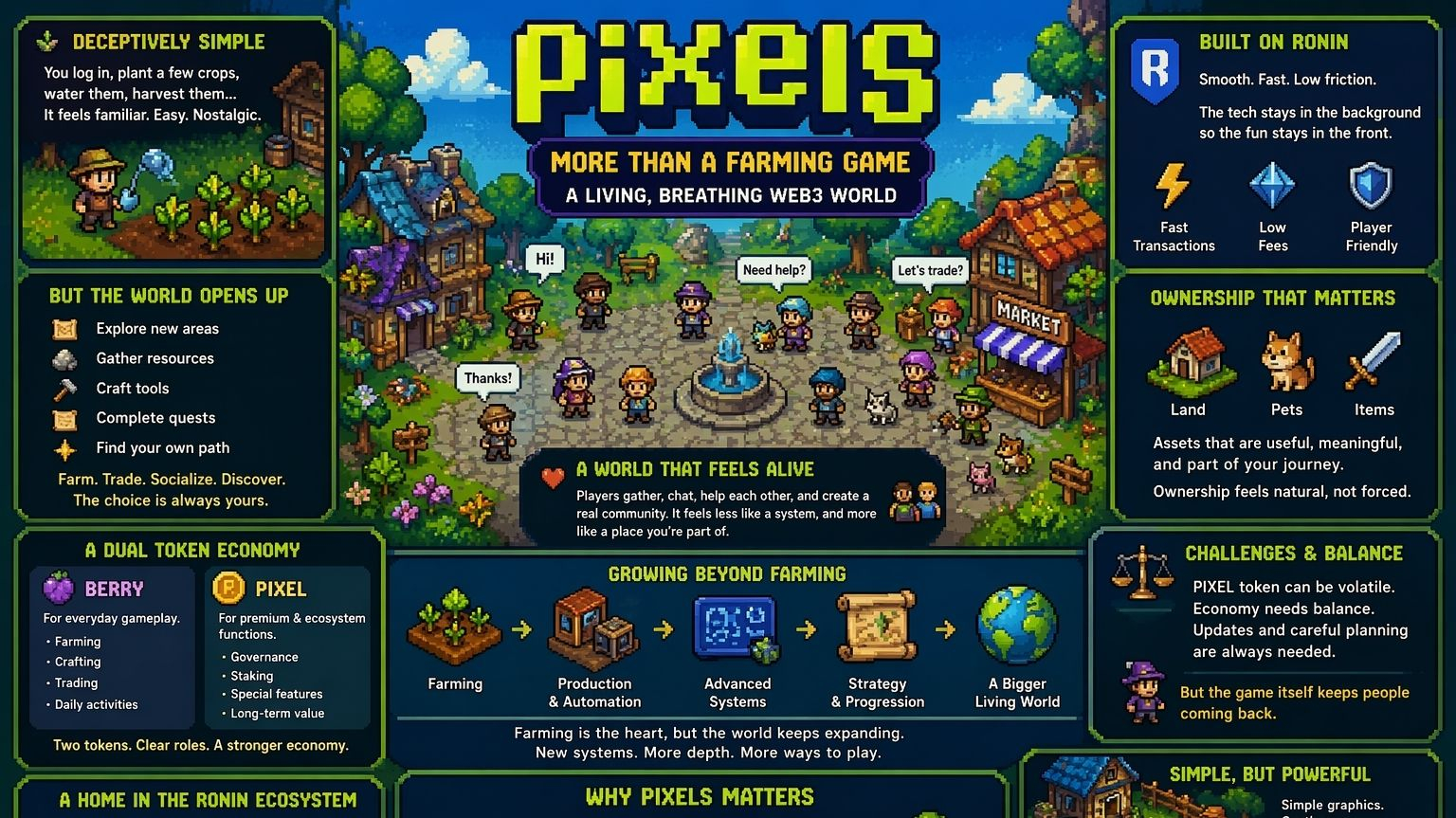
Pixels is one of those games that feels deceptively simple at first.
You log in, see the charming pixel-style world, plant a few crops, water them, harvest them, and think you already understand what it is. A casual farming game. Easy. Familiar. Almost nostalgic.
But that impression does not last very long.
The more time you spend in Pixels, the more the world starts to open up. What begins as a quiet farming routine gradually turns into something much bigger. You start exploring new places, collecting resources, crafting useful tools, completing quests, and finding your own rhythm inside the game. Some players enjoy building the most efficient farm possible. Others get pulled into trading, socializing, or simply wandering around the world to see what they can discover. That freedom gives Pixels a special kind of charm. It never feels like it is forcing you down one path.
What really gives the game its identity, though, is the way it feels alive.
A lot of Web3 games can feel mechanical. You log in, complete tasks, think about rewards, and leave. Pixels feels warmer than that. Players gather in shared spaces, chat casually, help each other out, and create the kind of atmosphere that makes the world feel inhabited rather than programmed. It feels less like a system you are using and more like a place you are visiting. That social energy is a huge part of why the game stands out.
Another reason the experience feels so smooth is its connection to the Ronin Network. In many blockchain games, the technology can feel like a barrier. Wallets, fees, and transaction friction can interrupt the fun. Pixels avoids much of that. On Ronin, everything feels lighter and faster, which lets the blockchain side stay mostly in the background. That matters more than people realize. When the technology stops getting in the way, the game itself gets room to breathe.
Ownership also feels more natural here than it does in many Web3 projects. In Pixels, assets are not just decorative ideas attached to a wallet. Land, pets, and items all have a role to play. They can improve efficiency, support progression, or add value to the overall experience. Because of that, digital ownership feels practical instead of forced. It becomes part of how you play, not just something you hold.
The in-game economy follows that same logic. Pixels uses both BERRY and PIXEL, and the separation actually helps the game feel more stable. BERRY handles the everyday side of gameplay, while PIXEL is tied to the larger premium and ecosystem-level functions. That split keeps the experience cleaner and gives each token a clearer purpose, which is something many blockchain games struggle to manage well.
What makes Pixels even more interesting is the way it has been evolving. It is no longer just a simple farming experience. Over time, the game has been growing into something deeper, with more advanced systems, more strategic choices, and stronger economic layers. Farming is still at the heart of it, but it increasingly feels like just one part of a much larger world. The introduction of automation and broader production mechanics shows that the game is thinking ahead. It is growing with its players.
Of course, like any project connected to crypto, it comes with challenges. The PIXEL token can be volatile, and maintaining a healthy game economy is never easy. That side of the experience will always need balance and careful updates. Still, the important thing is that Pixels does not rely only on token excitement to stay relevant. The game itself gives people a reason to return, and that makes a big difference.
Within the Ronin ecosystem, Pixels has become more than just another title. It often feels like an entry point, a social hub, and a living example of what Web3 gaming can look like when it focuses on accessibility and community instead of just speculation. While other games compete through intensity or complexity, Pixels succeeds by being inviting. It makes space for players to settle in.
It is not the flashiest game in the space, and it does not need to be. Its graphics are simple, its pace is gentle, and its appeal comes from the way everything fits together. The farming, the economy, the exploration, the ownership, and the social side all support each other in a way that feels surprisingly natural.
That is why Pixels continues to matter.
It is not just a game where people show up to earn. It is a game where people show up to spend time. And in a space where so many projects rise quickly and disappear just as fast, that kind of staying power says more than hype ever could.
