

Chapter 30 Day 30
Real Use Cases: NFTs & Ownership
Chapter 1: Ownership Is Being Redefined
For most of human history, ownership has been physical.
You owned land.
You owned gold.
You owned objects you could touch and protect.
Then the digital world arrived.
Suddenly, people started “owning” things that didn’t physically exist:
Music files
Photos
Online accounts
Digital items in games
But here’s the problem:
Did you truly own them?
Or were you just given access?
Most digital assets today are controlled by platforms. You don’t fully own them—you use them under terms and conditions.
This is where a major shift begins.
Non-Fungible Tokens (NFTs) introduce a new form of ownership—one that exists independently of centralized platforms.
And that changes the meaning of ownership itself.
Chapter 2: What NFTs Actually Are
NFT stands for Non-Fungible Token.
“Non-fungible” means unique.
Unlike currencies where one unit equals another, NFTs are different from each other.
Each NFT represents:
A unique digital item
Verified ownership
Stored on a blockchain
Think of it as a digital certificate of ownership.
But unlike traditional certificates, it is:
Tamper-proof
Publicly verifiable
Not controlled by a single entity
An NFT doesn’t just point to something.
It proves:
“This belongs to this wallet.”
That’s a fundamental shift.
Chapter 3: Digital Art — The First Wave
NFTs became widely known through digital art.
Artists who once struggled to monetize their work suddenly had a new tool.
They could:
Sell directly to buyers
Prove originality
Earn royalties on resales
Before NFTs:
Digital art could be copied endlessly.
After NFTs:
Ownership became distinct from copies.
Anyone can view the image.
But only one wallet owns the original token.
This created a new market.
Not just for art—but for creators.
Chapter 4: Beyond Art — Expanding Use Cases
If NFTs were only about art, they would remain niche.
But they are much more.
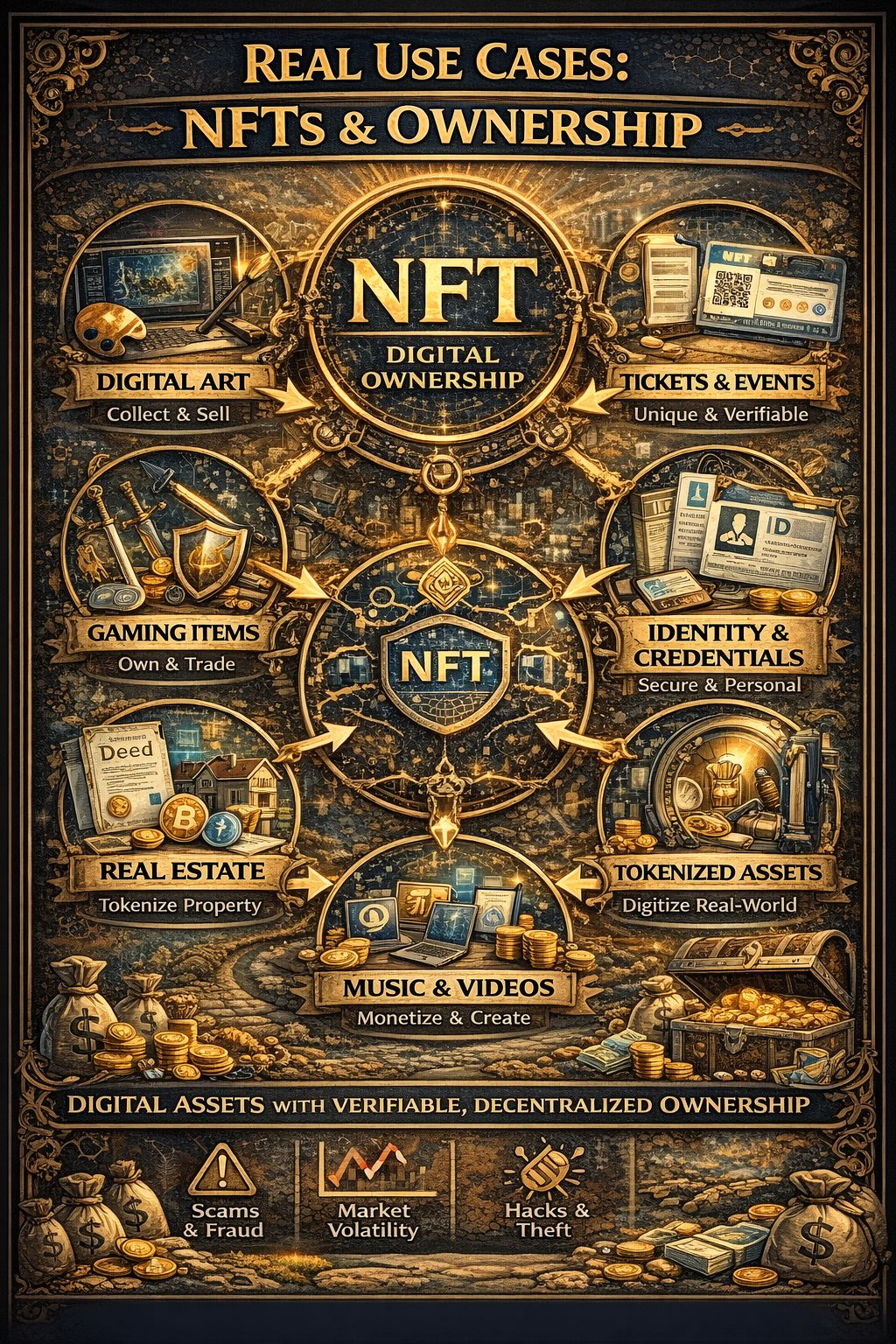
NFTs can represent:
Music
Videos
Game items
Tickets
Identity credentials
Contracts
This is where things get interesting.
Because NFTs are not about images.
They are about ownership records.
Anything that can be owned can be tokenized.
Chapter 5: Gaming — True Ownership of Digital Assets
In traditional games:
You buy skins
You unlock items
You collect assets
But you don’t own them.
If the game shuts down, everything disappears.
With NFTs:
Items can belong to you
You can trade them freely
They exist outside the game
This introduces:
Player-driven economies
Cross-platform assets
Real value for in-game items
Gaming becomes not just entertainment—but an ecosystem.
Chapter 6: Music and Creators — Direct Monetization
Artists often depend on platforms.
Streaming services. Labels. Intermediaries.
This limits control and earnings.
NFTs allow creators to:
Sell music directly
Offer exclusive content
Build closer relationships with fans
Fans can:
Own a piece of the work
Support creators directly
Participate in the ecosystem
This changes the creator economy.
It removes barriers.
And gives power back to creators.
Chapter 7: Tickets and Events — Fighting Fraud
Ticketing systems have long struggled with:
Counterfeiting
Scalping
Lack of transparency
NFT-based tickets solve many of these issues.
Each ticket:
Is unique
Can be verified
Cannot be duplicated
Organizers can:
Track ownership
Limit resale conditions
Prevent fraud
Users gain:
Security
Transparency
This is a practical, real-world application.
Chapter 8: Identity and Credentials
Identity is becoming increasingly digital.
But current systems are fragmented and insecure.
NFTs can represent:
Identity credentials
Certificates
Academic records
Instead of relying on institutions to verify documents, individuals can hold verifiable credentials themselves.
This means:
Faster verification
Reduced fraud
More control over personal data
It’s still early—but the potential is significant.
Chapter 9: Real Estate and Tokenization
One of the most powerful use cases is real-world asset tokenization.
Real estate is traditionally:
Expensive
Illiquid
Hard to access
NFTs can represent ownership of property.
This allows:
Fractional ownership
Easier transfer
Global participation
Imagine owning a small share of property anywhere in the world.
Without complex paperwork.
That’s the direction things are moving.
Chapter 10: Intellectual Property — Protecting Ideas
Creators often struggle to protect their work.
NFTs provide:
Proof of creation
Timestamped ownership
Transparent records
This helps in:
Copyright claims
Licensing
Royalty tracking
It’s not a complete solution—but it adds a powerful layer of protection.
Chapter 11: The Economics of NFTs
NFTs introduced new economic models.
Creators can:
Earn from initial sales
Receive royalties on resales
Collectors can:
Trade assets
Speculate on value
But value is not guaranteed.
It depends on:
Demand
Utility
Community
Some NFTs gain value.
Others don’t.
Understanding this is important.
Because hype alone is not sustainable.
Chapter 12: Risks and Misconceptions
NFTs are powerful—but not perfect.
Common risks include:
Scams and fake projects
Overvaluation
Lack of utility
Market volatility
Many people misunderstand NFTs.
They think:
Buying an NFT means owning the content rights (not always true)
All NFTs will increase in value (not true)
Education is critical.
Because misunderstanding leads to poor decisions.
Chapter 13: Ownership vs Access
This is one of the most important distinctions.
In traditional digital systems:
You have access.
In NFT systems:
You have ownership.
Access can be revoked.
Ownership cannot—unless you lose control of your wallet.
This changes the relationship between users and platforms.
It creates independence.
But also responsibility.
Chapter 14: The Future of NFTs
NFTs are still evolving.
Future developments may include:
Better user experience
Integration with real-world systems
More practical use cases
We may see:
NFT-based IDs
Property ownership records
Digital economies
The technology will mature.
And the hype will settle.
What remains will be real value.
Conclusion: A Shift in Digital Power
NFTs are not just about images.
They are about ownership.
They represent a shift from:
Platform control → user control
Access → ownership
Centralized → decentralized systems
This shift is still in progress.
But its impact is already visible.
From art to gaming to identity.
The question is not whether NFTs will exist.
The question is:
How will they be used?
Because like any tool, their value depends on application.
Used wisely, they can:
Empower creators
Expand access
Redefine ownership
Used carelessly, they can:
Create confusion
Lead to loss
Understanding them is the first step.
Using them wisely is the next.
@Binance Square Official @Bitcoin $BTC $ETH $BNB
