

Chapter 31 Day 31
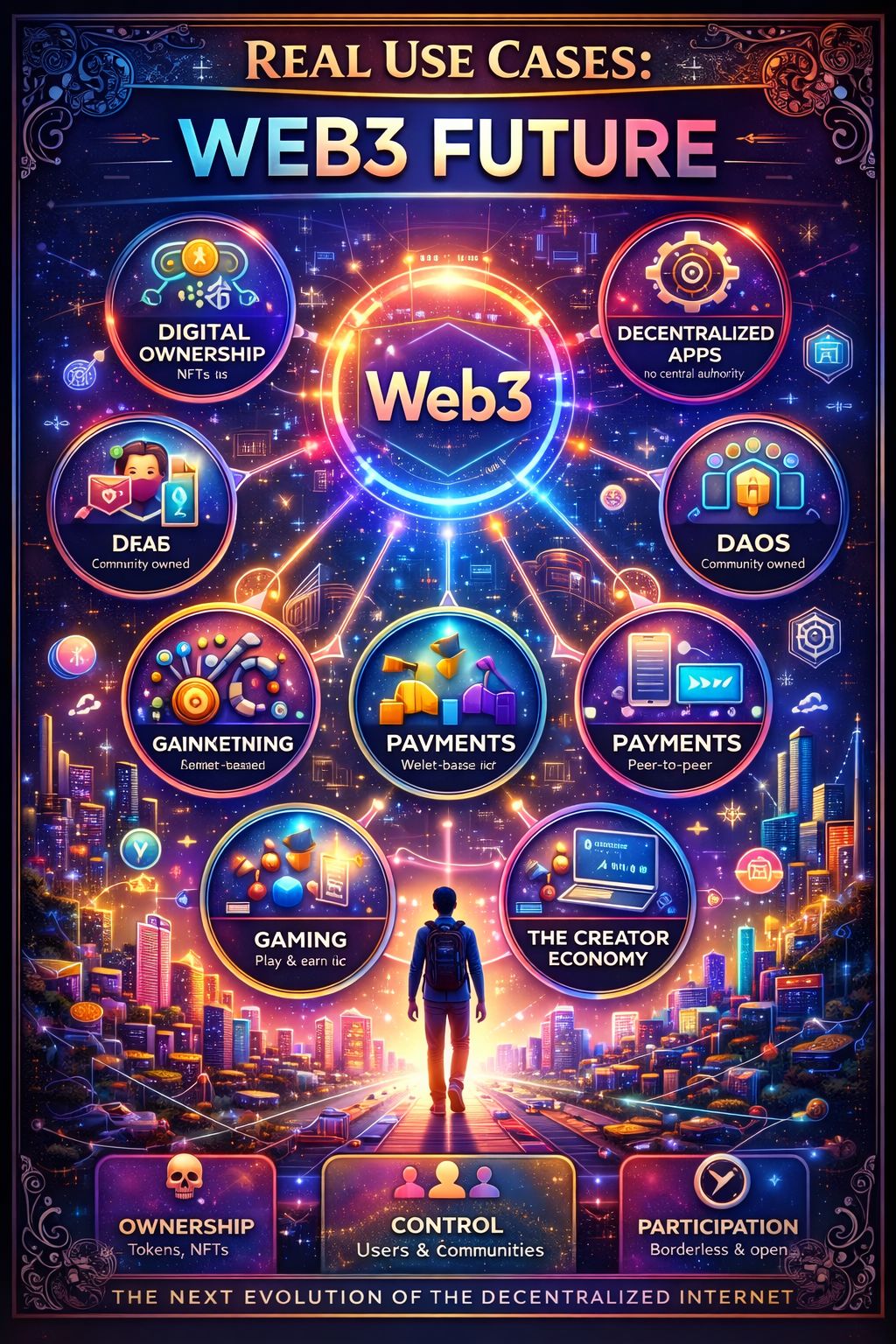
Real Use Cases: Web3 Future
Chapter 1: The Internet Is Evolving Again
The internet you use today didn’t start the way it is now.
There have been phases.
Web1 (Read-Only Era):
You could consume information. Websites were static. Interaction was minimal.
Web2 (Read-Write Era):
You could create content. Social media, apps, and platforms exploded. But control became centralized.
Big companies began owning:
Your data
Your content
Your identity
You use the platforms.
They own the system.
Now, a new phase is emerging.
Web3 (Read-Write-Own Era):
This is where things begin to shift.
Web3 is about:
Ownership
Decentralization
User control
It’s not just a technical upgrade.
It’s a philosophical change.
Chapter 2: What Web3 Actually Means
Web3 is often misunderstood.
It’s not just about cryptocurrencies.
It’s an ecosystem built on:
Blockchain technology
Smart contracts
Decentralized applications (dApps)
In Web3:
Users own their assets
Identity is wallet-based
Transactions are peer-to-peer
There is no single authority controlling everything.
Instead of logging in with email and password, you connect a wallet.
Instead of storing data on centralized servers, data can be distributed.
This changes how the internet functions.
Chapter 3: Digital Ownership — The Core Idea
Ownership is the foundation of Web3.
In Web2:
You post content → platform owns it
You earn attention → platform monetizes it
In Web3:
You own your assets
You control your data
You decide how it’s used
This is enabled by:
Tokens
NFTs
Blockchain verification
Ownership is not just symbolic.
It is programmable and transferable.
This creates new possibilities.
Chapter 4: Decentralized Applications (dApps)
dApps are applications that run on blockchain networks instead of centralized servers.
They offer:
Transparency
Security
Open access
Examples of dApps include:
Financial platforms
Gaming ecosystems
Social networks
Unlike traditional apps:
No central authority controls them
Rules are defined by smart contracts
Users interact directly with the system.
This reduces reliance on intermediaries.
Chapter 5: Decentralized Finance (DeFi) — A Core Pillar
One of the strongest use cases of Web3 is DeFi.
It recreates financial services:
Lending
Borrowing
Trading
Without banks.
Users can:
Earn interest
Access liquidity
Trade assets
All from their wallets.
This expands access.
But also requires understanding.
Because with freedom comes responsibility.
Chapter 6: NFTs — Ownership in the Digital World
NFTs play a major role in Web3.
They represent:
Digital ownership
Unique assets
Verifiable records
Use cases include:
Art
Gaming
Identity
Real-world assets
NFTs transform digital items into owned assets.
This creates:
New markets
New economies
New forms of value
Chapter 7: DAOs — Community Governance
Decentralized Autonomous Organizations (DAOs) are a new way of organizing people.
Instead of traditional leadership structures:
Decisions are made collectively
Voting is transparent
Rules are coded
Members hold tokens that give them voting power.
DAOs can manage:
Projects
Funds
Communities
This creates a new form of governance.
One that is:
Transparent
Inclusive
Decentralized
Chapter 8: Identity in Web3
Identity is changing.
In Web2:
Identity is platform-based
Accounts are controlled by companies
In Web3:
Identity is wallet-based
Users control access
This allows:
Portable identity
Less reliance on platforms
Greater privacy
You carry your identity across applications.
Not tied to one company.
Chapter 9: Payments — Borderless and Instant
Web3 enables new forms of payments.
Transactions are:
Fast
Borderless
Peer-to-peer
This benefits:
Freelancers
Remote workers
Global businesses
No need for:
Bank approvals
Long processing times
Payments become:
More efficient
More accessible
Chapter 10: The Creator Economy — A New Model
Web3 empowers creators.
Instead of relying on platforms, creators can:
Monetize directly
Build communities
Retain ownership
Revenue streams include:
NFTs
Tokens
Direct support
Fans become participants.
Not just consumers.
This shifts power.
From platforms → to creators.
Chapter 11: Gaming — From Play to Earn
Gaming in Web3 introduces new models.
Players can:
Own in-game assets
Trade items
Earn value
Games become economies.
Players become stakeholders.
This changes incentives.
Gaming is no longer just entertainment.
It becomes:
Interactive
Financial
Community-driven
Chapter 12: Data Ownership — Taking Back Control
Data is valuable.
In Web2:
Companies collect data
Users have limited control
In Web3:
Users can control data
Decide how it’s shared
Potentially monetize it
This creates:
Privacy improvements
New economic models
Data becomes an asset.
Chapter 13: Real-World Integration
Web3 is not limited to digital environments.
It is expanding into:
Supply chains
Real estate
Identity systems
Financial services
Real-world assets are being tokenized.
Processes are being automated.
Systems are becoming more transparent.
This bridges digital and physical worlds.
Chapter 14: Challenges and Limitations
Web3 is powerful—but not perfect.
Challenges include:
Complexity
User experience
Security risks
Regulatory uncertainty
Adoption requires:
Education
Better interfaces
Trust in systems
Many people are still unfamiliar with these technologies.
Growth will take time.
Chapter 15: The Future — A Gradual Transformation
Web3 will not replace everything overnight.
It will integrate slowly.
Some systems will remain centralized.
Others will become decentralized.
The future will likely be hybrid.
Where:
Users have more control
Systems are more transparent
Opportunities are more accessible
The key question is not if Web3 will grow.
But how it will shape the digital world.
Conclusion: A Shift in Digital Power
Web3 represents a shift.
From:
Control → ownership
Centralization → decentralization
Access → participation
It changes how we:
Use the internet
Interact with value
Define ownership
But like any technology, its impact depends on how it is used.
It can:
Empower users
Create opportunities
Redefine systems
Or it can:
Be misunderstood
Be misused
Create new challenges
Understanding Web3 is not just about technology.
It’s about preparing for a changing world.
@Binance Square Official @Bitcoin $BTC $ETH $BNB
