
The most common mistake in Web3 analysis is treating every project as a standalone game. When we look at the trajectory of Pixels, especially under the "Stacked" umbrella, it becomes clear that the team isn't just trying to make the best farming simulator on the market; they are building a fundamental gaming protocol.
The Power of the Shared State
In traditional Web2 gaming, data is siloed and your achievements, hours played, and social standing in one game mean absolutely nothing in another. Pixels is shattering this wall by creating a "Shared State." By using the Ronin Network as the backbone, the "Stacked" ecosystem allows your PIXEL identity to carry weight across different experiences. When a new developer launches a game within this ecosystem, they don't have to solve the "cold start" problem of finding users. They can instantly tap into the existing, verified, and highly active player base of Pixels. For the player, this means their time spent is never "wasted" it's an investment in a portable digital identity.
Reputation as the Ultimate Currency
We’ve discussed the importance of the "Trust Score" before, but in a multi-game ecosystem, reputation becomes the ultimate currency. If you are a high-value participant in Pixels, you are no longer just a "farmer." You are a "proven user."
In a world full of bots and cyber attacks, that proof is worth its weight in gold. High-reputation players might get early access to new titles, better reward tiers, or lower fees in the next "Stacked" game. This creates an incredible incentive for players to stay within the ecosystem. It transforms PIXEL from a token you "sell for profit" into an asset you "hold for access."
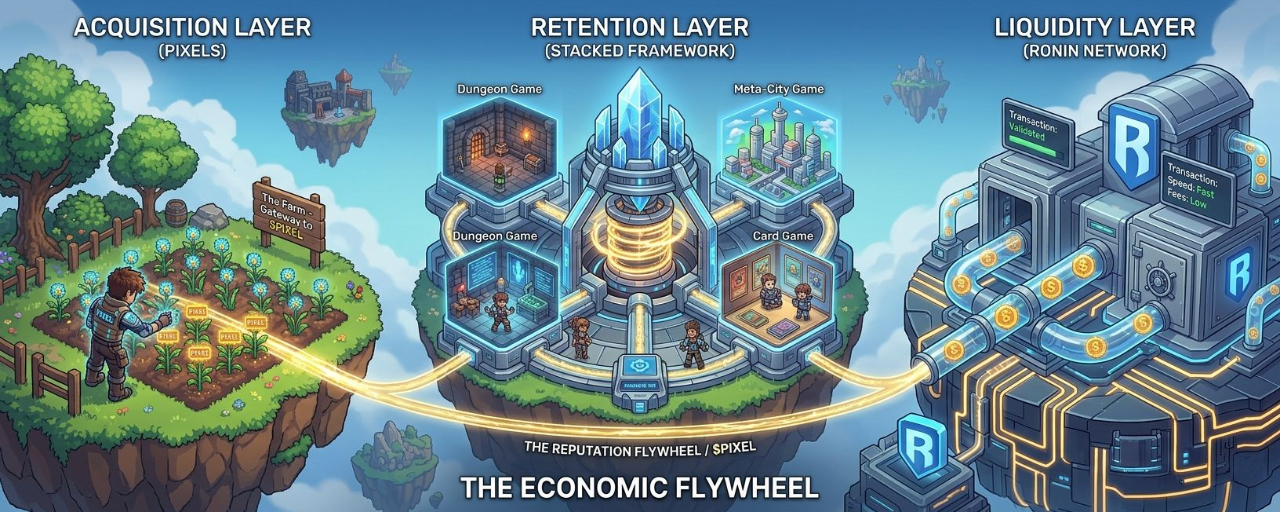
The Economic Flywheel
The genius of the Stacked vision lies in its three-part harmony:
Acquisition (Pixels): The farming game acts as a low-barrier, social, and addictive entry point for the masses.
Retention (Stacked): The framework allows for a constant stream of new games, providing fresh utility and "sinks" for the PIXEL token.
Liquidity (Ronin): The underlying network ensures transactions are fast, cheap, and secure, making the entire machine run smoothly.
This synergy is why Pixels has stayed relevant while many other "Play-to-Earn" projects have faded into obscurity. It isn't just about emissions dressed up as gameplay; it is a system designed to survive by becoming essential infrastructure.
Conclusion
We are witnessing the birth of a decentralized publishing house. The "game" we play today is simply the data-generation layer that proves you are a real, valuable human participant. As more developers "stack" their projects on top of this foundation, the intrinsic value of the PIXEL token moves away from pure speculation and toward functional necessity.
In the long run, the most successful games won't just be fun but they’ll be the ones that make you part of something bigger.
#pixel $PIXEL @Pixels #Web3Gaming #CryptoStrategy #RoninNetwork #BinanceSquare