
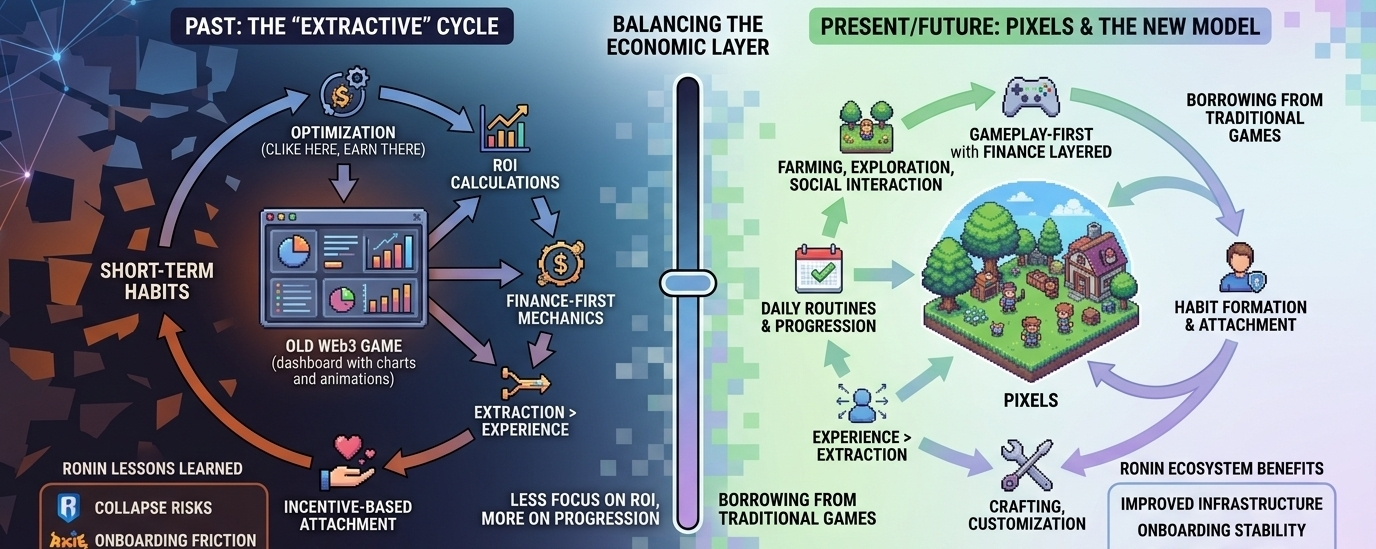
I still remember the first time I opened a Web3 game in the last cycle. At first glance, it didn’t even feel like a game in the way I grew up understanding games. It felt more like a dashboard with animations click here, earn there, open charts, repeat. Somewhere in that loop a simple question kept coming back: am I actually playing or just optimizing?
That doubt stayed with me whenever I heard about new next big Web3 games. So when Pixels came into the conversation I didn’t rush in. I’ve seen enough cycles in crypto to know how quickly this changes everything” stories fade. Still I kept watching partly because it sits on the Ronin ecosystem, which already carries both the success and collapse of earlier gaming experiments like Axie Infinity.
What made me pause wasn’t hype but intention. Pixels at least seemed to be trying something different: a game that behaves like a game first instead of a financial system wearing game mechanics. That shift alone felt worth paying attention to, even if it didn’t guarantee anything.
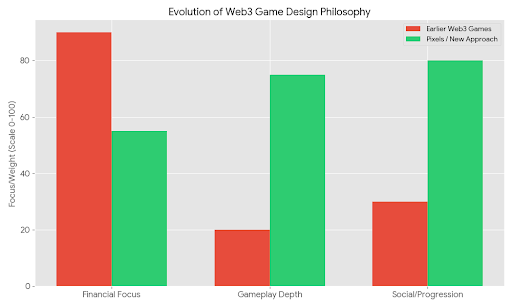
From what I’ve seen Pixels focuses on farming, exploration and social interaction. Nothing about it sounds revolutionary on paper. In fact it sounds almost simple compared to the overengineered Web3 games that came before it. But maybe that simplicity is the point. Earlier cycles didn’t fail because they lacked complexity they failed because they optimized for extraction, not experience.
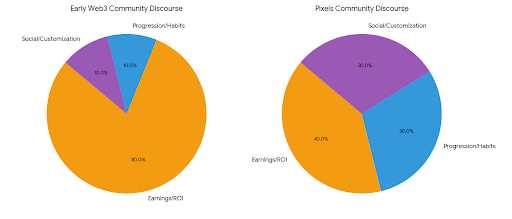
Watching gameplay and reading player feedback I noticed something subtle. People weren’t only talking about earnings. They were discussing progression daily routines, land ownership and small in game social moments. That kind of language doesn’t usually dominate early Web3 game communities. It suggests at the very least, that engagement isn’t purely financial for everyone involved.
Still I hesitate to call it a breakthrough. Crypto narratives move fast and memory is short. A game can feel alive one month and empty the next. We’ve seen that pattern too many times to ignore it.
But there is a difference in tone this time. Pixels doesn’t seem to position itself as a replacement for traditional games. It feels more like an attempt to borrow from them slowly and with fewer illusions of reinvention. That alone is already a correction from earlier cycles where everything tried to be both a game and a financial revolution at the same time.
The Ronin ecosystem also matters in this context. After past lessons there is at least more attention on infrastructure onboarding, and stability. It doesn’t solve the core problem of retention, but it reduces friction in ways that actually affect whether people stay long enough to form habits.
And that, ultimately is the real question. Not whether Pixels can attract players, but whether it can keep them when rewards stop being the main reason to log in. Most play to earn experiments struggle exactly there. Incentives bring people in quickly, but they don’t always build attachment.
I’ve noticed a small but interesting shift in how people talk about it. There is less focus on ROI calculations and more casual discussion around progression and customization. It may not mean much yet, but sentiment like that usually doesn’t appear in systems that are purely extractive.
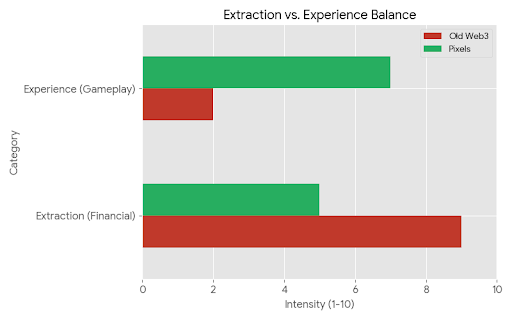
At the same time it would be a mistake to romanticize it. The economic layer is still central. Land tokens resources these systems still shape behavior in a very real way. The difference, if there is one is in balance rather than removal.
Earlier Web3 games often felt like finance first and gameplay second. Pixels feels slightly closer to gameplay first with finance layered underneath. That distinction might sound small, but it changes how people emotionally engage with the experience.
In the end, I don’t see a clear conclusion yet. Pixels doesn’t feel like proof that Web3 gaming has “arrived,” but it also doesn’t feel like the same old cycle repeating without change. It sits somewhere in between early uncertain, but not entirely familiar either.
Maybe it becomes part of a more sustainable version of Web3 gaming. Or maybe it ends up as another well designed attempt that couldn’t solve the retention problem. Time will decide that more honestly than any narrative ever can.
For now, I’m treating it the same way I treat most things in this space that feel slightly different but not fully provenpaying attention, but not attaching certainty.